




The chords of an ellipse are drawn through the positive end of the minor axis. Then, the mid-point lies on :
a) circle
b) parabola
c) ellipse
d) hyperbola
Answer
 Verified
591.3k+ views
Hint: For these kinds of questions, we make use of the concepts of ellipse. First we consider the general equation of the ellipse taken in its standard form where it’s major axis is the $x$-axis and its minor axis is the $y$-axis. Then we make use of the formula of the chord equation which is made up using the mid-points we assume. Later on we substitute the coordinates of the end of the minor axis since it is mentioned in the question that a chord is drawn through it which means the chord passes through that point.
Complete step-by-step solution:
The general equation of the ellipse taken in its standard form where it’s major axis is the $x$-axis and its minor axis is the $y$-axis is $\dfrac{{{x}^{2}}}{{{a}^{2}}}+\dfrac{{{y}^{2}}}{{{b}^{2}}}=1$.
Let us take a look at the picture of the ellipse to get a clear understanding .
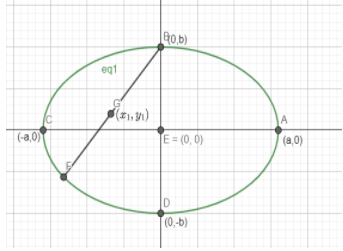
Let BF be the chord of the ellipse which has the mid-point $\left( {{x}_{1}},{{y}_{1}} \right)$ .
The equation of the ellipse with the mid-point $\left( {{x}_{1}},{{y}_{1}} \right)$ is ${{S}_{1}}={{S}_{11}}$ , where ${{S}_{1}}=\dfrac{x{{x}_{1}}}{{{a}^{2}}}+\dfrac{y{{y}_{1}}}{{{b}^{2}}}=1$ and ${{S}_{11}}=\dfrac{{{x}_{1}}^{2}}{{{a}^{2}}}+\dfrac{{{y}_{1}}^{2}}{{{b}^{2}}}=1$ .
Let us substitute and see what we get: the equation of the chord of the ellipse is.
Upon doing so, we get the following :
$\begin{align}
& \Rightarrow {{S}_{1}}={{S}_{11}} \\
& \Rightarrow \dfrac{x{{x}_{1}}}{{{a}^{2}}}+\dfrac{y{{y}_{1}}}{{{b}^{2}}}-1=\dfrac{{{x}_{1}}^{2}}{{{a}^{2}}}+\dfrac{{{y}_{1}}^{2}}{{{b}^{2}}}-1 \\
& \Rightarrow \dfrac{x{{x}_{1}}}{{{a}^{2}}}+\dfrac{y{{y}_{1}}}{{{b}^{2}}}=\dfrac{{{x}_{1}}^{2}}{{{a}^{2}}}+\dfrac{{{y}_{1}}^{2}}{{{b}^{2}}} \\
\end{align}$
The chord of the equation of the ellipse with point $\left( {{x}_{1}},{{y}_{1}} \right)$ is $\dfrac{x{{x}_{1}}}{{{a}^{2}}}+\dfrac{y{{y}_{1}}}{{{b}^{2}}}=\dfrac{{{x}_{1}}^{2}}{{{a}^{2}}}+\dfrac{{{y}_{1}}^{2}}{{{b}^{2}}}$.
Now it is given in the question that this chord is drawn through the positive end of the minor axis. The positive end of the minor axis is $\left( 0,b \right)$. Let us substitute in the equation of the chord of the ellipse.
Upon doing so, we get the following :
$\begin{align}
& \Rightarrow \dfrac{x{{x}_{1}}}{{{a}^{2}}}+\dfrac{y{{y}_{1}}}{{{b}^{2}}}=\dfrac{{{x}_{1}}^{2}}{{{a}^{2}}}+\dfrac{{{y}_{1}}^{2}}{{{b}^{2}}} \\
& \Rightarrow \dfrac{\left( 0 \right){{x}_{1}}}{{{a}^{2}}}+\dfrac{\left( b \right){{y}_{1}}}{{{b}^{2}}}=\dfrac{{{x}_{1}}^{2}}{{{a}^{2}}}+\dfrac{{{y}_{1}}^{2}}{{{b}^{2}}} \\
& \Rightarrow \dfrac{b{{y}_{1}}}{{{b}^{2}}}=\dfrac{{{x}_{1}}^{2}}{{{a}^{2}}}+\dfrac{{{y}_{1}}^{2}}{{{b}^{2}}} \\
\end{align}$
Let us replace $\left( {{x}_{1}},{{y}_{1}} \right)$ with $\left( x,y \right)$ respectively.
Upon doing so, we get the following :
\[\begin{align}
& \Rightarrow \dfrac{x{{x}_{1}}}{{{a}^{2}}}+\dfrac{y{{y}_{1}}}{{{b}^{2}}}=\dfrac{{{x}_{1}}^{2}}{{{a}^{2}}}+\dfrac{{{y}_{1}}^{2}}{{{b}^{2}}} \\
& \Rightarrow \dfrac{\left( 0 \right){{x}_{1}}}{{{a}^{2}}}+\dfrac{\left( b \right){{y}_{1}}}{{{b}^{2}}}=\dfrac{{{x}_{1}}^{2}}{{{a}^{2}}}+\dfrac{{{y}_{1}}^{2}}{{{b}^{2}}} \\
& \Rightarrow \dfrac{b{{y}_{1}}}{{{b}^{2}}}=\dfrac{{{x}_{1}}^{2}}{{{a}^{2}}}+\dfrac{{{y}_{1}}^{2}}{{{b}^{2}}} \\
& \Rightarrow \dfrac{by}{{{b}^{2}}}=\dfrac{{{x}^{2}}}{{{a}^{2}}}+\dfrac{{{y}^{2}}}{{{b}^{2}}} \\
\end{align}\]
This is the equation of an ellipse.
$\therefore $ The chords of an ellipse are drawn through the positive end of the minor axis. Then, the mid-point lies on an ellipse. So the answer is option C.
Note: It is important to know the definitions and formulae of all the conic sections. We should also know the standard equation of all the curves when both the axes are the major axis . We should also be careful while solving as there is a lot of scope for calculation errors. If we couldn’t recognize the general equation of the ellipse in the above question, we can complete the squares and then it would like the equation of the ellipse.
Complete step-by-step solution:
The general equation of the ellipse taken in its standard form where it’s major axis is the $x$-axis and its minor axis is the $y$-axis is $\dfrac{{{x}^{2}}}{{{a}^{2}}}+\dfrac{{{y}^{2}}}{{{b}^{2}}}=1$.
Let us take a look at the picture of the ellipse to get a clear understanding .
Let BF be the chord of the ellipse which has the mid-point $\left( {{x}_{1}},{{y}_{1}} \right)$ .
The equation of the ellipse with the mid-point $\left( {{x}_{1}},{{y}_{1}} \right)$ is ${{S}_{1}}={{S}_{11}}$ , where ${{S}_{1}}=\dfrac{x{{x}_{1}}}{{{a}^{2}}}+\dfrac{y{{y}_{1}}}{{{b}^{2}}}=1$ and ${{S}_{11}}=\dfrac{{{x}_{1}}^{2}}{{{a}^{2}}}+\dfrac{{{y}_{1}}^{2}}{{{b}^{2}}}=1$ .
Let us substitute and see what we get: the equation of the chord of the ellipse is.
Upon doing so, we get the following :
$\begin{align}
& \Rightarrow {{S}_{1}}={{S}_{11}} \\
& \Rightarrow \dfrac{x{{x}_{1}}}{{{a}^{2}}}+\dfrac{y{{y}_{1}}}{{{b}^{2}}}-1=\dfrac{{{x}_{1}}^{2}}{{{a}^{2}}}+\dfrac{{{y}_{1}}^{2}}{{{b}^{2}}}-1 \\
& \Rightarrow \dfrac{x{{x}_{1}}}{{{a}^{2}}}+\dfrac{y{{y}_{1}}}{{{b}^{2}}}=\dfrac{{{x}_{1}}^{2}}{{{a}^{2}}}+\dfrac{{{y}_{1}}^{2}}{{{b}^{2}}} \\
\end{align}$
The chord of the equation of the ellipse with point $\left( {{x}_{1}},{{y}_{1}} \right)$ is $\dfrac{x{{x}_{1}}}{{{a}^{2}}}+\dfrac{y{{y}_{1}}}{{{b}^{2}}}=\dfrac{{{x}_{1}}^{2}}{{{a}^{2}}}+\dfrac{{{y}_{1}}^{2}}{{{b}^{2}}}$.
Now it is given in the question that this chord is drawn through the positive end of the minor axis. The positive end of the minor axis is $\left( 0,b \right)$. Let us substitute in the equation of the chord of the ellipse.
Upon doing so, we get the following :
$\begin{align}
& \Rightarrow \dfrac{x{{x}_{1}}}{{{a}^{2}}}+\dfrac{y{{y}_{1}}}{{{b}^{2}}}=\dfrac{{{x}_{1}}^{2}}{{{a}^{2}}}+\dfrac{{{y}_{1}}^{2}}{{{b}^{2}}} \\
& \Rightarrow \dfrac{\left( 0 \right){{x}_{1}}}{{{a}^{2}}}+\dfrac{\left( b \right){{y}_{1}}}{{{b}^{2}}}=\dfrac{{{x}_{1}}^{2}}{{{a}^{2}}}+\dfrac{{{y}_{1}}^{2}}{{{b}^{2}}} \\
& \Rightarrow \dfrac{b{{y}_{1}}}{{{b}^{2}}}=\dfrac{{{x}_{1}}^{2}}{{{a}^{2}}}+\dfrac{{{y}_{1}}^{2}}{{{b}^{2}}} \\
\end{align}$
Let us replace $\left( {{x}_{1}},{{y}_{1}} \right)$ with $\left( x,y \right)$ respectively.
Upon doing so, we get the following :
\[\begin{align}
& \Rightarrow \dfrac{x{{x}_{1}}}{{{a}^{2}}}+\dfrac{y{{y}_{1}}}{{{b}^{2}}}=\dfrac{{{x}_{1}}^{2}}{{{a}^{2}}}+\dfrac{{{y}_{1}}^{2}}{{{b}^{2}}} \\
& \Rightarrow \dfrac{\left( 0 \right){{x}_{1}}}{{{a}^{2}}}+\dfrac{\left( b \right){{y}_{1}}}{{{b}^{2}}}=\dfrac{{{x}_{1}}^{2}}{{{a}^{2}}}+\dfrac{{{y}_{1}}^{2}}{{{b}^{2}}} \\
& \Rightarrow \dfrac{b{{y}_{1}}}{{{b}^{2}}}=\dfrac{{{x}_{1}}^{2}}{{{a}^{2}}}+\dfrac{{{y}_{1}}^{2}}{{{b}^{2}}} \\
& \Rightarrow \dfrac{by}{{{b}^{2}}}=\dfrac{{{x}^{2}}}{{{a}^{2}}}+\dfrac{{{y}^{2}}}{{{b}^{2}}} \\
\end{align}\]
This is the equation of an ellipse.
$\therefore $ The chords of an ellipse are drawn through the positive end of the minor axis. Then, the mid-point lies on an ellipse. So the answer is option C.
Note: It is important to know the definitions and formulae of all the conic sections. We should also know the standard equation of all the curves when both the axes are the major axis . We should also be careful while solving as there is a lot of scope for calculation errors. If we couldn’t recognize the general equation of the ellipse in the above question, we can complete the squares and then it would like the equation of the ellipse.
Recently Updated Pages
Which will be the least stable resonating structure class 11 chemistry CBSE

How many 5 digit telephone numbers can be construc-class-11-maths-CBSE
How do you find the angle of the resultant vector class 11 physics CBSE
Draw labelled diagram of the following i Gram seed class 11 biology CBSE
1 Quintal is equal to a 110 kg b 10 kg c 100kg d 1000 class 11 physics CBSE
What is the need and importance of classification class 11 biology CBSE
Trending doubts
One Metric ton is equal to kg A 10000 B 1000 C 100 class 11 physics CBSE
Find the value of the expression given below sin 30circ class 11 maths CBSE
Draw a diagram of nephron and explain its structur class 11 biology CBSE
10 examples of friction in our daily life
Proton was discovered by A Thomson B Rutherford C Chadwick class 11 chemistry CBSE
The teeth used for biting and cutting food are called class 11 biology CBSE