




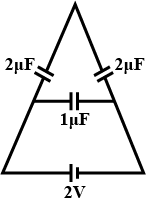
The charge (in $\mu C$ ) on any one of the 2$\mu F$ capacitor will be given respectively as:
A) 1, 2
B) 2, 1
C) 1, 1
D) 2, 2
Answer
 Verified
591.3k+ views
Hint:In order to find the charge we need to find the charge separately for each capacitor. Capacitors having $2\mu F$ are in series hence equal charge will be there with half of the voltage and capacitor $1\mu F$ is along 2V and have charge different to others. This is how we will get the charges on capacitors.
Step by step solution:
Step 1:
Let us know about the capacitor first before solving the question:
A capacitor (originally known as a condenser) is a passive two-terminal electrical component used to store energy electro statically in an electric field. The forms of practical capacitors vary widely, but all contain at least two electrical conductors (plates) separated by a dielectric (i.e. insulator).
The starting capacitor works by accumulating a large electrical charge inside the capacitor. During compressor or other motor startup, the start capacitor releases its charge to give a voltage "boost" to get the electric motor spinning.
Step 2:
In question we are given that a voltage supply of 2V has been given to three capacitors of charge 2, 2, and 1 micro farad .
The two capacitors are in series with each other and hence will have equal charge along them and also the voltage supply will get distributed along them in equal amounts.
Let them have a charge of ${Q_1}$ for both and the voltage will be $\dfrac{V}{2}$ which is 1V each.
Coming to the third capacitor it has the voltage 2V and let say it has a charge of ${Q_2}$
Now, for ${Q_1}$ charge is equal to the product of capacitance and voltage across it .
So ${Q_1}$=$2\mu F \times 1V$ . This is equal to $2\mu C$ for each.
Coming to the third one ${Q_2}$ =1$\mu F \times 2V$. This is equal to $2\mu C$
Hence both ${Q_1}$ and ${Q_2}$ have same charge of $2\mu C$
Option D is correct.
Additional information:
Capacitors have many important applications. They are used, for example, in digital circuits so that information stored in large computer memories is not lost during a momentary electric power failure; the electric energy stored in such capacitors maintains the information during the temporary loss of power.
Capacitors (sometimes known as condensers) are energy-storing devices that are widely used in televisions, radios, and other kinds of electronic equipment. Tune a radio into a station, take a flash photo with a digital camera, or flick the channels on your HDTV and you're making good use of capacitors.
Note:
To find the solution one must know that when capacitors are in series they possess equal charge and the voltage supply gets divided among them in equal amounts. To find the charge we need to remember one thing that charge is equal to the product of capacitance and voltage across it, and must not make mistakes in finding the voltage across capacitors.
Step by step solution:
Step 1:
Let us know about the capacitor first before solving the question:
A capacitor (originally known as a condenser) is a passive two-terminal electrical component used to store energy electro statically in an electric field. The forms of practical capacitors vary widely, but all contain at least two electrical conductors (plates) separated by a dielectric (i.e. insulator).
The starting capacitor works by accumulating a large electrical charge inside the capacitor. During compressor or other motor startup, the start capacitor releases its charge to give a voltage "boost" to get the electric motor spinning.
Step 2:
In question we are given that a voltage supply of 2V has been given to three capacitors of charge 2, 2, and 1 micro farad .
The two capacitors are in series with each other and hence will have equal charge along them and also the voltage supply will get distributed along them in equal amounts.
Let them have a charge of ${Q_1}$ for both and the voltage will be $\dfrac{V}{2}$ which is 1V each.
Coming to the third capacitor it has the voltage 2V and let say it has a charge of ${Q_2}$
Now, for ${Q_1}$ charge is equal to the product of capacitance and voltage across it .
So ${Q_1}$=$2\mu F \times 1V$ . This is equal to $2\mu C$ for each.
Coming to the third one ${Q_2}$ =1$\mu F \times 2V$. This is equal to $2\mu C$
Hence both ${Q_1}$ and ${Q_2}$ have same charge of $2\mu C$
Option D is correct.
Additional information:
Capacitors have many important applications. They are used, for example, in digital circuits so that information stored in large computer memories is not lost during a momentary electric power failure; the electric energy stored in such capacitors maintains the information during the temporary loss of power.
Capacitors (sometimes known as condensers) are energy-storing devices that are widely used in televisions, radios, and other kinds of electronic equipment. Tune a radio into a station, take a flash photo with a digital camera, or flick the channels on your HDTV and you're making good use of capacitors.
Note:
To find the solution one must know that when capacitors are in series they possess equal charge and the voltage supply gets divided among them in equal amounts. To find the charge we need to remember one thing that charge is equal to the product of capacitance and voltage across it, and must not make mistakes in finding the voltage across capacitors.
Recently Updated Pages
Basicity of sulphurous acid and sulphuric acid are

Master Class 12 English: Engaging Questions & Answers for Success
Master Class 12 Social Science: Engaging Questions & Answers for Success
Master Class 12 Maths: Engaging Questions & Answers for Success
Master Class 12 Economics: Engaging Questions & Answers for Success
Master Class 12 Physics: Engaging Questions & Answers for Success
Trending doubts
Which are the Top 10 Largest Countries of the World?
Draw a labelled sketch of the human eye class 12 physics CBSE
Give 10 examples of unisexual and bisexual flowers
Coming together federation is practiced in A India class 12 social science CBSE
Write the formula to find the shortest distance between class 12 maths CBSE
Find the foot of the perpendicular from point232to class 12 maths CBSE