




The centripetal force in a conical pendulum of semi vertical angle theta is equal to
A. The horizontal component of tension
B. The vertical component of tension
C. The tension in the string
D. Weight of the bob
Answer
 Verified
637.8k+ views
Hint- A conical pendulum consists of a Bob revolving in a horizontal circle with a constant speed at the end of a string. The string makes a constant angle with the vertical so it describes a cone whereas the bob of the pendulum describes a horizontal circle.
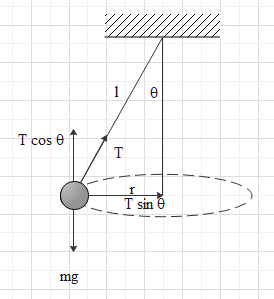
Here, $r$ is the radius of the circular path, $\theta $ is the angle between height $h$ and string, $l$is the length of the string, $m$ is the mass of the bob and $\omega $ is the angular velocity of the mass.
The force required to keep an object moving in a circular path is known as centripetal force. This force will be always directed inward towards the centre of rotation.
Step by step solution:
A conical pendulum consists of a Bob revolving in a horizontal circle with a constant speed at the end of a string. The string makes a constant angle with the vertical so it describes a cone whereas the bob of the pendulum describes a horizontal circle.
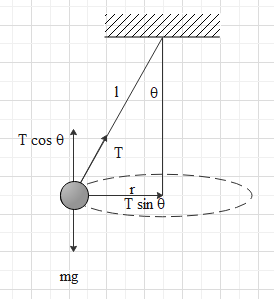
$r$ is the radius of the circular path, $\theta $ is the angle between height $h$ and string, $l$is the length of the string, $m$ is the mass of the bob and $\omega $ is the angular velocity of the mass.
Here, there are two forces acting on the pendulum, one is due to tension $T$ in the string and the other is due to force of gravity. The tension in the string can be resolved into two components, x component and y component. x component is $T\sin \theta $ and y component is $T\cos \theta $
The force of gravity $mg$ acting downward is balanced by the y component of tension that is $T\cos \theta $ .The necessary centripetal acceleration is provided by the x component of tension $T\sin \theta $.
The force required to keep an object moving in a circular path is known as centripetal force. This force will be always directed inward towards the centre of rotation. This necessary centripetal acceleration required for the motion of the conical pendulum is provided by the x component of tension which is the horizontal component.
So, the answer is option D.
Note: The force required to keep an object moving in a circular path is known as centripetal force. This force will be always directed inward towards the centre of rotation. Don't confuse centripetal force with centrifugal force. Centrifugal force is the force felt by an object moving on a circular path which acts away from the centre.
Here, $r$ is the radius of the circular path, $\theta $ is the angle between height $h$ and string, $l$is the length of the string, $m$ is the mass of the bob and $\omega $ is the angular velocity of the mass.
The force required to keep an object moving in a circular path is known as centripetal force. This force will be always directed inward towards the centre of rotation.
Step by step solution:
A conical pendulum consists of a Bob revolving in a horizontal circle with a constant speed at the end of a string. The string makes a constant angle with the vertical so it describes a cone whereas the bob of the pendulum describes a horizontal circle.
$r$ is the radius of the circular path, $\theta $ is the angle between height $h$ and string, $l$is the length of the string, $m$ is the mass of the bob and $\omega $ is the angular velocity of the mass.
Here, there are two forces acting on the pendulum, one is due to tension $T$ in the string and the other is due to force of gravity. The tension in the string can be resolved into two components, x component and y component. x component is $T\sin \theta $ and y component is $T\cos \theta $
The force of gravity $mg$ acting downward is balanced by the y component of tension that is $T\cos \theta $ .The necessary centripetal acceleration is provided by the x component of tension $T\sin \theta $.
The force required to keep an object moving in a circular path is known as centripetal force. This force will be always directed inward towards the centre of rotation. This necessary centripetal acceleration required for the motion of the conical pendulum is provided by the x component of tension which is the horizontal component.
So, the answer is option D.
Note: The force required to keep an object moving in a circular path is known as centripetal force. This force will be always directed inward towards the centre of rotation. Don't confuse centripetal force with centrifugal force. Centrifugal force is the force felt by an object moving on a circular path which acts away from the centre.
Recently Updated Pages
Basicity of sulphurous acid and sulphuric acid are

Master Class 11 English: Engaging Questions & Answers for Success
Master Class 11 Physics: Engaging Questions & Answers for Success
Master Class 11 Computer Science: Engaging Questions & Answers for Success
Master Class 11 Chemistry: Engaging Questions & Answers for Success
Master Class 11 Social Science: Engaging Questions & Answers for Success
Trending doubts
Difference Between Prokaryotic Cells and Eukaryotic Cells
Two of the body parts which do not appear in MRI are class 11 biology CBSE
One Metric ton is equal to kg A 10000 B 1000 C 100 class 11 physics CBSE
10 examples of friction in our daily life
Draw a diagram of nephron and explain its structur class 11 biology CBSE
What will happen if the mucus is not secreted by the class 11 biology CBSE