




The center of gravity of a hollow cone of height h is at distance x from its vertex where the of x is:
Answer
 Verified
666.3k+ views
Hint: Use the basic formula $x=\dfrac{\int z.\sigma dA}{\int \sigma dA}$, to determine the center of mass of a system. We will also know the difference between the center of gravity and the center of mass. Then after performing basic integral calculations the problem can be solved.
Formula used:
$x=\dfrac{\int z.\sigma dA}{\int \sigma dA}$
Complete step-by-step solution:
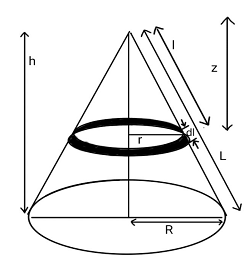
Let ‘x’ be the distance from the vertex of the cone to any point on the axis of the cone. Also let ‘R’ be the radius of the base of the cone. And ‘h’ is already given to be the height of the cone.
Let us take that, ‘r’ as the distance of any point on the cone from the axis of the cone, the distance being measured perpendicular to this axis.
From the picture, using the concept of geometry we can find that,
$\dfrac{r}{R}=\dfrac{z}{h}=\dfrac{l}{L}..........(i)$
Here “l” is the distance of any point on the cone directly from the vertex. Looking at the image here gives you better understanding.
Let $\sigma$ be the surface density of mass of the cone. Now imagine a circular plane perpendicular to the axis. Its circumference will be $2\pi r$. Now an infinitesimal area around the circle is $dA=2\pi r.dl$(look at the image).
The center of mass of a system is given by the formula,
$x=\dfrac{\int z.\sigma dA}{\int \sigma dA}$
Substituting the above values in the formula for center of mass, and using relations in equation (i), we obtain,
$\begin{align}
& x=\dfrac{\int{2}\sigma .\pi r.z.dl}{\int{2}\sigma .\pi r.dl} \\
& \Rightarrow x=\dfrac{2\pi \int\limits_{0}^{h}{\sigma \dfrac{RL}{{{h}^{2}}}{{z}^{2}}}dz}{2\pi \int\limits_{0}^{h}{\sigma \dfrac{RL}{{{h}^{2}}}z}dz} \\
\end{align}$
Cancelling the like terms, we get
$\Rightarrow x=\dfrac{\int\limits_{0}^{h}{{{z}^{2}}}dz}{\int\limits_{0}^{h}{z}dz}$
On integrating numerator and denominator separately, we get
$\Rightarrow x=\dfrac{\left[ \dfrac{{{z}^{3}}}{3} \right]_{0}^{h}}{\left[ \dfrac{{{z}^{2}}}{2} \right]_{0}^{h}}$
On applying the limits and simplifying, we get
$\begin{align}
& \Rightarrow x=\dfrac{\left[ \dfrac{{{h}^{3}}}{3}-0 \right]}{\left[ \dfrac{{{h}^{2}}}{2}-0 \right]} \\
& \Rightarrow x=\dfrac{{{h}^{3}}}{3}\times \dfrac{2}{{{h}^{2}}} \\
\end{align}$
After solving this, we obtain that, $x=\dfrac{2}{3}.h$
So, this is the final answer.
Additional information:
If a person can hold an object by its center of gravity, then it will not rotate by the effect of gravity. Center of gravity is defined as the point about which the torques of gravity are zero. By definition it is not exactly the same with the center of mass. But in a field where the gravitational acceleration is uniform, the center of gravity coincides with the center of mass.
Note: Usually, the definition of center of mass contains summation where the masses are discreet. But in case of continuous mass distribution we have to use integration. In the integration, convert all the variables in a single variable and then put the limits.
Formula used:
$x=\dfrac{\int z.\sigma dA}{\int \sigma dA}$
Complete step-by-step solution:
Let ‘x’ be the distance from the vertex of the cone to any point on the axis of the cone. Also let ‘R’ be the radius of the base of the cone. And ‘h’ is already given to be the height of the cone.
Let us take that, ‘r’ as the distance of any point on the cone from the axis of the cone, the distance being measured perpendicular to this axis.
From the picture, using the concept of geometry we can find that,
$\dfrac{r}{R}=\dfrac{z}{h}=\dfrac{l}{L}..........(i)$
Here “l” is the distance of any point on the cone directly from the vertex. Looking at the image here gives you better understanding.
Let $\sigma$ be the surface density of mass of the cone. Now imagine a circular plane perpendicular to the axis. Its circumference will be $2\pi r$. Now an infinitesimal area around the circle is $dA=2\pi r.dl$(look at the image).
The center of mass of a system is given by the formula,
$x=\dfrac{\int z.\sigma dA}{\int \sigma dA}$
Substituting the above values in the formula for center of mass, and using relations in equation (i), we obtain,
$\begin{align}
& x=\dfrac{\int{2}\sigma .\pi r.z.dl}{\int{2}\sigma .\pi r.dl} \\
& \Rightarrow x=\dfrac{2\pi \int\limits_{0}^{h}{\sigma \dfrac{RL}{{{h}^{2}}}{{z}^{2}}}dz}{2\pi \int\limits_{0}^{h}{\sigma \dfrac{RL}{{{h}^{2}}}z}dz} \\
\end{align}$
Cancelling the like terms, we get
$\Rightarrow x=\dfrac{\int\limits_{0}^{h}{{{z}^{2}}}dz}{\int\limits_{0}^{h}{z}dz}$
On integrating numerator and denominator separately, we get
$\Rightarrow x=\dfrac{\left[ \dfrac{{{z}^{3}}}{3} \right]_{0}^{h}}{\left[ \dfrac{{{z}^{2}}}{2} \right]_{0}^{h}}$
On applying the limits and simplifying, we get
$\begin{align}
& \Rightarrow x=\dfrac{\left[ \dfrac{{{h}^{3}}}{3}-0 \right]}{\left[ \dfrac{{{h}^{2}}}{2}-0 \right]} \\
& \Rightarrow x=\dfrac{{{h}^{3}}}{3}\times \dfrac{2}{{{h}^{2}}} \\
\end{align}$
After solving this, we obtain that, $x=\dfrac{2}{3}.h$
So, this is the final answer.
Additional information:
If a person can hold an object by its center of gravity, then it will not rotate by the effect of gravity. Center of gravity is defined as the point about which the torques of gravity are zero. By definition it is not exactly the same with the center of mass. But in a field where the gravitational acceleration is uniform, the center of gravity coincides with the center of mass.
Note: Usually, the definition of center of mass contains summation where the masses are discreet. But in case of continuous mass distribution we have to use integration. In the integration, convert all the variables in a single variable and then put the limits.
Recently Updated Pages
If x a + bt + ct2 where x is in meters and t is in class 11 physics CBSE

A car covers the first half distance between two places class 11 physics CBSE
The resultant of two vectors overrightarrow P and overrightarrow class 11 physics CBSE
Find the value of cos 135 class 11 maths CBSE
A mass M is held in place by an applied force F and class 11 physics CBSE
A solution of glucose in water is labelled as 10 dfracwv class 11 chemistry CBSE
Trending doubts
Find the value of the expression given below sin 30circ class 11 maths CBSE
One Metric ton is equal to kg A 10000 B 1000 C 100 class 11 physics CBSE
Draw a diagram of nephron and explain its structur class 11 biology CBSE
10 examples of friction in our daily life
Proton was discovered by A Thomson B Rutherford C Chadwick class 11 chemistry CBSE
Bond order ofO2 O2+ O2 and O22 is in order A O2 langle class 11 chemistry CBSE