




The center of family of circles cutting the family of circles ${{x}^{2}}+{{y}^{2}}+4x\left( \lambda -\dfrac{3}{2} \right)+3y\left( \lambda -\dfrac{4}{3} \right)-6\left( \lambda +2 \right)=0$ orthogonally lies on
$\left( A \right)\text{ }x-y-1=0$
$\left( B \right)\text{ 4}x+3y-6=0$
$\left( C \right)\text{ 4}x+3y+7=0$
$\left( D \right)\text{ 3}x-4y-1=0$
Answer
 Verified
512.1k+ views
Hint: In this question we will use the property of the family of circles to get the center of the family of circles. We will first simplify the expression and get all the lambda terms and non-lambda terms together. We will then consider two circles ${{S}_{1}}$ and ${{S}_{2}}$ with different values of $\lambda $, as ${{\lambda }_{1}}$ and ${{\lambda }_{2}}$. We will then use the property of the radical line of the family of circles and get the required equation.
Complete step by step answer:
We have the equation of the family of circles given to us as:
$\Rightarrow {{x}^{2}}+{{y}^{2}}+4x\left( \lambda -\dfrac{3}{2} \right)+3y\left( \lambda -\dfrac{4}{3} \right)-6\left( \lambda +2 \right)=0$
On multiplying the terms, we get:
$\Rightarrow {{x}^{2}}+{{y}^{2}}+4x\lambda -6x+3y\lambda -4y-6\lambda -12=0$
On taking all the $\lambda $ terms together, we get:
$\Rightarrow {{x}^{2}}+{{y}^{2}}-6x-4y-12+4x\lambda +3y\lambda -6\lambda =0$
On taking the term $\lambda $ common, we get:
$\Rightarrow {{x}^{2}}+{{y}^{2}}-6x-4y-12+\lambda \left( 4x+3y-6 \right)=0$
Now we know the property that the circles which cut the family of circles orthogonally form another family of circles which is called the conjugate family of circles and the center of the conjugate family of circles will be the radical line of the original family of circles.
Now, the radical line of the original family of circles will be the radical line of any two circles in the given family of the circle.
Therefore, we will consider two circles ${{S}_{1}}$ and ${{S}_{2}}$ with different ${{\lambda }_{1}}$ and ${{\lambda }_{2}}$. On substituting, we get:
$\Rightarrow {{S}_{1}}={{x}^{2}}+{{y}^{2}}-6x-4y-12+{{\lambda }_{1}}\left( 4x+3y-6 \right)=0$
$\Rightarrow {{S}_{2}}={{x}^{2}}+{{y}^{2}}-6x-4y-12+{{\lambda }_{2}}\left( 4x+3y-6 \right)=0$
Now the radical line is given by the formula ${{S}_{1}}-{{S}_{2}}=0$ therefore, on substituting, we get:
$\Rightarrow \left( \left( {{x}^{2}}+{{y}^{2}}-6x-4y-12 \right)+{{\lambda }_{1}}\left( 4x+3y-6 \right) \right)-\left( \left( {{x}^{2}}+{{y}^{2}}-6x-4y-12 \right)+{{\lambda }_{2}}\left( 4x+3y-6 \right) \right)=0$
On opening the bracket and simplifying, we get:
$\Rightarrow {{\lambda }_{1}}\left( 4x+3y-6 \right)-{{\lambda }_{2}}\left( 4x+3y-6 \right)=0$
On taking the bracket common, we get:
$\Rightarrow \left( {{\lambda }_{1}}-{{\lambda }_{2}} \right)\left( 4x+3y-6 \right)=0$
Now we know that ${{\lambda }_{1}}\ne {{\lambda }_{2}}$ therefore, ${{\lambda }_{1}}-{{\lambda }_{2}}\ne 0$ therefore, it can be cancelled.
We get the expression as:
$\Rightarrow 4x+3y-6=0$, which is the radical line and the center of the conjugate lies on the radical line therefore, it is the required solution.
It can be represented as:
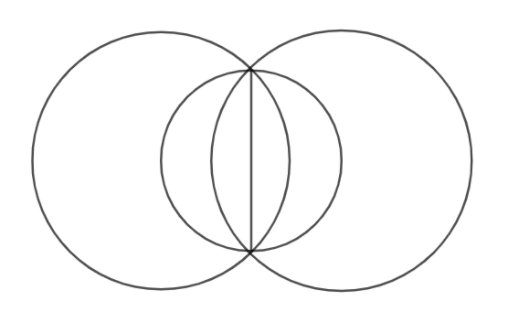
So, the correct answer is “Option B”.
Note: It is to be remembered that a collection of circles is called a family of circles. We use a family of circles to simplify calculations of similar types of circles. The general equation of a family of circles is ${{x}^{2}}+{{y}^{2}}+2gx+2fy+c=0$. Given the equation is known, various properties of the family of circles can be used.
Complete step by step answer:
We have the equation of the family of circles given to us as:
$\Rightarrow {{x}^{2}}+{{y}^{2}}+4x\left( \lambda -\dfrac{3}{2} \right)+3y\left( \lambda -\dfrac{4}{3} \right)-6\left( \lambda +2 \right)=0$
On multiplying the terms, we get:
$\Rightarrow {{x}^{2}}+{{y}^{2}}+4x\lambda -6x+3y\lambda -4y-6\lambda -12=0$
On taking all the $\lambda $ terms together, we get:
$\Rightarrow {{x}^{2}}+{{y}^{2}}-6x-4y-12+4x\lambda +3y\lambda -6\lambda =0$
On taking the term $\lambda $ common, we get:
$\Rightarrow {{x}^{2}}+{{y}^{2}}-6x-4y-12+\lambda \left( 4x+3y-6 \right)=0$
Now we know the property that the circles which cut the family of circles orthogonally form another family of circles which is called the conjugate family of circles and the center of the conjugate family of circles will be the radical line of the original family of circles.
Now, the radical line of the original family of circles will be the radical line of any two circles in the given family of the circle.
Therefore, we will consider two circles ${{S}_{1}}$ and ${{S}_{2}}$ with different ${{\lambda }_{1}}$ and ${{\lambda }_{2}}$. On substituting, we get:
$\Rightarrow {{S}_{1}}={{x}^{2}}+{{y}^{2}}-6x-4y-12+{{\lambda }_{1}}\left( 4x+3y-6 \right)=0$
$\Rightarrow {{S}_{2}}={{x}^{2}}+{{y}^{2}}-6x-4y-12+{{\lambda }_{2}}\left( 4x+3y-6 \right)=0$
Now the radical line is given by the formula ${{S}_{1}}-{{S}_{2}}=0$ therefore, on substituting, we get:
$\Rightarrow \left( \left( {{x}^{2}}+{{y}^{2}}-6x-4y-12 \right)+{{\lambda }_{1}}\left( 4x+3y-6 \right) \right)-\left( \left( {{x}^{2}}+{{y}^{2}}-6x-4y-12 \right)+{{\lambda }_{2}}\left( 4x+3y-6 \right) \right)=0$
On opening the bracket and simplifying, we get:
$\Rightarrow {{\lambda }_{1}}\left( 4x+3y-6 \right)-{{\lambda }_{2}}\left( 4x+3y-6 \right)=0$
On taking the bracket common, we get:
$\Rightarrow \left( {{\lambda }_{1}}-{{\lambda }_{2}} \right)\left( 4x+3y-6 \right)=0$
Now we know that ${{\lambda }_{1}}\ne {{\lambda }_{2}}$ therefore, ${{\lambda }_{1}}-{{\lambda }_{2}}\ne 0$ therefore, it can be cancelled.
We get the expression as:
$\Rightarrow 4x+3y-6=0$, which is the radical line and the center of the conjugate lies on the radical line therefore, it is the required solution.
It can be represented as:
So, the correct answer is “Option B”.
Note: It is to be remembered that a collection of circles is called a family of circles. We use a family of circles to simplify calculations of similar types of circles. The general equation of a family of circles is ${{x}^{2}}+{{y}^{2}}+2gx+2fy+c=0$. Given the equation is known, various properties of the family of circles can be used.
Recently Updated Pages
Master Class 11 Computer Science: Engaging Questions & Answers for Success

Master Class 11 Business Studies: Engaging Questions & Answers for Success
Master Class 11 Economics: Engaging Questions & Answers for Success
Master Class 11 English: Engaging Questions & Answers for Success
Master Class 11 Maths: Engaging Questions & Answers for Success
Master Class 11 Biology: Engaging Questions & Answers for Success
Trending doubts
One Metric ton is equal to kg A 10000 B 1000 C 100 class 11 physics CBSE
There are 720 permutations of the digits 1 2 3 4 5 class 11 maths CBSE
Discuss the various forms of bacteria class 11 biology CBSE
Draw a diagram of a plant cell and label at least eight class 11 biology CBSE
State the laws of reflection of light
Explain zero factorial class 11 maths CBSE