




The cell plate is referred to as
(a) Germplasm
(b) Idioblast
(c) Phragmoplast
(d) Middle lamella
Answer
 Verified
549k+ views
Hint: This structure is formed exclusively in the plant cells during the final stages of cytokinesis. It helps in the formation of a cell wall that will separate new daughter cells.
Complete answer:
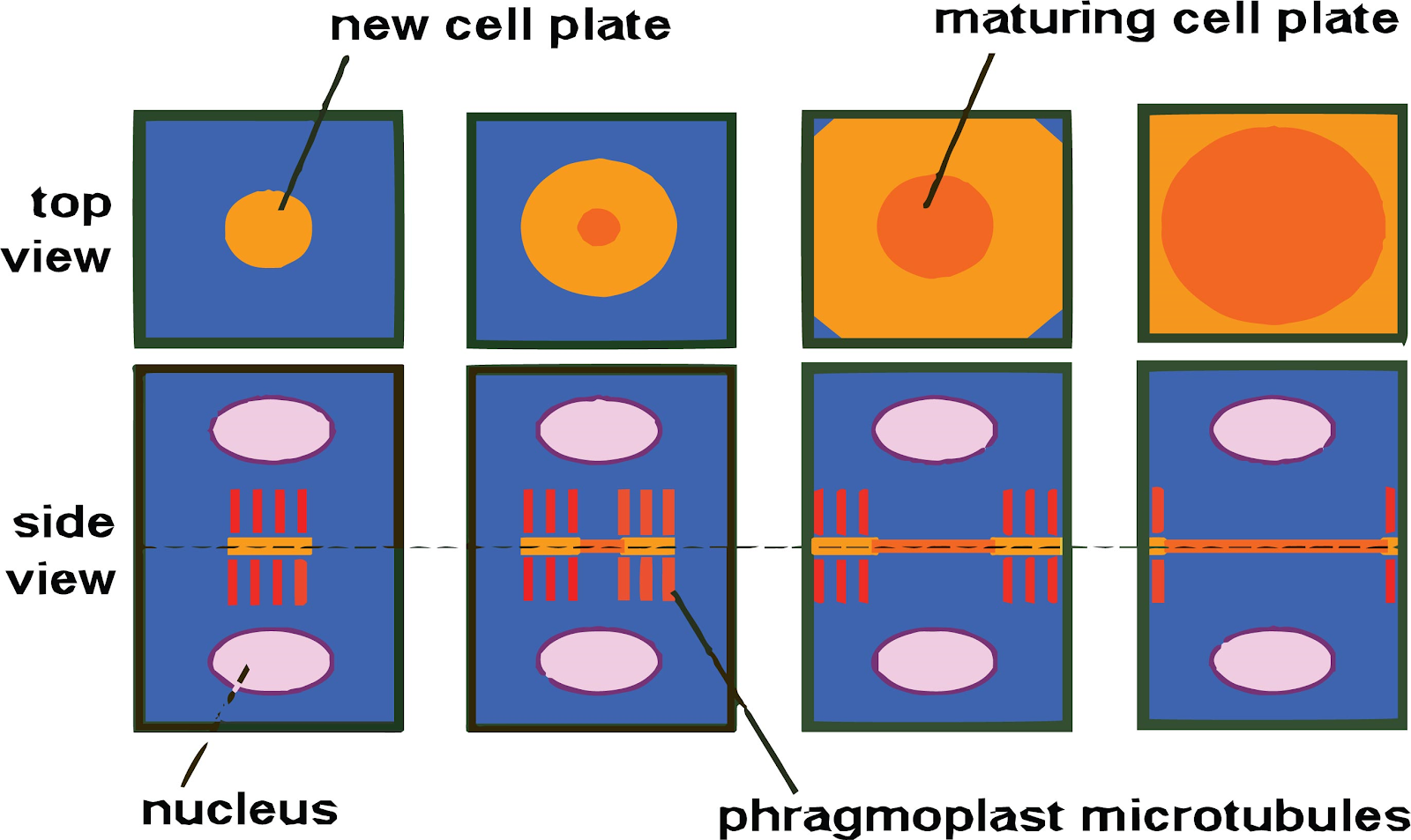
Cytokinesis occurs in the plant via a cell plate. The middle portion of the spindle will remain and it becomes interdigitated with microtubules for the formation of the phragmoplast. Vesicles possess pectic compounds and other wall substances will appear in the middle of the phragmoplast. They will fuse and form a film/ a cell plate that has membranes on either side.
Additional information
-Cytokinesis occurs by the creation of cell plates in terrestrial plants.
-This process involves constituents of the cell wall and cell membrane delivery of the Golgi-derived and the endosomal vesicles resulting in the fusion of these vesicles within this plate.
-Following the development of an early tubulo-vesicular (also called ER-Golgi intermediate compartment) network in the center of the cell, the initially labile cell plate consolidates into a tubular network, and finally a fenestrated sheet.
-The cell plate from the center of the plasma membrane parent cell extends out and result in the fusion thus completing the cell division.
-The phragmoplast grows and develops according to itself that helps in the targeting of the cell plate derived from the Golgi vesicles.
-In the center of the cell as the maturation of the cell plate occurs it leads to the phragmoplast disassembling thus new elements are added to its outside.
-This process leads to the steady expansion of the phragmoplast and at the same time, it continuously retargets the Golgi-derived vesicles to the expanding edge of the cell plate.
-This process marks the separation of the two daughter cells and also starts a series of biochemical modifications that change the flexible, callose-rich cell plate into a rigid primary cell wall rich in cellulose.
So, the correct answer is ‘Phragmoplast’.
Note:
The largest and most obvious distinction between plant and animal cytokinesis is that the plants form a cell plate during the cell division, while the animal cells form a furrow of cleavage. Plants have to form a cell plate because they have cell walls and animals do not have it.
Complete answer:
Cytokinesis occurs in the plant via a cell plate. The middle portion of the spindle will remain and it becomes interdigitated with microtubules for the formation of the phragmoplast. Vesicles possess pectic compounds and other wall substances will appear in the middle of the phragmoplast. They will fuse and form a film/ a cell plate that has membranes on either side.
Additional information
-Cytokinesis occurs by the creation of cell plates in terrestrial plants.
-This process involves constituents of the cell wall and cell membrane delivery of the Golgi-derived and the endosomal vesicles resulting in the fusion of these vesicles within this plate.
-Following the development of an early tubulo-vesicular (also called ER-Golgi intermediate compartment) network in the center of the cell, the initially labile cell plate consolidates into a tubular network, and finally a fenestrated sheet.
-The cell plate from the center of the plasma membrane parent cell extends out and result in the fusion thus completing the cell division.
-The phragmoplast grows and develops according to itself that helps in the targeting of the cell plate derived from the Golgi vesicles.
-In the center of the cell as the maturation of the cell plate occurs it leads to the phragmoplast disassembling thus new elements are added to its outside.
-This process leads to the steady expansion of the phragmoplast and at the same time, it continuously retargets the Golgi-derived vesicles to the expanding edge of the cell plate.
-This process marks the separation of the two daughter cells and also starts a series of biochemical modifications that change the flexible, callose-rich cell plate into a rigid primary cell wall rich in cellulose.
So, the correct answer is ‘Phragmoplast’.
Note:
The largest and most obvious distinction between plant and animal cytokinesis is that the plants form a cell plate during the cell division, while the animal cells form a furrow of cleavage. Plants have to form a cell plate because they have cell walls and animals do not have it.
Recently Updated Pages
Master Class 11 English: Engaging Questions & Answers for Success

Master Class 11 Social Science: Engaging Questions & Answers for Success
Master Class 11 Maths: Engaging Questions & Answers for Success
Master Class 11 Biology: Engaging Questions & Answers for Success
Master Class 11 Physics: Engaging Questions & Answers for Success
Master Class 11 Chemistry: Engaging Questions & Answers for Success
Trending doubts
One Metric ton is equal to kg A 10000 B 1000 C 100 class 11 physics CBSE
Difference Between Prokaryotic Cells and Eukaryotic Cells
Two of the body parts which do not appear in MRI are class 11 biology CBSE
Find the value of the expression given below sin 30circ class 11 maths CBSE
Draw a diagram of a plant cell and label at least eight class 11 biology CBSE
10 examples of friction in our daily life