




The cardiac pacemaker in a patient fails to function normally. The doctor finds that an artificial pacemaker is to be grafted in him. It will likely be grafted at the site of
(a) Atrioventricular bundle
(b) Purkinje system
(c) Sinoatrial node
(d) Atrioventricular node
Answer
 Verified
597.3k+ views
Hint: This bundle of neurons is present in the right atrium, and failure of this part causes irregular beating of hearts, improper flow of blood, and other cardiac issues. This involuntary myocardial structure generates electrical impulses.
Complete answer:
The cardiac pacemaker in a patient will be grafted at the site of the Sinoatrial node.
The Sinoatrial node is an advanced group of neurons present in the upper side of the atrium (right) in the heart. The Sinoatrial node is the pacemaker that is present naturally in the heart, which starts the heartbeat in humans. Due to the failure of the function of the sinoatrial node, patients often graft an artificial pacemaker in the heart.
Additional information:
- When the Sinoatrial node is damaged, it will start to transmit non- coordinated electrical impulses to the chambers of the heart, causing symptoms like improper heart rate, weakness, dizziness, and sudden falls by the unconscious.
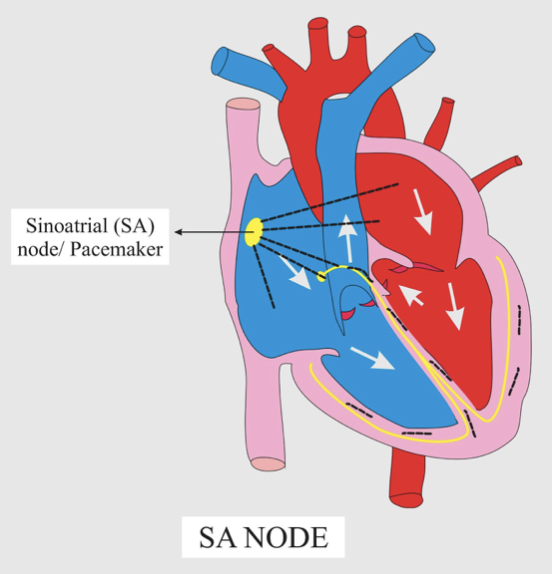
- The artificial pacemaker will form these rhythmical electrical impulses. Hence they are implanted at the place of the Sinoatrial node to reproduce the function of the sinoatrial node and rhythmic system to aid in the regulation of heartbeat.
- Sound of heartbeat is represented by Lubb and Dub sound. Lubb sound is formed by the closing of atrioventricular valves and the closing of semilunar valves at the root of the pulmonary artery and aorta produces Dub sound
So, the correct answer is the Sinoatrial node.
Note:
- Muscle fibers are made of Microfibrils which in turn is composed of Sarcomeres, which is the reason for the basic functioning of muscle i.e muscle contraction.
- The heart wall consists of three layers, which are Epicardium (the outermost layer) myocardium (middle thick layer) and endocardium (innermost layer).
- Since the cardiac muscles are involuntary and are not controlled by the somatic nervous system, is the reason why we are not able to control the heartbeat- like controlling other muscles.
Complete answer:
The cardiac pacemaker in a patient will be grafted at the site of the Sinoatrial node.
The Sinoatrial node is an advanced group of neurons present in the upper side of the atrium (right) in the heart. The Sinoatrial node is the pacemaker that is present naturally in the heart, which starts the heartbeat in humans. Due to the failure of the function of the sinoatrial node, patients often graft an artificial pacemaker in the heart.
Additional information:
- When the Sinoatrial node is damaged, it will start to transmit non- coordinated electrical impulses to the chambers of the heart, causing symptoms like improper heart rate, weakness, dizziness, and sudden falls by the unconscious.
- The artificial pacemaker will form these rhythmical electrical impulses. Hence they are implanted at the place of the Sinoatrial node to reproduce the function of the sinoatrial node and rhythmic system to aid in the regulation of heartbeat.
- Sound of heartbeat is represented by Lubb and Dub sound. Lubb sound is formed by the closing of atrioventricular valves and the closing of semilunar valves at the root of the pulmonary artery and aorta produces Dub sound
So, the correct answer is the Sinoatrial node.
Note:
- Muscle fibers are made of Microfibrils which in turn is composed of Sarcomeres, which is the reason for the basic functioning of muscle i.e muscle contraction.
- The heart wall consists of three layers, which are Epicardium (the outermost layer) myocardium (middle thick layer) and endocardium (innermost layer).
- Since the cardiac muscles are involuntary and are not controlled by the somatic nervous system, is the reason why we are not able to control the heartbeat- like controlling other muscles.
Recently Updated Pages
Three beakers labelled as A B and C each containing 25 mL of water were taken A small amount of NaOH anhydrous CuSO4 and NaCl were added to the beakers A B and C respectively It was observed that there was an increase in the temperature of the solutions contained in beakers A and B whereas in case of beaker C the temperature of the solution falls Which one of the following statements isarecorrect i In beakers A and B exothermic process has occurred ii In beakers A and B endothermic process has occurred iii In beaker C exothermic process has occurred iv In beaker C endothermic process has occurred

Master Class 11 Social Science: Engaging Questions & Answers for Success
Master Class 11 Physics: Engaging Questions & Answers for Success
Master Class 11 Maths: Engaging Questions & Answers for Success
Master Class 11 Economics: Engaging Questions & Answers for Success
Master Class 11 Computer Science: Engaging Questions & Answers for Success
Three beakers labelled as A B and C each containing 25 mL of water were taken A small amount of NaOH anhydrous CuSO4 and NaCl were added to the beakers A B and C respectively It was observed that there was an increase in the temperature of the solutions contained in beakers A and B whereas in case of beaker C the temperature of the solution falls Which one of the following statements isarecorrect i In beakers A and B exothermic process has occurred ii In beakers A and B endothermic process has occurred iii In beaker C exothermic process has occurred iv In beaker C endothermic process has occurred
Master Class 11 Social Science: Engaging Questions & Answers for Success
Master Class 11 Physics: Engaging Questions & Answers for Success
Trending doubts
One Metric ton is equal to kg A 10000 B 1000 C 100 class 11 physics CBSE
There are 720 permutations of the digits 1 2 3 4 5 class 11 maths CBSE
State and prove Bernoullis theorem class 11 physics CBSE
Draw a diagram of a plant cell and label at least eight class 11 biology CBSE
Difference Between Prokaryotic Cells and Eukaryotic Cells
Discuss the various forms of bacteria class 11 biology CBSE