




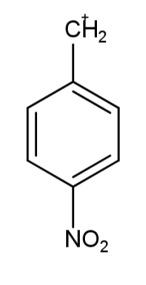
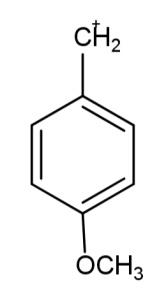
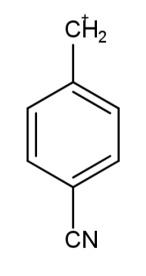
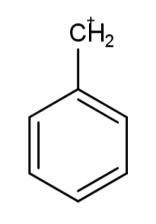
The carbocation which is most stable is:
A.
B.
C.
D.
Answer
 Verified
572.4k+ views
Hint: Carbon having a positive charge is called a carbocation, while when it contains a negative charge it is called a carbanion. These are reactive intermediates and the majority of the reactions occur by the formation of carbocation and carbanions. These species are highly reactive and short living therefore carries out a reaction.
Complete answer:
A carbocation is a highly reactive and unstable substance that is an intermediate that is formed in the middle of various reactions. Through the carbocation formation, the organic compounds are able to react and form different products. A carbon, when forms a cation with 6 electrons in its valence shell, is formed by the heterolytic cleavage of a covalent bond that leads to the formation of carbocations.
The factors that define the stability of the carbocation are the multiplicity in the bonds and the presence of the number of carbon atoms, this leads to the increase in the electron density that leads to more delocalization of electrons and hence more stability. The electron donating groups like methoxy and alkyl groups increase the electron density, while the electron withdrawing groups like nitro and cyanide groups decrease the density of electrons leading to less stabilization. So, carbocation in the second option has the most stability due to the methoxy group attached.
Hence, the most stable carbocation is option B.
Note: A
As the number of carbon atoms affects stability of carbocation, the order of stability of carbocation becomes, $3{}^\circ >2{}^\circ >1{}^\circ >0{}^\circ $ these are the degree of carbons. For a carbanion the order is opposite as that of the carbocation. This is because carbanions consist of a negative charge.
Complete answer:
A carbocation is a highly reactive and unstable substance that is an intermediate that is formed in the middle of various reactions. Through the carbocation formation, the organic compounds are able to react and form different products. A carbon, when forms a cation with 6 electrons in its valence shell, is formed by the heterolytic cleavage of a covalent bond that leads to the formation of carbocations.
The factors that define the stability of the carbocation are the multiplicity in the bonds and the presence of the number of carbon atoms, this leads to the increase in the electron density that leads to more delocalization of electrons and hence more stability. The electron donating groups like methoxy and alkyl groups increase the electron density, while the electron withdrawing groups like nitro and cyanide groups decrease the density of electrons leading to less stabilization. So, carbocation in the second option has the most stability due to the methoxy group attached.
Hence, the most stable carbocation is option B.
Note: A
As the number of carbon atoms affects stability of carbocation, the order of stability of carbocation becomes, $3{}^\circ >2{}^\circ >1{}^\circ >0{}^\circ $ these are the degree of carbons. For a carbanion the order is opposite as that of the carbocation. This is because carbanions consist of a negative charge.
Recently Updated Pages
Basicity of sulphurous acid and sulphuric acid are

Master Class 11 English: Engaging Questions & Answers for Success
Master Class 11 Physics: Engaging Questions & Answers for Success
Master Class 11 Computer Science: Engaging Questions & Answers for Success
Master Class 11 Chemistry: Engaging Questions & Answers for Success
Master Class 11 Social Science: Engaging Questions & Answers for Success
Trending doubts
Difference Between Prokaryotic Cells and Eukaryotic Cells
Two of the body parts which do not appear in MRI are class 11 biology CBSE
One Metric ton is equal to kg A 10000 B 1000 C 100 class 11 physics CBSE
10 examples of friction in our daily life
Draw a diagram of nephron and explain its structur class 11 biology CBSE
What will happen if the mucus is not secreted by the class 11 biology CBSE