




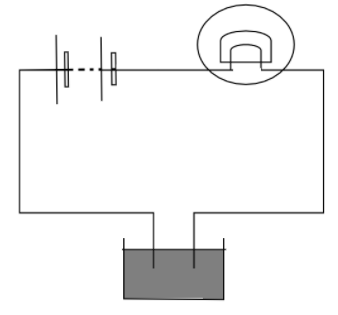
The bulb does not glow in the setup shown in the given figure. List the possible reasons. Explain your answer.
Answer
 Verified
614.7k+ views
Hint: For electricity to start flowing, you need a closed circuit. Electricity is the flow of particles with negative charges, called electrons. When a circuit is complete, electrons can flow from one end of a battery to the other, while travelling through the circuit elements. This flow of electrons through the components of the circuit is what makes them run or operate.
Complete step by step solution:
There might be several reasons why the bulb does not glow:
1. The bulb may be a fuse or not in a working condition; the filament might be broken or the connections in the circuit might be loose.
2. The battery used in the circuit may be exhausted and does not have enough energy to make the bulb glow.
3. The liquid in the beaker may be non-conducting. In such a case, the electric current would not be able to pass through the liquid and the circuit would be left incomplete.
4. The liquid might be conductive but its conductivity may be too low, such that the current that flows through the liquid would be too weak to produce enough heat in the filament of the bulb to make it glow.
Note: A circuit provides a path for the flow of electricity. If the path is broken, the electrons can’t flow through the circuit, whereas if the circuit is complete, then electrons can flow all the way around from one end of a power source to the other end of the power source. Sometimes, the appliances are connected to only the positive terminal of a source and the other end is connected to the ground, known as an earth connection. The earth is considered to be a source of excess electrons and helps complete the circuit.
Complete step by step solution:
There might be several reasons why the bulb does not glow:
1. The bulb may be a fuse or not in a working condition; the filament might be broken or the connections in the circuit might be loose.
2. The battery used in the circuit may be exhausted and does not have enough energy to make the bulb glow.
3. The liquid in the beaker may be non-conducting. In such a case, the electric current would not be able to pass through the liquid and the circuit would be left incomplete.
4. The liquid might be conductive but its conductivity may be too low, such that the current that flows through the liquid would be too weak to produce enough heat in the filament of the bulb to make it glow.
Note: A circuit provides a path for the flow of electricity. If the path is broken, the electrons can’t flow through the circuit, whereas if the circuit is complete, then electrons can flow all the way around from one end of a power source to the other end of the power source. Sometimes, the appliances are connected to only the positive terminal of a source and the other end is connected to the ground, known as an earth connection. The earth is considered to be a source of excess electrons and helps complete the circuit.
Recently Updated Pages
Master Class 11 English: Engaging Questions & Answers for Success

Master Class 11 Social Science: Engaging Questions & Answers for Success
Master Class 11 Maths: Engaging Questions & Answers for Success
Master Class 11 Biology: Engaging Questions & Answers for Success
Master Class 11 Physics: Engaging Questions & Answers for Success
Master Class 11 Chemistry: Engaging Questions & Answers for Success
Trending doubts
Explain the Treaty of Vienna of 1815 class 10 social science CBSE
What is the full form of POSCO class 10 social science CBSE
What planets have no moons Which one has only one moon class 10 physics CBSE
Define Potential, Developed, Stock and Reserved resources
In cricket, which Indian bowler is known as the "Yorker King"?
The diagonals of a rhombus are 10cm and 24cm Find the class 10 maths CBSE