




The breakdown mechanism in a lightly doped p-n junction under reverse biased condition is called:
A. Zener breakdown
B. Avalanche breakdown
C. High voltage breakdown
D. None of these
Answer
 Verified
552k+ views
Hint: p-n junction is an active element of the circuit, which is used where we want the flow of current in one direction and not in both. It is called a p-n junction because it is built using a p-type and a n-type semiconductor. When this diode is forward biased, only in that case it allows the current to flow through it.
Complete answer:
When the p-n junction is forward biased, ideally it allows all the current to flow through it. But when the same is reverse biased, it resists all the current to flow through it. But there is a limit up to what it can resist the current. After this limit, there is a break-through in the current and a large current starts to flow through it. This limit is called Avalanche breakdown which can be stated as:
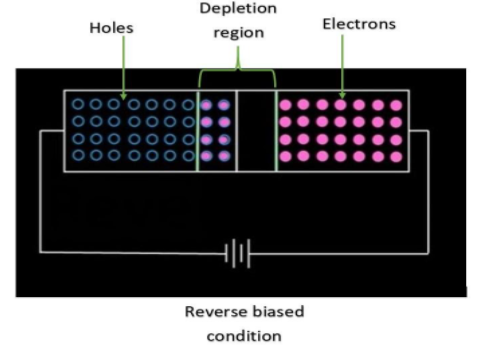
When the p-n junction is reverse biased, the interface between the p-type and n-type semiconductor starts to widen up. This is because the electrons from n-type semiconductor starts to get attracted towards the battery and from there goes into the p-type semiconductor to fill the holes near the interface.
As a result, this gap increases and is called the depletion region.
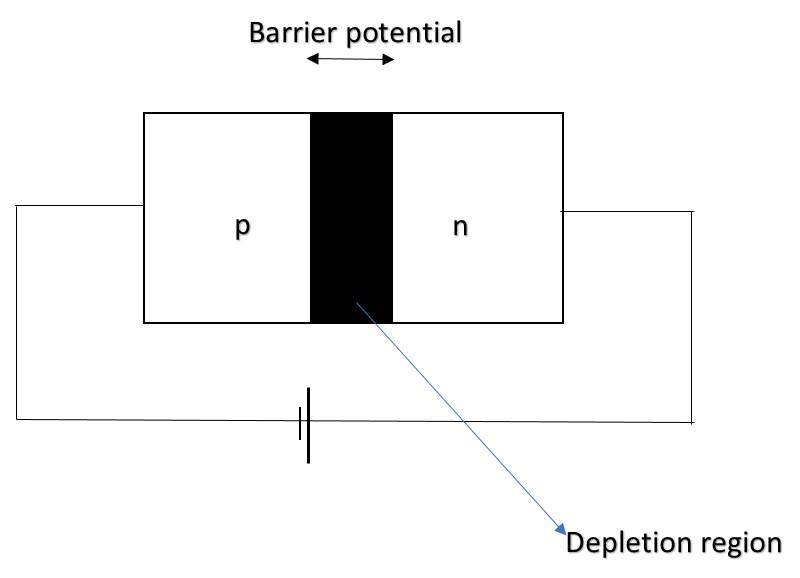
Now, this depletion region accumulates positive and negative charges at its ends due to which a potential difference is generated called Barrier potential. The value of this potential goes on increasing and once it becomes equal to the external applied voltage, after this point, there is a huge rush of electrons due to high potential difference. This produces a lot of heat energy and the diode gets destroyed. This phenomenon is called Avalanche breakdown.
Hence option B. is correct.
Note:
In the question, it is given that the p-n junction has lesser concentration. This is the reason we go for avalanche breakdown. A Zener diode is also a p-n junction which is always connected in reverse biased and the same phenomenon happens in it called Zener breakdown. Difference being that the concentration of p-n junction in diode is higher in Zener diode.
Complete answer:
When the p-n junction is forward biased, ideally it allows all the current to flow through it. But when the same is reverse biased, it resists all the current to flow through it. But there is a limit up to what it can resist the current. After this limit, there is a break-through in the current and a large current starts to flow through it. This limit is called Avalanche breakdown which can be stated as:
When the p-n junction is reverse biased, the interface between the p-type and n-type semiconductor starts to widen up. This is because the electrons from n-type semiconductor starts to get attracted towards the battery and from there goes into the p-type semiconductor to fill the holes near the interface.
As a result, this gap increases and is called the depletion region.
Now, this depletion region accumulates positive and negative charges at its ends due to which a potential difference is generated called Barrier potential. The value of this potential goes on increasing and once it becomes equal to the external applied voltage, after this point, there is a huge rush of electrons due to high potential difference. This produces a lot of heat energy and the diode gets destroyed. This phenomenon is called Avalanche breakdown.
Hence option B. is correct.
Note:
In the question, it is given that the p-n junction has lesser concentration. This is the reason we go for avalanche breakdown. A Zener diode is also a p-n junction which is always connected in reverse biased and the same phenomenon happens in it called Zener breakdown. Difference being that the concentration of p-n junction in diode is higher in Zener diode.
Recently Updated Pages
Master Class 12 Economics: Engaging Questions & Answers for Success

Master Class 12 Physics: Engaging Questions & Answers for Success
Master Class 12 English: Engaging Questions & Answers for Success
Master Class 12 Social Science: Engaging Questions & Answers for Success
Master Class 12 Maths: Engaging Questions & Answers for Success
Master Class 12 Business Studies: Engaging Questions & Answers for Success
Trending doubts
Which are the Top 10 Largest Countries of the World?
What are the major means of transport Explain each class 12 social science CBSE
Draw a labelled sketch of the human eye class 12 physics CBSE
Differentiate between insitu conservation and exsitu class 12 biology CBSE
Draw a neat and well labeled diagram of TS of ovary class 12 biology CBSE
Give 10 examples of unisexual and bisexual flowers