




The branch of biology dealing with classification is known as
A. Physiology
B. Taxonomy
C. Paleontology
D. Mycology
Answer
 Verified
586.2k+ views
Hint: Taxonomy is derived from Ancient Greek word where ‘taxis’ mean 'arrangement' and ‘nomia’ mean 'method'.
Complete answer: The science of naming, defining and classifying groups of biological organisms on the basis of shared characteristics is known as Taxonomy.
1. Organisms are grouped together into taxa and these groups are given a taxonomic rank
2. The groups of a given rank can be aggregated to form a super-group of higher rank, thus creating a taxonomic hierarchy.
3. The principal ranks in modern use are domain, kingdom, phylum (division is sometimes used in botany in place of phylum), class, order, family, genus, and species.
4. The Swedish botanist Carl Linnaeus is regarded as the founder of the current system of taxonomy.
5. He developed a system known as Linnaean taxonomy for categorizing organisms and binomial nomenclature for naming organisms.
The classification in descending order is-
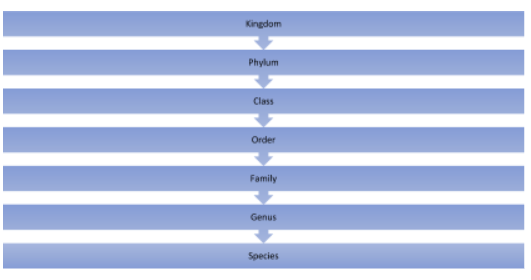
So, the correct answer is “Option B”.
Note: 1. The term "alpha taxonomy" is mainly used today to refer to the discipline of finding, describing, and naming taxa, particularly species.
2. William Bertram Turrill introduced the term "alpha taxonomy" in a series of papers in which he discussed the philosophy and possible future directions of the discipline of taxonomy.
3. Ernst Mayr in 1968 defined "beta taxonomy" as the classification of ranks higher than species.
The scientific work of deciding how to define species has been called Micro taxonomy.
Macro taxonomy is the study of groups at the higher taxonomic rank, sub-genus.
Complete answer: The science of naming, defining and classifying groups of biological organisms on the basis of shared characteristics is known as Taxonomy.
1. Organisms are grouped together into taxa and these groups are given a taxonomic rank
2. The groups of a given rank can be aggregated to form a super-group of higher rank, thus creating a taxonomic hierarchy.
3. The principal ranks in modern use are domain, kingdom, phylum (division is sometimes used in botany in place of phylum), class, order, family, genus, and species.
4. The Swedish botanist Carl Linnaeus is regarded as the founder of the current system of taxonomy.
5. He developed a system known as Linnaean taxonomy for categorizing organisms and binomial nomenclature for naming organisms.
The classification in descending order is-
So, the correct answer is “Option B”.
Note: 1. The term "alpha taxonomy" is mainly used today to refer to the discipline of finding, describing, and naming taxa, particularly species.
2. William Bertram Turrill introduced the term "alpha taxonomy" in a series of papers in which he discussed the philosophy and possible future directions of the discipline of taxonomy.
3. Ernst Mayr in 1968 defined "beta taxonomy" as the classification of ranks higher than species.
The scientific work of deciding how to define species has been called Micro taxonomy.
Macro taxonomy is the study of groups at the higher taxonomic rank, sub-genus.
Recently Updated Pages
Master Class 11 Computer Science: Engaging Questions & Answers for Success

Master Class 11 Business Studies: Engaging Questions & Answers for Success
Master Class 11 Economics: Engaging Questions & Answers for Success
Master Class 11 English: Engaging Questions & Answers for Success
Master Class 11 Maths: Engaging Questions & Answers for Success
Master Class 11 Biology: Engaging Questions & Answers for Success
Trending doubts
One Metric ton is equal to kg A 10000 B 1000 C 100 class 11 physics CBSE
There are 720 permutations of the digits 1 2 3 4 5 class 11 maths CBSE
Discuss the various forms of bacteria class 11 biology CBSE
Draw a diagram of a plant cell and label at least eight class 11 biology CBSE
State the laws of reflection of light
10 examples of friction in our daily life