




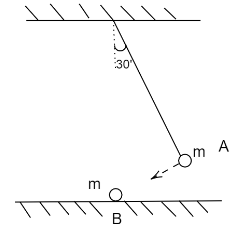
The bob of a pendulum released from ${30^ \circ }$ to the vertical hits another bob $B$ of the same mass at rest on the table as shown in the figure below. How high does the bob $A$ rise after the collision? Neglect the size of the bobs and assume the collision to be elastic.
Answer
 Verified
548.4k+ views
Hint:Apply law of conservation of momentum –The momentum that characterizes the motion of an isolated system remains constant. The total momentum of a system remains constant in any interaction if no external force is acted on the system.
Complete step by step answer:
Before the collision,let the speed of bob $A$ be $v$ and the speed of bob $B$ is $u = 0$.After the collision the speed of bob $A$ becomes ${v_1}$ and speed of bob $B$ is ${v_2}$.According to law of conservation of momentum,
Initial moment of bob $A$ and $B$ before collision $ = $final momentum after collision of bob $A$ and $B$
$mv + mu = m{v_1} + m{v_2}$
$\Rightarrow v = {v_1} + {v_2}$…(i)
For a perfectly elastic collision coefficient of Restitution is $e = 1$.
$e = \dfrac{{{v_2} - {v_1}}}{{v + u}} \\
\Rightarrow e= \dfrac{{{v_2} - {v_1}}}{v}$
$\because e = 1$
$v = {v_1} - {v_2}$…(ii)
Solving (i) and (ii) we get,
$\therefore {v_1} = 0$
Therefore, bob $A$ will not rise since the speed becomes zero and the bob comes to rest.
Note:An elastic collision is a collision in which there is no loss in kinetic energy in the system as a result of collision. It is observed in an elastic collision that after the initial speeds of the two bodies get exchanged after collision. In the above situation also bob $B$ was at rest and bob $A$ was in motion but after collision bob $A$ comes to rest. In inelastic collision there is loss in energy which gets dissipated during the interaction.
Complete step by step answer:
Before the collision,let the speed of bob $A$ be $v$ and the speed of bob $B$ is $u = 0$.After the collision the speed of bob $A$ becomes ${v_1}$ and speed of bob $B$ is ${v_2}$.According to law of conservation of momentum,
Initial moment of bob $A$ and $B$ before collision $ = $final momentum after collision of bob $A$ and $B$
$mv + mu = m{v_1} + m{v_2}$
$\Rightarrow v = {v_1} + {v_2}$…(i)
For a perfectly elastic collision coefficient of Restitution is $e = 1$.
$e = \dfrac{{{v_2} - {v_1}}}{{v + u}} \\
\Rightarrow e= \dfrac{{{v_2} - {v_1}}}{v}$
$\because e = 1$
$v = {v_1} - {v_2}$…(ii)
Solving (i) and (ii) we get,
$\therefore {v_1} = 0$
Therefore, bob $A$ will not rise since the speed becomes zero and the bob comes to rest.
Note:An elastic collision is a collision in which there is no loss in kinetic energy in the system as a result of collision. It is observed in an elastic collision that after the initial speeds of the two bodies get exchanged after collision. In the above situation also bob $B$ was at rest and bob $A$ was in motion but after collision bob $A$ comes to rest. In inelastic collision there is loss in energy which gets dissipated during the interaction.
Recently Updated Pages
Basicity of sulphurous acid and sulphuric acid are

Master Class 11 English: Engaging Questions & Answers for Success
Master Class 11 Physics: Engaging Questions & Answers for Success
Master Class 11 Computer Science: Engaging Questions & Answers for Success
Master Class 11 Chemistry: Engaging Questions & Answers for Success
Master Class 11 Social Science: Engaging Questions & Answers for Success
Trending doubts
Difference Between Prokaryotic Cells and Eukaryotic Cells
Two of the body parts which do not appear in MRI are class 11 biology CBSE
One Metric ton is equal to kg A 10000 B 1000 C 100 class 11 physics CBSE
10 examples of friction in our daily life
Draw a diagram of nephron and explain its structur class 11 biology CBSE
What will happen if the mucus is not secreted by the class 11 biology CBSE