




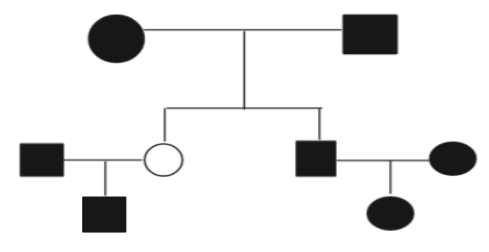
The Black hair of guinea pigs is produced by a dominant gene B and white by its recessive allele b. Unless there is evidence to the contrary, assume II1 and II4 do not carry the recessive allele. What is the probability of finding recessive offspring of \[III-1 \times III-2\]?
a. $\dfrac{1}{4}$
b. $\dfrac{1}{8}$
c. $\dfrac{1}{2}$
d. $\dfrac{1}{{12}}$
Answer
 Verified
571.8k+ views
Hint: Dominant refers to the interaction between a gene's two copies. Individuals obtain two copies of each gene from each parent, known as alleles. One allele will be expressed if the alleles of a gene are different; it is the dominant gene. Another allele's influence, called recessive, is concealed or masked. A recessive allele is a variant of a gene that, when passed, must be homozygous to manifest itself in the phenotype.
Complete answer:
Genes decide traits, such as skin, hair, or eye colour. Each gene is made up of two alleles, the mother's one and the father's other. Such alleles may be dominant or recessive either. In other words, when both the alleles are dominant, characteristics are normally conveyed. The allele is said to be recessive if certain traits are missing or not expressed, but present in the parent.
$I-1$ and $I-2$ are heterozygous (Bb) as given in the Question, and $II-1$ and $II-4$, homozygous dominant (BB). To create a plurality of dominant black coloured guinea pigs are crossed with $II-2$ (bb) and $II-3$ (Bb). In the $F_3$ generation, black coloured guinea pigs can be either homozygous dominant or heterozygous dominant. However, if we consider the chance of discovering \[III-1 \times III-2\] recessive offspring, it will be $\dfrac{1}{8}$.
Hence, the correct answer is option (B).
Note: The three laws of inheritance given by Mendel are -
• The Law of Dominance
• The Law of Segregation and
• The Law of Independent Assortment.
These laws came into existence in many different characteristics through experiments on pea plants. Hybrid offspring can be the dominant trait in the phenotype, according to the rule of dominance.
Complete answer:
Genes decide traits, such as skin, hair, or eye colour. Each gene is made up of two alleles, the mother's one and the father's other. Such alleles may be dominant or recessive either. In other words, when both the alleles are dominant, characteristics are normally conveyed. The allele is said to be recessive if certain traits are missing or not expressed, but present in the parent.
$I-1$ and $I-2$ are heterozygous (Bb) as given in the Question, and $II-1$ and $II-4$, homozygous dominant (BB). To create a plurality of dominant black coloured guinea pigs are crossed with $II-2$ (bb) and $II-3$ (Bb). In the $F_3$ generation, black coloured guinea pigs can be either homozygous dominant or heterozygous dominant. However, if we consider the chance of discovering \[III-1 \times III-2\] recessive offspring, it will be $\dfrac{1}{8}$.
Hence, the correct answer is option (B).
Note: The three laws of inheritance given by Mendel are -
• The Law of Dominance
• The Law of Segregation and
• The Law of Independent Assortment.
These laws came into existence in many different characteristics through experiments on pea plants. Hybrid offspring can be the dominant trait in the phenotype, according to the rule of dominance.
Recently Updated Pages
Basicity of sulphurous acid and sulphuric acid are

Master Class 12 English: Engaging Questions & Answers for Success
Master Class 12 Social Science: Engaging Questions & Answers for Success
Master Class 12 Maths: Engaging Questions & Answers for Success
Master Class 12 Economics: Engaging Questions & Answers for Success
Master Class 12 Physics: Engaging Questions & Answers for Success
Trending doubts
Which are the Top 10 Largest Countries of the World?
Draw a labelled sketch of the human eye class 12 physics CBSE
Draw ray diagrams each showing i myopic eye and ii class 12 physics CBSE
Give 10 examples of unisexual and bisexual flowers
Coming together federation is practiced in A India class 12 social science CBSE
Write the formula to find the shortest distance between class 12 maths CBSE