




The biggest stuffed animal in the world is a snake $420m$ long, constructed by Norwegian children. Suppose the snake is laid out in a park as shown in above figure, forming two straight sides of an angle of ${105^ \circ }$, with one side $240m$ long. Olaf and Inge run a race they invent. Inge runs directly from the tail of the snake to its head, and Olaf starts from the same place at the same moment but runs along the snake.
(a) If both children run steadily at $12.0km/h$ , Inge reaches the head of the snake how much earlier than Olaf?
(b) If Inge runs the race again at a constant speed of $12.0km/h$ , at what constant speed must Olaf run to reach the end of the snake at the same time as Inge?
Answer
 Verified
557.1k+ views
Hint: For the first part of the question, let, the tail of the snake is along the x-axis. Then, find the displacement from tail to head of the snake and thereafter, calculate the time taken by each child, using the formula, speed = distance/time. And, for the second part, using the same formula of velocity, find the speed of Olaf, if he must reach the end of the snake at the same time as Inge.
Complete step by step answer:
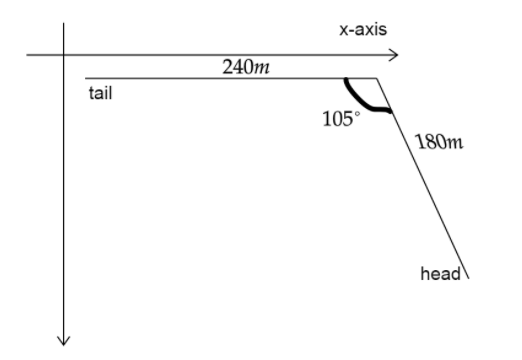
When the snake is laid out in a park forming two straight sides of an angle of ${105^ \circ }$, then one side is $240m$ long. Therefore, length of another side is-
$ = (420 - 240)m$
$ = 180m$ .
Now, take the x-axis along the tail of the snake.
So, the displacement from the tail of the snake to its head will be,
$(240m)\hat i + 180m\{ \cos ({180^ \circ } - {105^ \circ })\} \hat i - 180m(\sin {75^ \circ })\hat j$
$ = (240 + 180 \times 0.2588)m\hat i - (180 \times 0.9659)m\hat j$
$ = 287m\hat i - 174m\hat j$ ,(taking the values approximately)
And, the magnitude of this, is-
$\sqrt {{{(287)}^2} + {{(174)}^2}} m$
$ = 355m$
As, we know, speed = distance/time, so, the time required for each child’s run is –
For Inge:
$\Delta t = \dfrac{d}{v}$
$ = \dfrac{{335m(h)(1km)(3600s)}}{{(12km)(1000m)(1h)}}$
$ = 101s$
For Olaf:
$\Delta t = \dfrac{{420m.s}}{{3.33m}}$
$ = 126s$ .
Therefore, Inge reaches the head of the snake $(126 - 101)s = 25s$ earlier than Olaf.
So, for the part (a), the correct answer is $25s$ .
Now, for the part (b),
We have, Olaf has to reach the end of the snake at the same time as Inge, when Inge runs the race at a constant speed of $12.0km/h$
Let, Olaf must run at the constant speed $v$ $km/h$ .
Therefore, using the formula, $v = \dfrac{d}{{\Delta t}}$ , we get,
$v = \dfrac{{420m}}{{101s}}\left( {\dfrac{{3600s}}{{1h}}} \right)\left( {\dfrac{{km}}{{{{10}^3}m}}} \right)$
$ = 15.0km/h$ .
So, Olaf must run the race at constant speed $15km/h$ to reach the end of the snake at the same time as Inge, when Inge runs at a constant speed of $12km/h$ .
Hence, the correct answer is option (B).
Note: For part (a), we know, magnitude of a vector $\vec a = {a_1}\hat i + {a_2}\hat j + {a_3}\hat k$ is, $a = \sqrt {{a_1}^2 + {a_2}^2 + {a_3}^2} $ . Using this formula, we have found the magnitude of the displacement from the tail of the snake to its head. And, in both parts, speed is calculated from the definition, ‘the time rate of change of distance is known as speed’.
Complete step by step answer:
When the snake is laid out in a park forming two straight sides of an angle of ${105^ \circ }$, then one side is $240m$ long. Therefore, length of another side is-
$ = (420 - 240)m$
$ = 180m$ .
Now, take the x-axis along the tail of the snake.
So, the displacement from the tail of the snake to its head will be,
$(240m)\hat i + 180m\{ \cos ({180^ \circ } - {105^ \circ })\} \hat i - 180m(\sin {75^ \circ })\hat j$
$ = (240 + 180 \times 0.2588)m\hat i - (180 \times 0.9659)m\hat j$
$ = 287m\hat i - 174m\hat j$ ,(taking the values approximately)
And, the magnitude of this, is-
$\sqrt {{{(287)}^2} + {{(174)}^2}} m$
$ = 355m$
As, we know, speed = distance/time, so, the time required for each child’s run is –
For Inge:
$\Delta t = \dfrac{d}{v}$
$ = \dfrac{{335m(h)(1km)(3600s)}}{{(12km)(1000m)(1h)}}$
$ = 101s$
For Olaf:
$\Delta t = \dfrac{{420m.s}}{{3.33m}}$
$ = 126s$ .
Therefore, Inge reaches the head of the snake $(126 - 101)s = 25s$ earlier than Olaf.
So, for the part (a), the correct answer is $25s$ .
Now, for the part (b),
We have, Olaf has to reach the end of the snake at the same time as Inge, when Inge runs the race at a constant speed of $12.0km/h$
Let, Olaf must run at the constant speed $v$ $km/h$ .
Therefore, using the formula, $v = \dfrac{d}{{\Delta t}}$ , we get,
$v = \dfrac{{420m}}{{101s}}\left( {\dfrac{{3600s}}{{1h}}} \right)\left( {\dfrac{{km}}{{{{10}^3}m}}} \right)$
$ = 15.0km/h$ .
So, Olaf must run the race at constant speed $15km/h$ to reach the end of the snake at the same time as Inge, when Inge runs at a constant speed of $12km/h$ .
Hence, the correct answer is option (B).
Note: For part (a), we know, magnitude of a vector $\vec a = {a_1}\hat i + {a_2}\hat j + {a_3}\hat k$ is, $a = \sqrt {{a_1}^2 + {a_2}^2 + {a_3}^2} $ . Using this formula, we have found the magnitude of the displacement from the tail of the snake to its head. And, in both parts, speed is calculated from the definition, ‘the time rate of change of distance is known as speed’.
Recently Updated Pages
Master Class 11 Business Studies: Engaging Questions & Answers for Success

Master Class 11 Economics: Engaging Questions & Answers for Success
Master Class 11 Computer Science: Engaging Questions & Answers for Success
Master Class 11 English: Engaging Questions & Answers for Success
Master Class 11 Maths: Engaging Questions & Answers for Success
Master Class 11 Biology: Engaging Questions & Answers for Success
Trending doubts
One Metric ton is equal to kg A 10000 B 1000 C 100 class 11 physics CBSE
Discuss the various forms of bacteria class 11 biology CBSE
Draw a diagram of a plant cell and label at least eight class 11 biology CBSE
State the laws of reflection of light
Explain zero factorial class 11 maths CBSE
10 examples of friction in our daily life