




The \[BC{{l}_{3}}\] is planar molecule, whereas \[NC{{l}_{3}}\] is a pyramidal because:
a.) N — Cl bond more covalent bond than B — Cl bond.
b.) B — Cl bond is more polar than N — Cl bond.
c.) nitrogen atom is similar to boron atom.
d.) \[BC{{l}_{3}}\] has no lone pair but \[NC{{l}_{3}}\] has a lone pair or electrons.
Answer
 Verified
640.8k+ views
Hint: Molecular geometry is the three-dimensional arrangement of a molecule constituting the general shape as well as the bond length, bond angle and other geometrical parameters that is useful for determining the position of each atom.
Complete step by step solution:
According to the valence shell electron pair repulsion theory (VSEPR), molecules try to attain a geometry that minimizes the repulsion between electrons in the valence shell of the atom.
The valence shell is taken as a sphere and with electrons localizing on the spherical surface at maximum distance from one another.
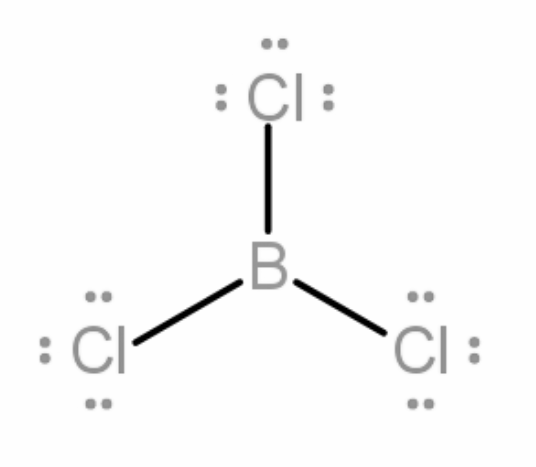
Now given in the question \[BC{{l}_{3}}\] is a planar molecule, we know that boron has 3 valence electrons, it will form a covalent bond with each of the chlorine atoms. Therefore, 3 bond pairs will be formed. There will be no lone pairs as all the valence electrons of boron will make a bond with the 3 chlorine atoms.
Now the molecule will try to attain a geometry that minimizes the repulsion between the bond pair - bond pair, forming an angle of 120 degree between all the bonds.
On arranging all the bond pairs \[BC{{l}_{3}}\] forms a trigonal planar shape.
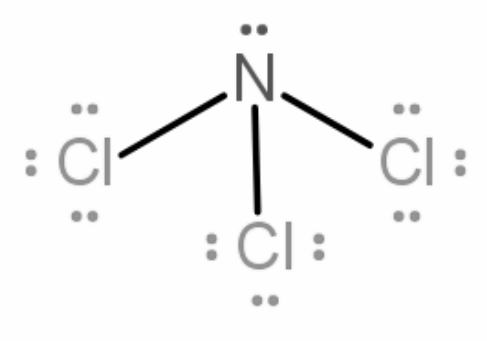
Similarly, in \[NC{{l}_{3}}\], Nitrogen has 5 valence electrons, it will form a covalent bond with each of the chlorine atoms. Therefore, 3 bond pairs will be formed. There will be one lone pair left as only 3 of the 5 valence electrons are used in bond formation.
Now the molecule will try to attain a geometry that minimizes the repulsion between the bond pair - lone pair, forming an angle of 109.5 degree between all the bonds.
On arranging all the bond pairs \[NC{{l}_{3}}\] forms a pyramidal shape.
Therefore, we can conclude that the \[BC{{l}_{3}}\] is planar because it has no lone pairs and \[NC{{l}_{3}}\] is pyramidal as it has one lone pair of electrons. So, the correct option is (d).
Note: Geometry of a molecule is the arrangement of (lone pair + bond pair) around the central atom and it corresponds to the coordination number of the molecule while shape is the structure of the molecule excluding the lone pair on the central atom. Lone pairs are not considered when we determine the shape of the molecules.
Complete step by step solution:
According to the valence shell electron pair repulsion theory (VSEPR), molecules try to attain a geometry that minimizes the repulsion between electrons in the valence shell of the atom.
The valence shell is taken as a sphere and with electrons localizing on the spherical surface at maximum distance from one another.
Now given in the question \[BC{{l}_{3}}\] is a planar molecule, we know that boron has 3 valence electrons, it will form a covalent bond with each of the chlorine atoms. Therefore, 3 bond pairs will be formed. There will be no lone pairs as all the valence electrons of boron will make a bond with the 3 chlorine atoms.
Now the molecule will try to attain a geometry that minimizes the repulsion between the bond pair - bond pair, forming an angle of 120 degree between all the bonds.
On arranging all the bond pairs \[BC{{l}_{3}}\] forms a trigonal planar shape.
Similarly, in \[NC{{l}_{3}}\], Nitrogen has 5 valence electrons, it will form a covalent bond with each of the chlorine atoms. Therefore, 3 bond pairs will be formed. There will be one lone pair left as only 3 of the 5 valence electrons are used in bond formation.
Now the molecule will try to attain a geometry that minimizes the repulsion between the bond pair - lone pair, forming an angle of 109.5 degree between all the bonds.
On arranging all the bond pairs \[NC{{l}_{3}}\] forms a pyramidal shape.
Therefore, we can conclude that the \[BC{{l}_{3}}\] is planar because it has no lone pairs and \[NC{{l}_{3}}\] is pyramidal as it has one lone pair of electrons. So, the correct option is (d).
Note: Geometry of a molecule is the arrangement of (lone pair + bond pair) around the central atom and it corresponds to the coordination number of the molecule while shape is the structure of the molecule excluding the lone pair on the central atom. Lone pairs are not considered when we determine the shape of the molecules.
Recently Updated Pages
Master Class 11 English: Engaging Questions & Answers for Success

Master Class 11 Social Science: Engaging Questions & Answers for Success
Master Class 11 Maths: Engaging Questions & Answers for Success
Master Class 11 Biology: Engaging Questions & Answers for Success
Master Class 11 Physics: Engaging Questions & Answers for Success
Master Class 11 Chemistry: Engaging Questions & Answers for Success
Trending doubts
One Metric ton is equal to kg A 10000 B 1000 C 100 class 11 physics CBSE
Difference Between Prokaryotic Cells and Eukaryotic Cells
Find the value of the expression given below sin 30circ class 11 maths CBSE
Difference between physical and chemical change class 11 chemistry CBSE
Two of the body parts which do not appear in MRI are class 11 biology CBSE
Draw a diagram of a plant cell and label at least eight class 11 biology CBSE