




The basic character of oxides MgO, SrO, \[{K_2}O\] , NiO, and \[C{s_2}O\] increase in the order:
A. \[MgO > SrO > {K_2}O > NiO > C{s_2}O\]
B. \[C{s_2}O < {K_2}O < MgO < SrO < NiO\]
C. \[NiO < MgO < SrO < {K_2}O < C{s_2}O\]
D. \[{K_2}O < NiO < MgO < SrO < C{s_2}O\]
Answer
 Verified
651.3k+ views
Hint: To solve this question, we must first understand the concepts of acidity and basicity. Then we need to identify the variation in the basic character of elements according to their position in the periodic table to get the final answer.
Complete Step-by-Step Answer:
Before we move forward with the solution of the given question, let us first understand some important basic concepts.
Acidity and basicity are two characteristics that are dependent on the electronic configuration of the atoms and molecules under consideration. If a given atom has a valence shell that is filled at more than half its capacity, i.e. greater than its half-shell electronic configuration. Then to achieve more stability, this atom would tend to accept electrons from external chemical species. These atoms also exhibit high levels of electronegativity and are known as acidic chemical species.
On the other hand, if a given atom has a valence shell that is filled at less than half its capacity, then these atoms tend to donate these valence electrons to achieve more stable electronic configuration. Such chemical species are known as basic chemical species.
When metals form compounds with oxygen, it results in the formation of basic oxide compounds. The degree of basicity of these oxides indirectly depends on the position of the metal in the periodic table. As we move from left to right in a period, the electronegativity of the elements increases. Because of this, the basic character decreases. On the other hand, as we move from top to bottom in a group, the effective nuclear charge on the atoms decreases. Because of this, the basic character increases as we move from top to bottom in a group.
The positions of the elements given to us can be identified from the periodic table:
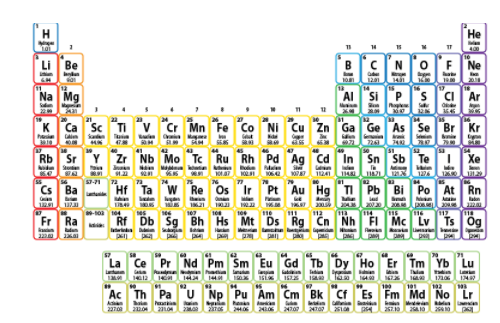
Hence, on the basis of the discussion done above, we can conclude that the basic character of the oxides of the given elements increase in the order:
\[NiO < MgO < SrO < {K_2}O < C{s_2}O\]
Hence, Option C is the correct option
Note: Just like metal oxides are basic in nature, the oxides formed by non – metals are acidic in nature. Another trend to be kept in mind is that oxides of alkali earth metals are less basic than alkali earth metals.
Complete Step-by-Step Answer:
Before we move forward with the solution of the given question, let us first understand some important basic concepts.
Acidity and basicity are two characteristics that are dependent on the electronic configuration of the atoms and molecules under consideration. If a given atom has a valence shell that is filled at more than half its capacity, i.e. greater than its half-shell electronic configuration. Then to achieve more stability, this atom would tend to accept electrons from external chemical species. These atoms also exhibit high levels of electronegativity and are known as acidic chemical species.
On the other hand, if a given atom has a valence shell that is filled at less than half its capacity, then these atoms tend to donate these valence electrons to achieve more stable electronic configuration. Such chemical species are known as basic chemical species.
When metals form compounds with oxygen, it results in the formation of basic oxide compounds. The degree of basicity of these oxides indirectly depends on the position of the metal in the periodic table. As we move from left to right in a period, the electronegativity of the elements increases. Because of this, the basic character decreases. On the other hand, as we move from top to bottom in a group, the effective nuclear charge on the atoms decreases. Because of this, the basic character increases as we move from top to bottom in a group.
The positions of the elements given to us can be identified from the periodic table:
Hence, on the basis of the discussion done above, we can conclude that the basic character of the oxides of the given elements increase in the order:
\[NiO < MgO < SrO < {K_2}O < C{s_2}O\]
Hence, Option C is the correct option
Note: Just like metal oxides are basic in nature, the oxides formed by non – metals are acidic in nature. Another trend to be kept in mind is that oxides of alkali earth metals are less basic than alkali earth metals.
Recently Updated Pages
Write structures of the following compounds i 2 Chloro3methylpentane class 11 chemistry CBSE

What is BLO What is the full form of BLO class 8 social science CBSE
Explain the Treaty of Vienna of 1815 class 10 social science CBSE
A Paragraph on Pollution in about 100-150 Words
XIX+XXX A 49 B 51 C 55 D 44 class 5 maths CBSE
If x a + bt + ct2 where x is in meters and t is in class 11 physics CBSE
Trending doubts
One Metric ton is equal to kg A 10000 B 1000 C 100 class 11 physics CBSE
Draw a diagram of nephron and explain its structur class 11 biology CBSE
10 examples of friction in our daily life
Proton was discovered by A Thomson B Rutherford C Chadwick class 11 chemistry CBSE
Bond order ofO2 O2+ O2 and O22 is in order A O2 langle class 11 chemistry CBSE
Draw a labelled diagram of the neuron and describe class 11 biology CBSE