




The base BC of is produced on both sides of it upto points D and E. If\[\angle {\rm{ABD}}\] is greater than\[\angle {\rm{ACE}}\], then which of the following is not true?
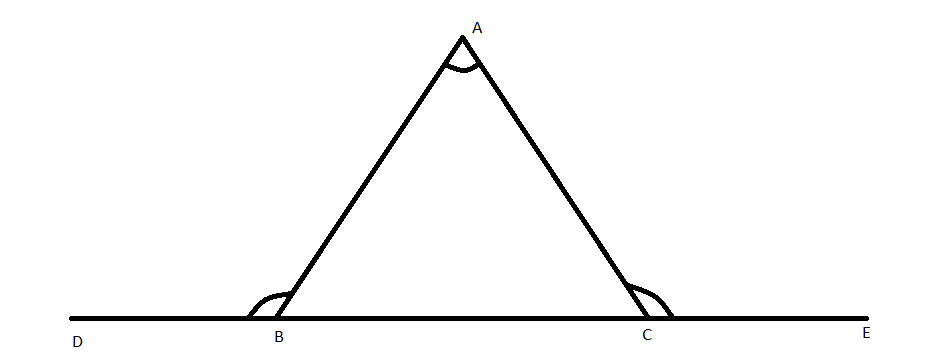
A) \[\angle {\rm{ABC}}\]is smaller than\[\angle {\rm{ACB}}\]
B) AC is greater than AB
C) AB is greater than AC
D) \[{\rm{AB + AC > BC}}\]
Answer
 Verified
574.5k+ views
Hint:
Here we have to use the basic calculation of angles of a triangle to find which statement is not true. Firstly we will take the condition given in the question and then by simplifying and solving that condition we will get another satisfying condition and then we will see the contradicting statement of this new condition given in the options and that is the answer of the question.
Complete step by step solution:
Here in this question we have to find out the not true statement.
It is given that for the,\[\angle {\rm{ABD}} > \angle {\rm{ACE}}\]
Now we have to simplify this given condition and solve it to get another satisfying condition. Therefore, we get
\[\angle {\rm{ABD}} > \angle {\rm{ACE}}\]
If the above condition is true then the greater than sign will change If we will subtract these angles from\[{180^0}\]. So, we get
\[\left( {{{180}^0} - \angle {\rm{ABD}}} \right) < \left( {{{180}^0} - \angle {\rm{ACE}}} \right)\]
We can write it as
\[\angle {\rm{ABC}} < \angle {\rm{ACB}}\]
We know that if the two angles of a triangle are equal then the sides opposite to them are always equal. Similarly we can apply this concept here. As we know that the angle \[\angle {\rm{ABC}}\]is less than the angle \[\angle {\rm{ACB}}\]then the side AC is smaller than the side AB.
Therefore, side AC is smaller than side AB.
Hence, statement in option B is contradicting this condition.
So, option B is the correct option.
Note:
Here we have to keep note of the greater than or smaller than condition because a little mistake in that we give the wrong condition then we will get the wrong answer. We should know that in a triangle if the two angles of a triangle are equal then the sides opposite to them are always equal. Vertically Opposite Angles (vertical angles) are the angles opposite each other when two lines intersect or cross each other and pairs of vertically opposite angles (vertical angles) are always equal to each other.
Here we have to use the basic calculation of angles of a triangle to find which statement is not true. Firstly we will take the condition given in the question and then by simplifying and solving that condition we will get another satisfying condition and then we will see the contradicting statement of this new condition given in the options and that is the answer of the question.
Complete step by step solution:
Here in this question we have to find out the not true statement.
It is given that for the,\[\angle {\rm{ABD}} > \angle {\rm{ACE}}\]
Now we have to simplify this given condition and solve it to get another satisfying condition. Therefore, we get
\[\angle {\rm{ABD}} > \angle {\rm{ACE}}\]
If the above condition is true then the greater than sign will change If we will subtract these angles from\[{180^0}\]. So, we get
\[\left( {{{180}^0} - \angle {\rm{ABD}}} \right) < \left( {{{180}^0} - \angle {\rm{ACE}}} \right)\]
We can write it as
\[\angle {\rm{ABC}} < \angle {\rm{ACB}}\]
We know that if the two angles of a triangle are equal then the sides opposite to them are always equal. Similarly we can apply this concept here. As we know that the angle \[\angle {\rm{ABC}}\]is less than the angle \[\angle {\rm{ACB}}\]then the side AC is smaller than the side AB.
Therefore, side AC is smaller than side AB.
Hence, statement in option B is contradicting this condition.
So, option B is the correct option.
Note:
Here we have to keep note of the greater than or smaller than condition because a little mistake in that we give the wrong condition then we will get the wrong answer. We should know that in a triangle if the two angles of a triangle are equal then the sides opposite to them are always equal. Vertically Opposite Angles (vertical angles) are the angles opposite each other when two lines intersect or cross each other and pairs of vertically opposite angles (vertical angles) are always equal to each other.
Recently Updated Pages
Master Class 10 Computer Science: Engaging Questions & Answers for Success

Master Class 10 General Knowledge: Engaging Questions & Answers for Success
Master Class 10 English: Engaging Questions & Answers for Success
Master Class 10 Social Science: Engaging Questions & Answers for Success
Master Class 10 Maths: Engaging Questions & Answers for Success
Master Class 10 Science: Engaging Questions & Answers for Success
Trending doubts
What is the median of the first 10 natural numbers class 10 maths CBSE
Which women's tennis player has 24 Grand Slam singles titles?
Who is the Brand Ambassador of Incredible India?
Why is there a time difference of about 5 hours between class 10 social science CBSE
Write a letter to the principal requesting him to grant class 10 english CBSE
A moving boat is observed from the top of a 150 m high class 10 maths CBSE