




The base and the corresponding altitude of a parallelogram are 10cm and 3.5cm, respectively. The area of the parallelogram is
\[\begin{align}
& A.30c{{m}^{2}} \\
& B.35c{{m}^{2}} \\
& C.70c{{m}^{2}} \\
& D.17.5c{{m}^{2}} \\
\end{align}\]
Answer
 Verified
654.9k+ views
Hint: First draw the parallelogram and name the vertices. Draw the altitude in the parallelogram. Mark the distances given in the question. Now apply formula for area of parallelogram. \[\text{Area of parallelogram}=\text{base }\times \text{ height}\text{.}\]
Complete step-by-step answer:
First draw a parallelogram ABCD vertices, \[AB\parallel \,CD\]sides:
Drop a perpendicular from D on to AB.
Mark the foot of perpendicular as P.
As per given condition, the base length we can say:
\[AB=10cm\]
As per the second condition, we can say length of altitude will be:
\[Altitude=3.5cm\]
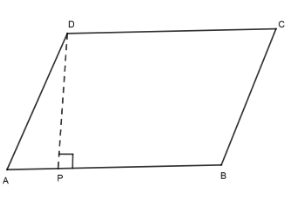
Parallelogram: - In Euclidean geometry a parallelogram is a simple quadrilateral with two parts of opposite parallel sides. The opposite or facing sides of a parallelogram are of equal length and opposite angles are of equal measures.
Altitude: - The altitude or height of parallelogram is the perpendicular distance from base to the opposite side (which may have to be extended). In the figure above the altitude corresponding to base AB is shown.
Area of parallelogram: - The area of parallelogram is found by multiplying base and height.
\[A=B\times H\]
By the given equation, we can say value of base B as:
\[B=10cm\]
By definition of altitude, we can say altitude is nothing but height. So, from the question, we can say value of height H as:
\[H=3.5cm\]
By substituting these values into area formula, we get it as:
\[A=B\times H=3.5\times 10\]
By simplifying the base into a fraction, we get it as:
\[A=\dfrac{35}{10}\times 10\]
By cancelling the common terms, we can write it as:
\[A=35\text{ sq units}\]
As both the lengths are in cm, we can say area to be:
\[A=35c{{m}^{2}}\]
So, the correct answer is “Option B”.
Note: Be careful while using definitions. Generally students confuse between altitudes, height. They both are one and the same. While dropping perpendicular, see that the altitude is perpendicular to base, if you draw perpendicular to opposite side then you cannot apply the formula of area. Because height in the formula of area is perpendicular to the box.
Complete step-by-step answer:
First draw a parallelogram ABCD vertices, \[AB\parallel \,CD\]sides:
Drop a perpendicular from D on to AB.
Mark the foot of perpendicular as P.
As per given condition, the base length we can say:
\[AB=10cm\]
As per the second condition, we can say length of altitude will be:
\[Altitude=3.5cm\]
Parallelogram: - In Euclidean geometry a parallelogram is a simple quadrilateral with two parts of opposite parallel sides. The opposite or facing sides of a parallelogram are of equal length and opposite angles are of equal measures.
Altitude: - The altitude or height of parallelogram is the perpendicular distance from base to the opposite side (which may have to be extended). In the figure above the altitude corresponding to base AB is shown.
Area of parallelogram: - The area of parallelogram is found by multiplying base and height.
\[A=B\times H\]
By the given equation, we can say value of base B as:
\[B=10cm\]
By definition of altitude, we can say altitude is nothing but height. So, from the question, we can say value of height H as:
\[H=3.5cm\]
By substituting these values into area formula, we get it as:
\[A=B\times H=3.5\times 10\]
By simplifying the base into a fraction, we get it as:
\[A=\dfrac{35}{10}\times 10\]
By cancelling the common terms, we can write it as:
\[A=35\text{ sq units}\]
As both the lengths are in cm, we can say area to be:
\[A=35c{{m}^{2}}\]
So, the correct answer is “Option B”.
Note: Be careful while using definitions. Generally students confuse between altitudes, height. They both are one and the same. While dropping perpendicular, see that the altitude is perpendicular to base, if you draw perpendicular to opposite side then you cannot apply the formula of area. Because height in the formula of area is perpendicular to the box.
Recently Updated Pages
Differentiate between voluntary action and reflex class 10 biology CBSE

The uses of bleaching powder are A It is used bleaching class 10 chemistry CBSE
Fill in the blanks with abstract nouns of the words class 10 english CBSE
How many threedigit numbers are there class 10 maths CBSE
What is a reflex arc class 10 biology CBSE
Construct a square whose diagonal is 6cm Measure the class 10 maths CBSE
Trending doubts
Explain the Treaty of Vienna of 1815 class 10 social science CBSE
The slogan Jai Hind was given by A Lal Bahadur Shastri class 10 social science CBSE
10 examples of evaporation in daily life with explanations
What is the full form of POSCO class 10 social science CBSE
Identify the feminine form of noun nephew a shenephew class 10 english CBSE
Make a sketch of the human nerve cell What function class 10 biology CBSE