




The base and height of $ \Delta LMN $ are 8cm and 6cm respectively. The base and height of $ \Delta DEF $ are 10cm and 4cm respectively. Write the ratio $ A\left( \Delta LMN \right):A\left( \Delta DEF \right) $ .
Answer
 Verified
611.1k+ views
Hint: In this question, we are given the base and height of two triangles $ \Delta LMN\text{ and }\Delta DEF $ . We need to find the ratio of their areas. For this, we will find the area of both triangles and then write them in division form to find the ratio. The area of the triangle with base b and the height h is given as,
$ \text{Area}=\dfrac{1}{2}\times b\times h $ .
Complete step by step answer:
Here we are given the base of the triangle $ \Delta LMN $ as 8cm and the height of the triangle $ \Delta LMN $ as 6cm. Also, we have given the base of the triangle $ \Delta DEF $ as 10cm and the height of the triangle $ \Delta DEF $ as 4cm. Let us first find the areas of both triangles one by one. For $ \Delta LMN $, the base of the triangle = 8cm and the height of the triangle = 6cm.
We know the area of a triangle with height h and base b is given by $ \text{Area}=\dfrac{1}{2}\times b\times h $ .
So area of $ \Delta LMN=\dfrac{1}{2}\times 8cm\times 6cm\Rightarrow \dfrac{48}{2}c{{m}^{2}}=24c{{m}^{2}} $ .
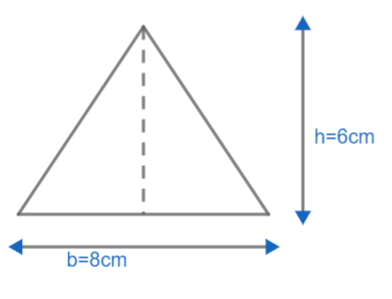
Hence the area of the triangle $ \Delta LMN $ is equal to $ 24c{{m}^{2}} $ .
Now let us find the area of the triangle $ \Delta DEF $ . Base b of the triangle $ \Delta DEF $ = 10cm and height h of the triangle $ \Delta DEF $ = 4cm.
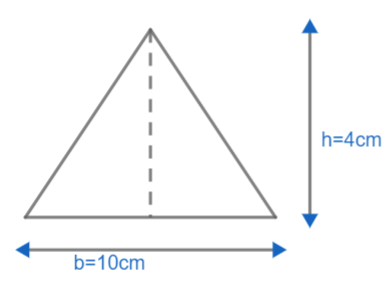
So, area of $ \Delta DEF=\dfrac{1}{2}\times 10cm\times 4cm\Rightarrow \dfrac{40}{2}c{{m}^{2}}=20c{{m}^{2}} $ .
Hence the area of the triangle $ \Delta DEF $ is equal to $ 20c{{m}^{2}} $ .
Now, we need to find the ratio of the areas of both triangles $ \Delta LMN\text{ and }\Delta DEF $ in the form $ A\left( \Delta LMN \right):A\left( \Delta DEF \right) $ .
Let us write both areas in division form to simplify the ratio, we get:
$ \dfrac{A\left( \Delta LMN \right)}{A\left( \Delta DEF \right)}=\dfrac{24c{{m}^{2}}}{20c{{m}^{2}}} $ .
Dividing the numerator and denominator by 4 we get:
$ \dfrac{A\left( \Delta LMN \right)}{A\left( \Delta DEF \right)}=\dfrac{6}{5} $ .
In ratio form, we can write it as,
$ A\left( \Delta LMN \right):A\left( \Delta DEF \right)=6:5 $ .
Hence the required ratio is 6:5.
Note:
Students usually forget about $ \dfrac{1}{2} $ in the formula of the area of a triangle. Make sure to write units after calculating any measurements. Squared units are used for the area. Here base and height were given in centimeters, so the area was found in squared centimeters. While finding the ratio of two quantities, make sure that both the quantities have the same ratio.
$ \text{Area}=\dfrac{1}{2}\times b\times h $ .
Complete step by step answer:
Here we are given the base of the triangle $ \Delta LMN $ as 8cm and the height of the triangle $ \Delta LMN $ as 6cm. Also, we have given the base of the triangle $ \Delta DEF $ as 10cm and the height of the triangle $ \Delta DEF $ as 4cm. Let us first find the areas of both triangles one by one. For $ \Delta LMN $, the base of the triangle = 8cm and the height of the triangle = 6cm.
We know the area of a triangle with height h and base b is given by $ \text{Area}=\dfrac{1}{2}\times b\times h $ .
So area of $ \Delta LMN=\dfrac{1}{2}\times 8cm\times 6cm\Rightarrow \dfrac{48}{2}c{{m}^{2}}=24c{{m}^{2}} $ .
Hence the area of the triangle $ \Delta LMN $ is equal to $ 24c{{m}^{2}} $ .
Now let us find the area of the triangle $ \Delta DEF $ . Base b of the triangle $ \Delta DEF $ = 10cm and height h of the triangle $ \Delta DEF $ = 4cm.
So, area of $ \Delta DEF=\dfrac{1}{2}\times 10cm\times 4cm\Rightarrow \dfrac{40}{2}c{{m}^{2}}=20c{{m}^{2}} $ .
Hence the area of the triangle $ \Delta DEF $ is equal to $ 20c{{m}^{2}} $ .
Now, we need to find the ratio of the areas of both triangles $ \Delta LMN\text{ and }\Delta DEF $ in the form $ A\left( \Delta LMN \right):A\left( \Delta DEF \right) $ .
Let us write both areas in division form to simplify the ratio, we get:
$ \dfrac{A\left( \Delta LMN \right)}{A\left( \Delta DEF \right)}=\dfrac{24c{{m}^{2}}}{20c{{m}^{2}}} $ .
Dividing the numerator and denominator by 4 we get:
$ \dfrac{A\left( \Delta LMN \right)}{A\left( \Delta DEF \right)}=\dfrac{6}{5} $ .
In ratio form, we can write it as,
$ A\left( \Delta LMN \right):A\left( \Delta DEF \right)=6:5 $ .
Hence the required ratio is 6:5.
Note:
Students usually forget about $ \dfrac{1}{2} $ in the formula of the area of a triangle. Make sure to write units after calculating any measurements. Squared units are used for the area. Here base and height were given in centimeters, so the area was found in squared centimeters. While finding the ratio of two quantities, make sure that both the quantities have the same ratio.
Recently Updated Pages
Master Class 11 English: Engaging Questions & Answers for Success

Master Class 11 Social Science: Engaging Questions & Answers for Success
Master Class 11 Maths: Engaging Questions & Answers for Success
Master Class 11 Biology: Engaging Questions & Answers for Success
Master Class 11 Physics: Engaging Questions & Answers for Success
Master Class 11 Chemistry: Engaging Questions & Answers for Success
Trending doubts
Explain the Treaty of Vienna of 1815 class 10 social science CBSE
What is the Total Duration of Football Match?
The shortest day of the year in India
In which year voting age was reduced from 21 to 18?
10 examples of evaporation in daily life with explanations
What planets have no moons Which one has only one moon class 10 physics CBSE