




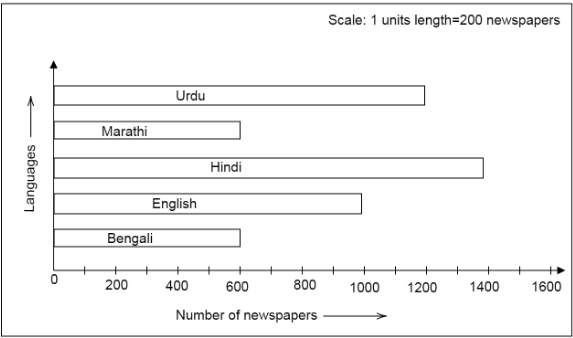
The bar graph given below represents the circulation of newspapers in different languages in a town. Study the bar graph and answer the following questions.
What is the circulation of English newspapers?
Answer
 Verified
619.8k+ views
Hint: We use the depiction of data given in the form of a bar graph to calculate the circulation of English newspapers. Use the scale given for the bar graph. Since this is a horizontal bar graph, we look at the edges of the bars where the bar is ending and draw a vertical line to the axis representing the number of newspapers to calculate the number of newspapers of that particular language.
Complete step-by-step solution:
We are given a bar graph that gives us number of newspapers in each of the five languages i.e. Urdu, Marathi, Hindi, English and Bengali.
We have to calculate the circulation of English newspapers from the bar graph given to us.
Since we know this is a horizontal bar graph, we move from the origin i.e. left side of the graph to the right side of the graph.
To calculate circulation of English newspapers we calculate the point on the axis representing the number of newspapers by drawing a vertical line or dropping a straight vertical line from the edge of the bar representing English language.
We draw a vertical line from the edge of the bar representing English to the axis representing the number of newspapers.
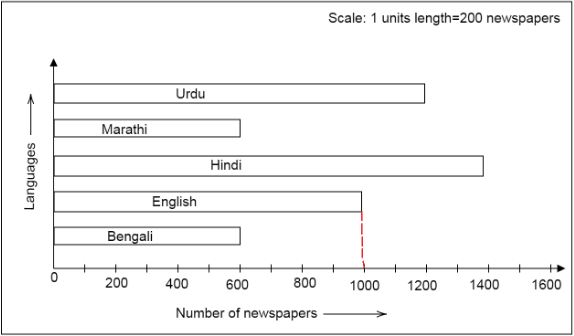
We see that the number of newspapers of the axis comes out as 1000
\[\therefore \]Circulation of English newspapers is 1000
Note: Many students get confused with scale of the bar graph as we are already given the measures 200, 400, 600, 800, 1000, 1200 … on the axis representing number of newspapers and then they apply wrong meaning of scale and write each unit as 200, keep in mind the lines between each unit represent exactly half number of newspapers that are represented by 1 unit, i.e. half lines or lines in between the units are 100 newspapers in count.
Complete step-by-step solution:
We are given a bar graph that gives us number of newspapers in each of the five languages i.e. Urdu, Marathi, Hindi, English and Bengali.
We have to calculate the circulation of English newspapers from the bar graph given to us.
Since we know this is a horizontal bar graph, we move from the origin i.e. left side of the graph to the right side of the graph.
To calculate circulation of English newspapers we calculate the point on the axis representing the number of newspapers by drawing a vertical line or dropping a straight vertical line from the edge of the bar representing English language.
We draw a vertical line from the edge of the bar representing English to the axis representing the number of newspapers.
We see that the number of newspapers of the axis comes out as 1000
\[\therefore \]Circulation of English newspapers is 1000
Note: Many students get confused with scale of the bar graph as we are already given the measures 200, 400, 600, 800, 1000, 1200 … on the axis representing number of newspapers and then they apply wrong meaning of scale and write each unit as 200, keep in mind the lines between each unit represent exactly half number of newspapers that are represented by 1 unit, i.e. half lines or lines in between the units are 100 newspapers in count.
Recently Updated Pages
Master Class 11 English: Engaging Questions & Answers for Success

Master Class 11 Physics: Engaging Questions & Answers for Success
Master Class 11 Computer Science: Engaging Questions & Answers for Success
Master Class 11 Chemistry: Engaging Questions & Answers for Success
Master Class 11 Social Science: Engaging Questions & Answers for Success
Master Class 11 Accountancy: Engaging Questions & Answers for Success
Trending doubts
Difference Between Prokaryotic Cells and Eukaryotic Cells
Two of the body parts which do not appear in MRI are class 11 biology CBSE
One Metric ton is equal to kg A 10000 B 1000 C 100 class 11 physics CBSE
10 examples of friction in our daily life
Draw a diagram of nephron and explain its structur class 11 biology CBSE
Draw a diagram of a plant cell and label at least eight class 11 biology CBSE