




The axis of the Earth is inclined to its orbital plane at an angle of:
A. 23.5’
B. 66.5’
C. 25.3’
D. 65.5’
Answer
 Verified
624k+ views
Hint: The word ‘obliquity’ is the name given to the inclination of the plane of the orbit of the earth (tilt in the axis of the earth) by scientists.
Complete step-by-step solution:
The earth has seasons (summer, winter, rainy, and spring) because of the inclination of the plane of the earth’s orbit around the sun.
When the respective hemisphere gets oriented towards the sun, that region of the earth warms with the reason being exposed to the increased solar radiation.
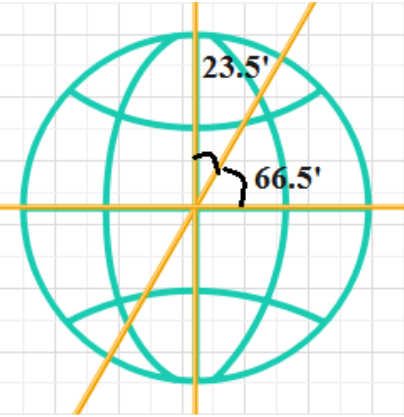
Similarly, when the respective hemisphere gets oriented away from the sun, that region of the earth cools with the reason being exposed to the decreased solar radiation.
The shorter days - longer nights and vice versa are also because of the tilt of the axis of the earth.
The tilt of the earth’s axis is a slowly constantly changing parameter. If this angle/tilt changes, then there will be difficulty in differentiating the seasons.
As the axis of the Earth is inclined to its orbital plane at an angle of 23.5’, thus, option (A) is correct.
Additional information:
The Sun is slightly tilted about 7 degrees.
The Uranus is almost tilted about 97 degrees.
The Mercury is nearly tilted about 0 degrees.
Note: The things to be on your finger-tips for further information on solving these types of problems are: The axis of the earth’s rotation makes an angle equal to 66.5 degrees with the plane of its orbit around the sun, and this tilt is called as the inclination of the earth’s axis.
Complete step-by-step solution:
The earth has seasons (summer, winter, rainy, and spring) because of the inclination of the plane of the earth’s orbit around the sun.
When the respective hemisphere gets oriented towards the sun, that region of the earth warms with the reason being exposed to the increased solar radiation.
Similarly, when the respective hemisphere gets oriented away from the sun, that region of the earth cools with the reason being exposed to the decreased solar radiation.
The shorter days - longer nights and vice versa are also because of the tilt of the axis of the earth.
The tilt of the earth’s axis is a slowly constantly changing parameter. If this angle/tilt changes, then there will be difficulty in differentiating the seasons.
As the axis of the Earth is inclined to its orbital plane at an angle of 23.5’, thus, option (A) is correct.
Additional information:
The Sun is slightly tilted about 7 degrees.
The Uranus is almost tilted about 97 degrees.
The Mercury is nearly tilted about 0 degrees.
Note: The things to be on your finger-tips for further information on solving these types of problems are: The axis of the earth’s rotation makes an angle equal to 66.5 degrees with the plane of its orbit around the sun, and this tilt is called as the inclination of the earth’s axis.
Recently Updated Pages
Master Class 11 English: Engaging Questions & Answers for Success

Master Class 11 Social Science: Engaging Questions & Answers for Success
Master Class 11 Maths: Engaging Questions & Answers for Success
Master Class 11 Biology: Engaging Questions & Answers for Success
Master Class 11 Physics: Engaging Questions & Answers for Success
Master Class 11 Chemistry: Engaging Questions & Answers for Success
Trending doubts
One Metric ton is equal to kg A 10000 B 1000 C 100 class 11 physics CBSE
Difference Between Prokaryotic Cells and Eukaryotic Cells
Find the value of the expression given below sin 30circ class 11 maths CBSE
Difference between physical and chemical change class 11 chemistry CBSE
Two of the body parts which do not appear in MRI are class 11 biology CBSE
Draw a diagram of a plant cell and label at least eight class 11 biology CBSE