




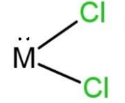
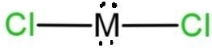
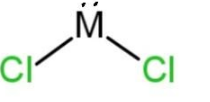
The atomic number of the central atom in $MC{{l}_{2}}$is 50. The shape of gaseous $MC{{l}_{2}}$ is given as:
A.

B.
C.
D.
Answer
 Verified
573.9k+ views
Hint: Shape of any molecule depends upon the bonded pairs of electrons, as well as the non-bonded, free electrons. Shapes of various molecules are derived through VSEPR theory.
Complete step by step solution:
Given is the molecule with formula $MC{{l}_{2}}$, the molecule has atomic number 50. So, the 2 chlorine atoms will have $C{{l}_{2}}$ = 17 + 17 = 34,
Therefore, 34 – 50 = 16, which is the atomic number of the central atom. This means that the central atom is sulfur, S. So the molecule will have two lone pairs and 2 bond pairs of electrons. As the total valence electrons will be 14, 6 from which placed on both the chlorine atoms, remaining 2 lone pairs placed on the sulfur, here M central atom. So, the shape of this molecule will be bent due to the presence of 2 lone pairs and 2 bond pairs. The shape with 2 lone pairs is C, which is
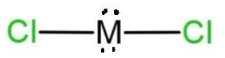
Hence, option C is correct, but the shape is bent.
Note: The shape of molecules is determined by the VSEPR theory, that states that lone pairs are localized on a central atom and occupy more space in comparison with bond pairs, which distorts the shape of the molecule. Hence the two lone pairs are placed on the central atom that changes its shape from linear to bent. This is an example of irregular geometry in VSEPR theory.
Complete step by step solution:
Given is the molecule with formula $MC{{l}_{2}}$, the molecule has atomic number 50. So, the 2 chlorine atoms will have $C{{l}_{2}}$ = 17 + 17 = 34,
Therefore, 34 – 50 = 16, which is the atomic number of the central atom. This means that the central atom is sulfur, S. So the molecule will have two lone pairs and 2 bond pairs of electrons. As the total valence electrons will be 14, 6 from which placed on both the chlorine atoms, remaining 2 lone pairs placed on the sulfur, here M central atom. So, the shape of this molecule will be bent due to the presence of 2 lone pairs and 2 bond pairs. The shape with 2 lone pairs is C, which is
Hence, option C is correct, but the shape is bent.
Note: The shape of molecules is determined by the VSEPR theory, that states that lone pairs are localized on a central atom and occupy more space in comparison with bond pairs, which distorts the shape of the molecule. Hence the two lone pairs are placed on the central atom that changes its shape from linear to bent. This is an example of irregular geometry in VSEPR theory.
Recently Updated Pages
Master Class 11 English: Engaging Questions & Answers for Success

Master Class 11 Social Science: Engaging Questions & Answers for Success
Master Class 11 Maths: Engaging Questions & Answers for Success
Master Class 11 Biology: Engaging Questions & Answers for Success
Master Class 11 Physics: Engaging Questions & Answers for Success
Master Class 11 Chemistry: Engaging Questions & Answers for Success
Trending doubts
One Metric ton is equal to kg A 10000 B 1000 C 100 class 11 physics CBSE
Difference Between Prokaryotic Cells and Eukaryotic Cells
Two of the body parts which do not appear in MRI are class 11 biology CBSE
Find the value of the expression given below sin 30circ class 11 maths CBSE
Draw a diagram of a plant cell and label at least eight class 11 biology CBSE
10 examples of friction in our daily life