




The area velocity of the angular momentum of the planet is related by which of the following relations?
$A.\dfrac{{\vartriangle \bar A}}{{\vartriangle t}} = \dfrac{{\bar L}}{{2{m_p}}}$
$B.\dfrac{{\vartriangle \bar A}}{{\vartriangle t}} = \dfrac{{\bar L}}{{{m_p}}}$
$C.\dfrac{{\vartriangle \bar A}}{{\vartriangle t}} = \dfrac{{2\bar L}}{{{m_p}}}$
$D.\dfrac{{\vartriangle \bar A}}{{\vartriangle t}} = \dfrac{{\bar L}}{{\sqrt {2{m_p}} }}$
Answer
 Verified
651.9k+ views
- Hint – Here we will proceed by using the concept of area velocity is the area swept out per unit time by a particle moving along a curve.
Complete step-by-step solution -
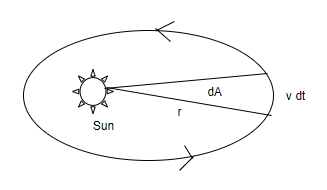
The concept of area velocity is closely linked with the concept of angular momentum. Kepler’s second law states that the area of velocity of a planet, with the sun takes as origin, is constant
Let us consider,
${m_p} = $ mass of the planet.
The angular momentum known as a law of area, $L = {m_p}vr$
$vr = \dfrac{L}{{{m_p}}}$ ….. (1)
Time period, $t = \dfrac{{2\pi r}}{v}$
Total area swapped in time $t,A = \pi {r^2}$
Area velocity, $\dfrac{A}{t} = \dfrac{{\dfrac{{\pi {r^2}}}{{2\pi r}}}}{v} = \dfrac{{vr}}{2}$
From equation 1 we get,
$\dfrac{A}{t} = \dfrac{L}{{2{m_p}}}$
In vector form, a real velocity is given by
$\dfrac{{\bar A}}{t} = \dfrac{{\bar L}}{{2{m_p}}}$
Therefore, A is the correct option.
Note – Whenever we come up with this type of problem, one must know that conservation of areal velocity is a general property of central force motion, and, within the context of classical mechanics, is equivalent to the conservation of angular momentum.
Complete step-by-step solution -
The concept of area velocity is closely linked with the concept of angular momentum. Kepler’s second law states that the area of velocity of a planet, with the sun takes as origin, is constant
Let us consider,
${m_p} = $ mass of the planet.
The angular momentum known as a law of area, $L = {m_p}vr$
$vr = \dfrac{L}{{{m_p}}}$ ….. (1)
Time period, $t = \dfrac{{2\pi r}}{v}$
Total area swapped in time $t,A = \pi {r^2}$
Area velocity, $\dfrac{A}{t} = \dfrac{{\dfrac{{\pi {r^2}}}{{2\pi r}}}}{v} = \dfrac{{vr}}{2}$
From equation 1 we get,
$\dfrac{A}{t} = \dfrac{L}{{2{m_p}}}$
In vector form, a real velocity is given by
$\dfrac{{\bar A}}{t} = \dfrac{{\bar L}}{{2{m_p}}}$
Therefore, A is the correct option.
Note – Whenever we come up with this type of problem, one must know that conservation of areal velocity is a general property of central force motion, and, within the context of classical mechanics, is equivalent to the conservation of angular momentum.
Recently Updated Pages
Master Class 11 English: Engaging Questions & Answers for Success

Master Class 11 Social Science: Engaging Questions & Answers for Success
Master Class 11 Maths: Engaging Questions & Answers for Success
Master Class 11 Biology: Engaging Questions & Answers for Success
Master Class 11 Physics: Engaging Questions & Answers for Success
Master Class 11 Chemistry: Engaging Questions & Answers for Success
Trending doubts
One Metric ton is equal to kg A 10000 B 1000 C 100 class 11 physics CBSE
Difference Between Prokaryotic Cells and Eukaryotic Cells
Find the value of the expression given below sin 30circ class 11 maths CBSE
Difference between physical and chemical change class 11 chemistry CBSE
Two of the body parts which do not appear in MRI are class 11 biology CBSE
Draw a diagram of a plant cell and label at least eight class 11 biology CBSE