




The area under acceleration-time graph represents-
(A). displacement
(B). velocity
(C). change in velocity
(D). distance travelled
Answer
 Verified
608.7k+ views
Hint: Acceleration is the rate of change of velocity of a body. It is also the double derivative of displacement and single derivative of velocity. Acceleration is directly proportional to velocity and inversely proportional to time. The area of a graph is the product of its dimensions. According to Newton’s second law of motion, a body undergoes acceleration when there is force acting on it.
Complete answer:
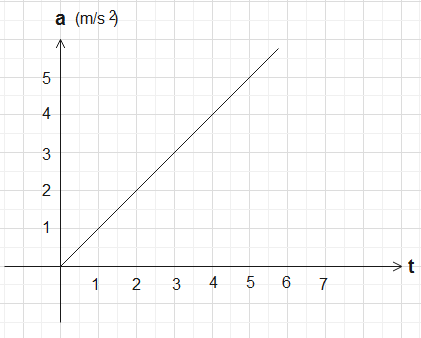
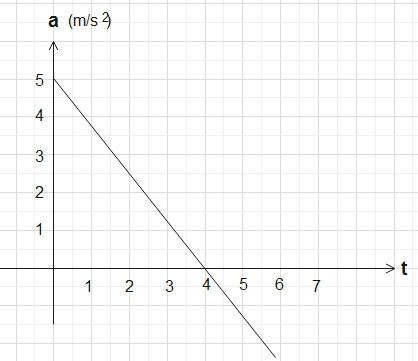
The change in velocity per unit time is called acceleration. Its SI unit is $m\,{{s}^{-2}}$. The formula for acceleration is-
$\text{acceleration = }\dfrac{\text{change}\,\text{in}\,\text{velocity}}{\text{time}}$
From the above eq, $\text{acceleration}\times \text{time}=\text{ change in velocity}$ - (1)
Area under the curve in the graphs above is given by-
$\text{Area}=\text{ acceleration x time}$ - (2)
From eq (1) and eq (2), we get,
Area= change in velocity.
Therefore, the area covered under the curve of acceleration- time graph is change in velocity, so the correct option is (C).
Additional Information:
The slope of the graph is given by $\tan \theta $(here,$\theta $ is the angle made by the graph with the positive direction of x-axis). Slope between two points gives us the change in acceleration for a given period of time between those two points. The higher the slope, the more change in acceleration for a given time period. Slope is also given by the tangent drawn to a graph.
Note:
Area of a graph is the two dimensional space covered under it. It is calculated as the product of dimensions. In a graph, the physical quantities along the x-axis and y-axis are its dimensions. According to the second law of motion, acceleration is due to the application of force.
Complete answer:
The change in velocity per unit time is called acceleration. Its SI unit is $m\,{{s}^{-2}}$. The formula for acceleration is-
$\text{acceleration = }\dfrac{\text{change}\,\text{in}\,\text{velocity}}{\text{time}}$
From the above eq, $\text{acceleration}\times \text{time}=\text{ change in velocity}$ - (1)
Area under the curve in the graphs above is given by-
$\text{Area}=\text{ acceleration x time}$ - (2)
From eq (1) and eq (2), we get,
Area= change in velocity.
Therefore, the area covered under the curve of acceleration- time graph is change in velocity, so the correct option is (C).
Additional Information:
The slope of the graph is given by $\tan \theta $(here,$\theta $ is the angle made by the graph with the positive direction of x-axis). Slope between two points gives us the change in acceleration for a given period of time between those two points. The higher the slope, the more change in acceleration for a given time period. Slope is also given by the tangent drawn to a graph.
Note:
Area of a graph is the two dimensional space covered under it. It is calculated as the product of dimensions. In a graph, the physical quantities along the x-axis and y-axis are its dimensions. According to the second law of motion, acceleration is due to the application of force.
Recently Updated Pages
Master Class 12 Business Studies: Engaging Questions & Answers for Success

Master Class 12 Chemistry: Engaging Questions & Answers for Success
Master Class 12 Biology: Engaging Questions & Answers for Success
Class 12 Question and Answer - Your Ultimate Solutions Guide
Master Class 11 English: Engaging Questions & Answers for Success
Master Class 11 Social Science: Engaging Questions & Answers for Success
Trending doubts
Which are the Top 10 Largest Countries of the World?
Draw a labelled sketch of the human eye class 12 physics CBSE
Differentiate between homogeneous and heterogeneous class 12 chemistry CBSE
Differentiate between Pyramid of energy and pyramid class 12 biology CBSE
Why is the cell called the structural and functional class 12 biology CBSE
Draw the diagram of the pyramid of energy Explain In class 12 biology CBSE