




The area of the triangle formed by the tangent and normal at the point $\left( 1,\sqrt{3} \right)$ to the circle ${{x}^{2}}+{{y}^{2}}=4$ and the x-axis is
[a] $3\sqrt{3}$
[b] $2\sqrt{3}$
[c] $4\sqrt{3}$
[d] $5\sqrt{3}$
Answer
 Verified
602.7k+ views
Hint: Use the fact that the equation of the tangent to any second degree conic $a{{x}^{2}}+2hxy+b{{y}^{2}}+2gx+2fy+c=0$ at point $\left( {{x}_{1}},{{y}_{1}} \right)$ on the conic can be obtained by replacing ${{x}^{2}}$ by $x{{x}_{1}}$, ${{y}^{2}}$ by $y{{y}_{1}},xy$ by $\dfrac{x{{y}_{1}}+{{x}_{1}}y}{2},x$ by $\dfrac{x+{{x}_{1}}}{2}$ and $y$ by $\dfrac{y+{{y}_{1}}}{2}$. Hence find the equation of the tangent to the circle ${{x}^{2}}+{{y}^{2}}=4$ at the point $\left( 1,\sqrt{3} \right)$. Use the fact that the tangent and the normal are perpendicular to each other at the point of contact. Hence fin the equation of the normal. Hence find the coordinates of the point at which the normal touches the x-axis and the coordinates of the point at which the tangent intersects the x-axis. Hence find the area of the triangle formed by the normal, the tangent and the x-axis.
Complete step by step answer:
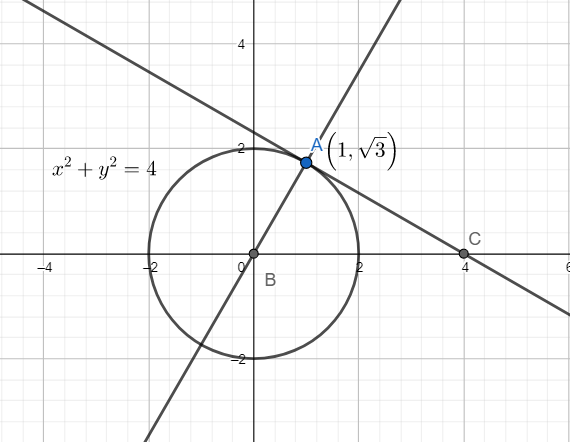
AC is the tangent at point A and AB is normal at point A.
Equation of the circle is ${{x}^{2}}+{{y}^{2}}=4$
We know that the equation of the tangent to any second degree conic $a{{x}^{2}}+2hxy+b{{y}^{2}}+2gx+2fy+c=0$ at point $\left( {{x}_{1}},{{y}_{1}} \right)$ on the conic can be obtained by replacing ${{x}^{2}}$ by $x{{x}_{1}}$, ${{y}^{2}}$ by $y{{y}_{1}},xy$ by $\dfrac{x{{y}_{1}}+{{x}_{1}}y}{2},x$ by $\dfrac{x+{{x}_{1}}}{2}$ and $y$ by $\dfrac{y+{{y}_{1}}}{2}$
Here ${{x}_{1}}=1,{{y}_{1}}=\sqrt{3}$
Hence the equation of the tangent is
$\begin{align}
& x\left( 1 \right)+y\left( \sqrt{3} \right)=4 \\
& \Rightarrow x+\sqrt{3}y=4 \\
\end{align}$
We know that the slope of the line $ax+by+c=0$ is given by $m=\dfrac{-a}{b}$
Hence the slope of the tangent AC is $\dfrac{-1}{\sqrt{3}}$
We know that the product of slopes of two perpendicular lines is -1.
Hence the slope of the normal AB is $\dfrac{-1}{\dfrac{-1}{\sqrt{3}}}=\sqrt{3}$
Hence the equation of the normal AB is
$\begin{align}
& y-\sqrt{3}=\sqrt{3}\left( x-1 \right) \\
& \Rightarrow y=\sqrt{3}x \\
\end{align}$
Finding coordinates of C:
C is the point of intersection of the x-axis and the line $x+\sqrt{3}y=4$
Hence the y-coordinate of C is 0.
Substituting y = 0 in the equation of the tangent AC, we get
$x+0=4\Rightarrow x=4$
Hence, we have
$C\equiv \left( 4,0 \right)$
Finding the coordinates of B:
B is the point of intersection of the line $y=\sqrt{3}x$ and the x-axis
Hence the y-coordinate of the point B is 0
Substituting y = 0 in the equation of AB, we get
$\sqrt{3}x=0\Rightarrow x=0$
Hence, we have
$B\equiv \left( 0,0 \right)$
We know that the area of the triangle formed by the points $A\left( {{x}_{1}},{{y}_{1}} \right),B\left( {{x}_{2}},{{y}_{2}} \right)$ and $C\left( {{x}_{3}},{{y}_{3}} \right)$ is given by
$\Delta =\dfrac{1}{2}\left| \begin{matrix}
{{x}_{2}}-{{x}_{1}} & {{y}_{2}}-{{y}_{1}} \\
{{x}_{3}}-{{x}_{1}} & {{y}_{3}}-{{y}_{1}} \\
\end{matrix} \right|$
Hence the area of the triangle ABC is given by
$\Delta =\dfrac{1}{2}\left| \begin{matrix}
4-0 & 0-0 \\
1-0 & \sqrt{3}-0 \\
\end{matrix} \right|=2\sqrt{3}$
Hence the area of the triangle formed by the tangent and normal and the x-axis to the circle ${{x}^{2}}+{{y}^{2}}=4$ at the point $\left( 1,\sqrt{3} \right)$ is $2\sqrt{3}$.
Hence option [b] is correct.
Note:
Alternative Solution: Best Method:
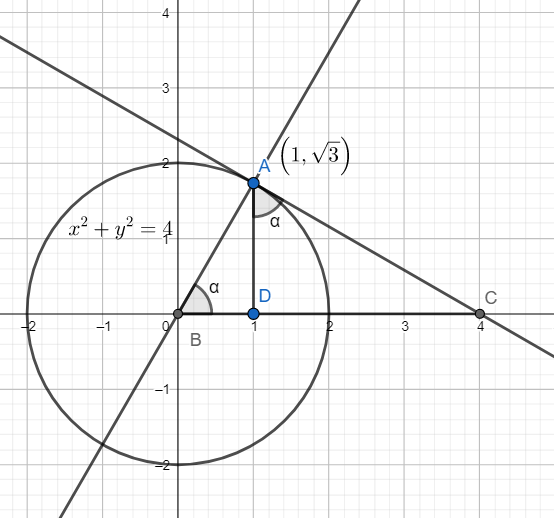
Let $\angle ABC=\alpha $
Since ABC is a right angled triangle, we have $\angle ACD=90{}^\circ -\alpha $
Since ADC is a right-angled triangle, we have $\angle DAC=90{}^\circ -\left( 90{}^\circ -\alpha \right)=\alpha $
We have $AD=\sqrt{3},AB=2$
Now, we have In triangle $\sin \alpha =\dfrac{AD}{AB}=\dfrac{\sqrt{3}}{2}\text{ }\left( i \right)$
In triangle ADC, we have $\cos \alpha =\dfrac{AD}{AC}\text{=}\dfrac{\sqrt{3}}{AC}\text{ }\left( ii \right)$
Squaring and adding equation (i) and equation (ii), we get
${{\sin }^{2}}\alpha +{{\cos }^{2}}\alpha =\dfrac{3}{4}+\dfrac{3}{A{{C}^{2}}}$
We know that ${{\sin }^{2}}x+{{\cos }^{2}}x=1$
Hence, we have
$\begin{align}
& \dfrac{3}{4}+\dfrac{3}{A{{C}^{2}}}=1 \\
& \Rightarrow \dfrac{3}{A{{C}^{2}}}=\dfrac{1}{4} \\
& \Rightarrow A{{C}^{2}}=12 \\
& \Rightarrow AC=2\sqrt{3} \\
\end{align}$
In triangle ABC, by Pythagoras theorem, we have
$\begin{align}
& A{{B}^{2}}+A{{C}^{2}}=B{{C}^{2}} \\
& \Rightarrow 4+12=B{{C}^{2}} \\
& \Rightarrow BC=4 \\
\end{align}$
Hence, we have $BC=4,AD=\sqrt{3}$
We know that the area of a triangle of height h and base b is given by $\Delta =\dfrac{1}{2}bh$
Hence, we have
$\Delta =\dfrac{1}{2}\times 4\times \sqrt{3}=2\sqrt{3}$, which is the same as obtained above.
Complete step by step answer:
AC is the tangent at point A and AB is normal at point A.
Equation of the circle is ${{x}^{2}}+{{y}^{2}}=4$
We know that the equation of the tangent to any second degree conic $a{{x}^{2}}+2hxy+b{{y}^{2}}+2gx+2fy+c=0$ at point $\left( {{x}_{1}},{{y}_{1}} \right)$ on the conic can be obtained by replacing ${{x}^{2}}$ by $x{{x}_{1}}$, ${{y}^{2}}$ by $y{{y}_{1}},xy$ by $\dfrac{x{{y}_{1}}+{{x}_{1}}y}{2},x$ by $\dfrac{x+{{x}_{1}}}{2}$ and $y$ by $\dfrac{y+{{y}_{1}}}{2}$
Here ${{x}_{1}}=1,{{y}_{1}}=\sqrt{3}$
Hence the equation of the tangent is
$\begin{align}
& x\left( 1 \right)+y\left( \sqrt{3} \right)=4 \\
& \Rightarrow x+\sqrt{3}y=4 \\
\end{align}$
We know that the slope of the line $ax+by+c=0$ is given by $m=\dfrac{-a}{b}$
Hence the slope of the tangent AC is $\dfrac{-1}{\sqrt{3}}$
We know that the product of slopes of two perpendicular lines is -1.
Hence the slope of the normal AB is $\dfrac{-1}{\dfrac{-1}{\sqrt{3}}}=\sqrt{3}$
Hence the equation of the normal AB is
$\begin{align}
& y-\sqrt{3}=\sqrt{3}\left( x-1 \right) \\
& \Rightarrow y=\sqrt{3}x \\
\end{align}$
Finding coordinates of C:
C is the point of intersection of the x-axis and the line $x+\sqrt{3}y=4$
Hence the y-coordinate of C is 0.
Substituting y = 0 in the equation of the tangent AC, we get
$x+0=4\Rightarrow x=4$
Hence, we have
$C\equiv \left( 4,0 \right)$
Finding the coordinates of B:
B is the point of intersection of the line $y=\sqrt{3}x$ and the x-axis
Hence the y-coordinate of the point B is 0
Substituting y = 0 in the equation of AB, we get
$\sqrt{3}x=0\Rightarrow x=0$
Hence, we have
$B\equiv \left( 0,0 \right)$
We know that the area of the triangle formed by the points $A\left( {{x}_{1}},{{y}_{1}} \right),B\left( {{x}_{2}},{{y}_{2}} \right)$ and $C\left( {{x}_{3}},{{y}_{3}} \right)$ is given by
$\Delta =\dfrac{1}{2}\left| \begin{matrix}
{{x}_{2}}-{{x}_{1}} & {{y}_{2}}-{{y}_{1}} \\
{{x}_{3}}-{{x}_{1}} & {{y}_{3}}-{{y}_{1}} \\
\end{matrix} \right|$
Hence the area of the triangle ABC is given by
$\Delta =\dfrac{1}{2}\left| \begin{matrix}
4-0 & 0-0 \\
1-0 & \sqrt{3}-0 \\
\end{matrix} \right|=2\sqrt{3}$
Hence the area of the triangle formed by the tangent and normal and the x-axis to the circle ${{x}^{2}}+{{y}^{2}}=4$ at the point $\left( 1,\sqrt{3} \right)$ is $2\sqrt{3}$.
Hence option [b] is correct.
Note:
Alternative Solution: Best Method:
Let $\angle ABC=\alpha $
Since ABC is a right angled triangle, we have $\angle ACD=90{}^\circ -\alpha $
Since ADC is a right-angled triangle, we have $\angle DAC=90{}^\circ -\left( 90{}^\circ -\alpha \right)=\alpha $
We have $AD=\sqrt{3},AB=2$
Now, we have In triangle $\sin \alpha =\dfrac{AD}{AB}=\dfrac{\sqrt{3}}{2}\text{ }\left( i \right)$
In triangle ADC, we have $\cos \alpha =\dfrac{AD}{AC}\text{=}\dfrac{\sqrt{3}}{AC}\text{ }\left( ii \right)$
Squaring and adding equation (i) and equation (ii), we get
${{\sin }^{2}}\alpha +{{\cos }^{2}}\alpha =\dfrac{3}{4}+\dfrac{3}{A{{C}^{2}}}$
We know that ${{\sin }^{2}}x+{{\cos }^{2}}x=1$
Hence, we have
$\begin{align}
& \dfrac{3}{4}+\dfrac{3}{A{{C}^{2}}}=1 \\
& \Rightarrow \dfrac{3}{A{{C}^{2}}}=\dfrac{1}{4} \\
& \Rightarrow A{{C}^{2}}=12 \\
& \Rightarrow AC=2\sqrt{3} \\
\end{align}$
In triangle ABC, by Pythagoras theorem, we have
$\begin{align}
& A{{B}^{2}}+A{{C}^{2}}=B{{C}^{2}} \\
& \Rightarrow 4+12=B{{C}^{2}} \\
& \Rightarrow BC=4 \\
\end{align}$
Hence, we have $BC=4,AD=\sqrt{3}$
We know that the area of a triangle of height h and base b is given by $\Delta =\dfrac{1}{2}bh$
Hence, we have
$\Delta =\dfrac{1}{2}\times 4\times \sqrt{3}=2\sqrt{3}$, which is the same as obtained above.
Recently Updated Pages
Master Class 10 Social Science: Engaging Questions & Answers for Success

Master Class 10 Science: Engaging Questions & Answers for Success
Master Class 10 Maths: Engaging Questions & Answers for Success
Master Class 10 General Knowledge: Engaging Questions & Answers for Success
Master Class 10 Computer Science: Engaging Questions & Answers for Success
Class 10 Question and Answer - Your Ultimate Solutions Guide
Trending doubts
What is the full form of PNG A Petrol Natural Gas B class 10 chemistry CBSE
Explain the Treaty of Vienna of 1815 class 10 social science CBSE
In cricket, how many legal balls are there in a standard over?
Why is there a time difference of about 5 hours between class 10 social science CBSE
Who Won 36 Oscar Awards? Record Holder Revealed
What is the median of the first 10 natural numbers class 10 maths CBSE