




The area of the region bounded by the curves \[y = \left| {x - 1} \right|\] and $y = 3 - \left| x \right|$ is ?
A.$2$ sq. units
B.$3$ sq. units
C.$4$ sq. units
D.$6$ sq. units
Answer
 Verified
522.6k+ views
Hint: The given curves are modulus functions. To solve them, we first write them in the form of separated conditional functions. We can then plot their rough graph and find out their points of intersection.
Complete answer: The given curves are $y = \left| {x - 1} \right|$ and $y = 3 - \left| x \right|$
The first curve is $y = \left| {x - 1} \right|$
Thus, $y = x - 1$ for $x \geqslant 1$ … (i)
And $y = - \left( {x - 1} \right)$ for $x < 1$
i.e. $y = 1 - x$ for $x < 1$ … (ii)
Similarly, the second curve is $y = 3 - \left| x \right|$
i.e. $y = 3 - x$ for $x \geqslant 0$ … (iii)
and $y = 3 - \left( { - x} \right)$ for $x < 0$
i.e. $y = 3 + x$ for $x < 0$ … (iv)
We now sketch the graph as follows.
As per the graph, the required area is the area of the quadrilateral ABCD.
This can be calculated by subtracting the area of triangles AED and CDF from the area of the triange EBF.
Thus, required area, $A = $ar(EBF) – ar(AED) – ar(CDF)
Area of a triangle is given by the formula $A = \frac{1}{2} \times b \times h$
Thus, $A = \left( {\frac{1}{2} \times 4 \times 3} \right) - \left[ {\left( {\frac{1}{2} \times 2 \times 2} \right) + \left( {\frac{1}{2} \times 2 \times 1} \right)} \right]$
i.e. $A = 6 - \left( {2 + 1} \right)$
$\therefore A = 3$sq. units
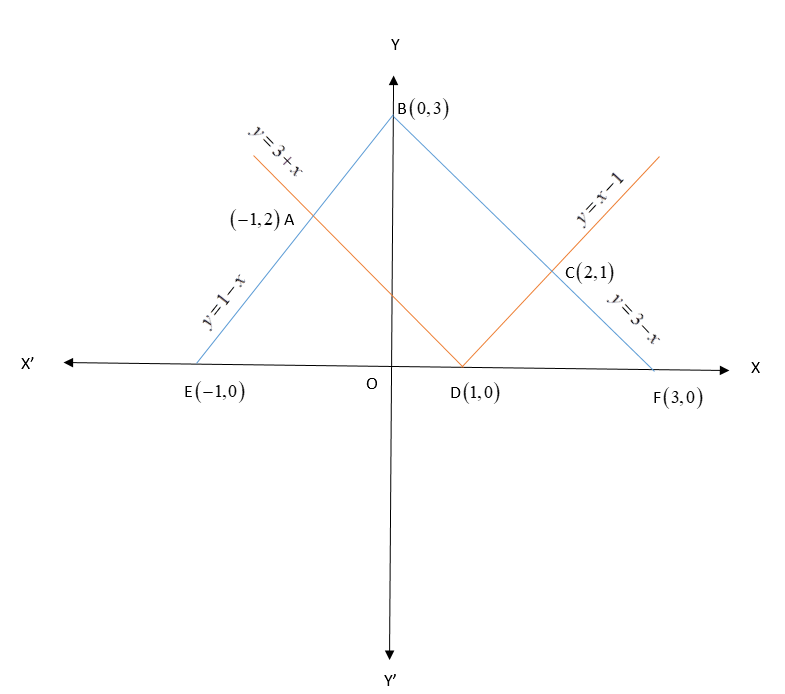
Hence, the area enclosed by the curves $y = \left| {x - 1} \right|$ and $y = 3 - \left| x \right|$ is 3 sq. units.
And hence the correct option is B.
Note:
Such questions involving the use of modulus functions must be solved carefully. It is very important to conditionally separate the given functions first. We also have to remember the formulae for the areas of various different geometrical shapes. Draw a rough graph by plotting all the curves and then calculate the area accordingly.
Complete answer: The given curves are $y = \left| {x - 1} \right|$ and $y = 3 - \left| x \right|$
The first curve is $y = \left| {x - 1} \right|$
Thus, $y = x - 1$ for $x \geqslant 1$ … (i)
And $y = - \left( {x - 1} \right)$ for $x < 1$
i.e. $y = 1 - x$ for $x < 1$ … (ii)
Similarly, the second curve is $y = 3 - \left| x \right|$
i.e. $y = 3 - x$ for $x \geqslant 0$ … (iii)
and $y = 3 - \left( { - x} \right)$ for $x < 0$
i.e. $y = 3 + x$ for $x < 0$ … (iv)
We now sketch the graph as follows.
As per the graph, the required area is the area of the quadrilateral ABCD.
This can be calculated by subtracting the area of triangles AED and CDF from the area of the triange EBF.
Thus, required area, $A = $ar(EBF) – ar(AED) – ar(CDF)
Area of a triangle is given by the formula $A = \frac{1}{2} \times b \times h$
Thus, $A = \left( {\frac{1}{2} \times 4 \times 3} \right) - \left[ {\left( {\frac{1}{2} \times 2 \times 2} \right) + \left( {\frac{1}{2} \times 2 \times 1} \right)} \right]$
i.e. $A = 6 - \left( {2 + 1} \right)$
$\therefore A = 3$sq. units
Hence, the area enclosed by the curves $y = \left| {x - 1} \right|$ and $y = 3 - \left| x \right|$ is 3 sq. units.
And hence the correct option is B.
Note:
Such questions involving the use of modulus functions must be solved carefully. It is very important to conditionally separate the given functions first. We also have to remember the formulae for the areas of various different geometrical shapes. Draw a rough graph by plotting all the curves and then calculate the area accordingly.
Recently Updated Pages
Basicity of sulphurous acid and sulphuric acid are

Master Class 12 English: Engaging Questions & Answers for Success
Master Class 12 Social Science: Engaging Questions & Answers for Success
Master Class 12 Maths: Engaging Questions & Answers for Success
Master Class 12 Economics: Engaging Questions & Answers for Success
Master Class 12 Physics: Engaging Questions & Answers for Success
Trending doubts
Which are the Top 10 Largest Countries of the World?
Draw a labelled sketch of the human eye class 12 physics CBSE
Draw ray diagrams each showing i myopic eye and ii class 12 physics CBSE
Give 10 examples of unisexual and bisexual flowers
Coming together federation is practiced in A India class 12 social science CBSE
Write the formula to find the shortest distance between class 12 maths CBSE