




The area of the parallelogram formed by the lines \[y=mx,y=mx+1,y=nx\] and \[y=nx+1\] equals
\[\dfrac{\left| m+n \right|}{\left( m-n \right){}^{2}}\]
\[\dfrac{2}{\left| m+n \right|}\]
\[\dfrac{1}{\left| m+n \right|}\]
\[\dfrac{1}{\left| n-m \right|}\]
Answer
 Verified
630k+ views
Hint: Consider parallelogram as PQRS. Take the 4 lines y = mx and y = mx + 1 are parallel and y = nx and y = nx + 1 are parallel. Parallel lines do not intersect. Thus with 4 lines find the coordinates of their intersection. Then find area by dividing the parallelogram into 2 equal halves i.e. triangles.
Complete step-by-step solution -
We have been given four equations of line,
\[y=mx,y=mx+1,y=nx\] and \[y=nx+1\]
Hence we need to find the area of the parallelogram formed by these lines.
Now the line y = mx and y = mx + 1 are parallel, which means that both these lines won’t intersect. Similarly, the lines y = nx and y = nx +1 are parallel, so they won’t intersect.
Now let us consider each line to get the coordinates of the parallelogram.
\[\begin{align}
& y=mx-(1) \\
& y=nx-(2) \\
& y=mx+1-(3) \\
& y=nx+1-(4) \\
\end{align}\]
Let us first consider equation (1) and equation (2).
y = mx and y = nx. The intersection point of these two equations passes through the origin. Thus their coordinates are (0, 0). Let us consider this as P (0, 0), which is an intersection point.
Now let us consider (3) and (4). We can equate them as,
\[mx+1=nx+1\]
Cancel out 1 from both sides and simplify it,
\[\begin{align}
& mx=nx \\
& mx-nx=0 \\
& \left( m-n \right)x=0 \\
\end{align}\]
\[\left( m-n \right)\] cannot be zero, as \[m\ne n\].
Thus both lines (3) and (4) are not identical. Hence, put x = 0 in the equation, we get y = 1. Thus we get the second point as Q = (0, 1).
Now let us take equation (1) and equation (4).
\[y=mx\] and \[y=nx+1\], equating them we get,
\[\begin{align}
& mx=nx+1 \\
& mx-nx=1 \\
& \left( m-n \right)x=1 \\
& \therefore x=\dfrac{1}{m-n} \\
\end{align}\]
Thus put, \[x=\dfrac{1}{m-n}\] in y = mx, we get, \[y=\dfrac{m}{m-n}\].
Thus the coordinates are, \[R=\left( \dfrac{1}{m-n},\dfrac{m}{m-n} \right)\].
Now let us take equation (2) and equation (3).
\[y=nx\] and \[y=mx+1\], let us equate them,
\[\begin{align}
& nx=mx+1 \\
& nx-mx=1 \\
& x\left( n-m \right)=1 \\
\end{align}\]
\[x=\dfrac{1}{n-m}\], put this in y = nx.
We get, \[y=\dfrac{n}{n-m}\]
Thus the coordinates are, \[S=\left( \dfrac{1}{n-m},\dfrac{n}{n-m} \right)\].
Thus we got 4 coordinates of the parallelogram formed by the four lines as,
P = (0, 0), Q = (0, 1), \[R=\left( \dfrac{1}{m-n},\dfrac{m}{m-n} \right)\] and \[S=\left( \dfrac{1}{n-m},\dfrac{n}{n-m} \right)\].
From the figure,
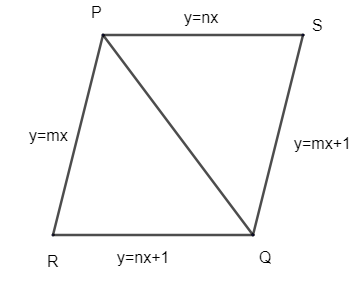
y = nx line is parallelogram to line, y = nx + 1.
Similarly, line y = mx is parallel to y = mx + 1.
Now P is the intersection point of y = mx and y = nx. Similarly, R us the intersection of line y = mx and y = nx + 1.
S is the intersection of y =nx and y = mx + 1. Point Q is the intersection of line y = mx +1 and y = nx + 1.
PQ is the diagonal of the parallelogram. By the properties of the parallelogram, diagonal PQ divides the parallelogram into two equal half i.e. it divides it into 2 equal triangles.
Area of parallelogram = ar \[\left( \Delta PRQ \right)\] + ar \[\left( \Delta PSQ \right)\]
Now ar \[\left( \Delta PRQ \right)\] = ar \[\left( \Delta PSQ \right)\]
\[\therefore \] Area of parallelogram = ar \[\left( \Delta PRQ \right)\] + ar \[\left( \Delta PRQ \right)\]
A = 2 ar \[\left( \Delta PRQ \right)\]
Now let us find the area of \[\left( \Delta PRQ \right)\]
Area of a triangle \[=\dfrac{1}{2}\left| \begin{matrix}
{{x}_{1}} & {{y}_{1}} & 1 \\
{{x}_{2}} & {{y}_{2}} & 1 \\
{{x}_{3}} & {{y}_{3}} & 1 \\
\end{matrix} \right|=\dfrac{1}{2}\left| {{x}_{1}}\left( {{y}_{2}}-{{y}_{3}} \right)-{{x}_{2}}\left( {{y}_{1}}-{{y}_{3}} \right)+{{x}_{3}}\left( {{y}_{1}}-{{y}_{2}} \right) \right|\]
Now we know the coordinates of P, Q and R. Substitute them in the above equation.
\[\begin{align}
& P=\left( 0,0 \right)=\left( {{x}_{1}},{{y}_{1}} \right) \\
& Q=\left( 0,1 \right)=\left( {{x}_{2}},{{y}_{2}} \right) \\
& R=\left( \dfrac{1}{m-n},\dfrac{m}{m-n} \right)=\left( {{x}_{3}},{{y}_{3}} \right) \\
\end{align}\]
\[\therefore \] Area of triangle = \[\dfrac{1}{2}\left| \begin{matrix}
0 & 0 & 1 \\
0 & 1 & 1 \\
\dfrac{1}{m-n} & \dfrac{m}{m-n} & 1 \\
\end{matrix} \right|\]
\[\begin{align}
& A=\dfrac{1}{2}\left| 0\left[ 1-\dfrac{m}{m-n} \right]-0\left[ 0-\dfrac{1}{m-n} \right]+1\left[ 0-\dfrac{1}{m-n} \right] \right| \\
& A=\dfrac{1}{2}\left| 0-0+1\times \left( \dfrac{-1}{m-n} \right) \right|=\dfrac{1}{2}\left| \dfrac{-1}{m-n} \right| \\
& A=\dfrac{1}{2}\left| \dfrac{-1}{-\left( n-m \right)} \right| \\
& A=\dfrac{1}{2}\left| \dfrac{1}{n-m} \right| \\
\end{align}\]
We got area of triangle PQR \[=\dfrac{1}{2}\left| \dfrac{1}{n-m} \right|=ar\left( \Delta PRQ \right)\]
\[\therefore \] Area of parallelogram \[=2\times ar\left( \Delta PRQ \right)\]
\[=2\times \dfrac{1}{2}\left| \dfrac{1}{n-m} \right|=\left| \dfrac{1}{n-m} \right|\]
\[\therefore \] Hence area of parallelogram = \[\left| \dfrac{1}{n-m} \right|\]
\[\therefore \] Option (d) is the correct answer.
Note: You should understand how to take the coordinates of the parallelogram from the given equation of 4 lines. In parallelograms opposite sides are parallel. So use this property to classify them and accordingly find the lines that intersect points P, Q, R, S.
Complete step-by-step solution -
We have been given four equations of line,
\[y=mx,y=mx+1,y=nx\] and \[y=nx+1\]
Hence we need to find the area of the parallelogram formed by these lines.
Now the line y = mx and y = mx + 1 are parallel, which means that both these lines won’t intersect. Similarly, the lines y = nx and y = nx +1 are parallel, so they won’t intersect.
Now let us consider each line to get the coordinates of the parallelogram.
\[\begin{align}
& y=mx-(1) \\
& y=nx-(2) \\
& y=mx+1-(3) \\
& y=nx+1-(4) \\
\end{align}\]
Let us first consider equation (1) and equation (2).
y = mx and y = nx. The intersection point of these two equations passes through the origin. Thus their coordinates are (0, 0). Let us consider this as P (0, 0), which is an intersection point.
Now let us consider (3) and (4). We can equate them as,
\[mx+1=nx+1\]
Cancel out 1 from both sides and simplify it,
\[\begin{align}
& mx=nx \\
& mx-nx=0 \\
& \left( m-n \right)x=0 \\
\end{align}\]
\[\left( m-n \right)\] cannot be zero, as \[m\ne n\].
Thus both lines (3) and (4) are not identical. Hence, put x = 0 in the equation, we get y = 1. Thus we get the second point as Q = (0, 1).
Now let us take equation (1) and equation (4).
\[y=mx\] and \[y=nx+1\], equating them we get,
\[\begin{align}
& mx=nx+1 \\
& mx-nx=1 \\
& \left( m-n \right)x=1 \\
& \therefore x=\dfrac{1}{m-n} \\
\end{align}\]
Thus put, \[x=\dfrac{1}{m-n}\] in y = mx, we get, \[y=\dfrac{m}{m-n}\].
Thus the coordinates are, \[R=\left( \dfrac{1}{m-n},\dfrac{m}{m-n} \right)\].
Now let us take equation (2) and equation (3).
\[y=nx\] and \[y=mx+1\], let us equate them,
\[\begin{align}
& nx=mx+1 \\
& nx-mx=1 \\
& x\left( n-m \right)=1 \\
\end{align}\]
\[x=\dfrac{1}{n-m}\], put this in y = nx.
We get, \[y=\dfrac{n}{n-m}\]
Thus the coordinates are, \[S=\left( \dfrac{1}{n-m},\dfrac{n}{n-m} \right)\].
Thus we got 4 coordinates of the parallelogram formed by the four lines as,
P = (0, 0), Q = (0, 1), \[R=\left( \dfrac{1}{m-n},\dfrac{m}{m-n} \right)\] and \[S=\left( \dfrac{1}{n-m},\dfrac{n}{n-m} \right)\].
From the figure,
y = nx line is parallelogram to line, y = nx + 1.
Similarly, line y = mx is parallel to y = mx + 1.
Now P is the intersection point of y = mx and y = nx. Similarly, R us the intersection of line y = mx and y = nx + 1.
S is the intersection of y =nx and y = mx + 1. Point Q is the intersection of line y = mx +1 and y = nx + 1.
PQ is the diagonal of the parallelogram. By the properties of the parallelogram, diagonal PQ divides the parallelogram into two equal half i.e. it divides it into 2 equal triangles.
Area of parallelogram = ar \[\left( \Delta PRQ \right)\] + ar \[\left( \Delta PSQ \right)\]
Now ar \[\left( \Delta PRQ \right)\] = ar \[\left( \Delta PSQ \right)\]
\[\therefore \] Area of parallelogram = ar \[\left( \Delta PRQ \right)\] + ar \[\left( \Delta PRQ \right)\]
A = 2 ar \[\left( \Delta PRQ \right)\]
Now let us find the area of \[\left( \Delta PRQ \right)\]
Area of a triangle \[=\dfrac{1}{2}\left| \begin{matrix}
{{x}_{1}} & {{y}_{1}} & 1 \\
{{x}_{2}} & {{y}_{2}} & 1 \\
{{x}_{3}} & {{y}_{3}} & 1 \\
\end{matrix} \right|=\dfrac{1}{2}\left| {{x}_{1}}\left( {{y}_{2}}-{{y}_{3}} \right)-{{x}_{2}}\left( {{y}_{1}}-{{y}_{3}} \right)+{{x}_{3}}\left( {{y}_{1}}-{{y}_{2}} \right) \right|\]
Now we know the coordinates of P, Q and R. Substitute them in the above equation.
\[\begin{align}
& P=\left( 0,0 \right)=\left( {{x}_{1}},{{y}_{1}} \right) \\
& Q=\left( 0,1 \right)=\left( {{x}_{2}},{{y}_{2}} \right) \\
& R=\left( \dfrac{1}{m-n},\dfrac{m}{m-n} \right)=\left( {{x}_{3}},{{y}_{3}} \right) \\
\end{align}\]
\[\therefore \] Area of triangle = \[\dfrac{1}{2}\left| \begin{matrix}
0 & 0 & 1 \\
0 & 1 & 1 \\
\dfrac{1}{m-n} & \dfrac{m}{m-n} & 1 \\
\end{matrix} \right|\]
\[\begin{align}
& A=\dfrac{1}{2}\left| 0\left[ 1-\dfrac{m}{m-n} \right]-0\left[ 0-\dfrac{1}{m-n} \right]+1\left[ 0-\dfrac{1}{m-n} \right] \right| \\
& A=\dfrac{1}{2}\left| 0-0+1\times \left( \dfrac{-1}{m-n} \right) \right|=\dfrac{1}{2}\left| \dfrac{-1}{m-n} \right| \\
& A=\dfrac{1}{2}\left| \dfrac{-1}{-\left( n-m \right)} \right| \\
& A=\dfrac{1}{2}\left| \dfrac{1}{n-m} \right| \\
\end{align}\]
We got area of triangle PQR \[=\dfrac{1}{2}\left| \dfrac{1}{n-m} \right|=ar\left( \Delta PRQ \right)\]
\[\therefore \] Area of parallelogram \[=2\times ar\left( \Delta PRQ \right)\]
\[=2\times \dfrac{1}{2}\left| \dfrac{1}{n-m} \right|=\left| \dfrac{1}{n-m} \right|\]
\[\therefore \] Hence area of parallelogram = \[\left| \dfrac{1}{n-m} \right|\]
\[\therefore \] Option (d) is the correct answer.
Note: You should understand how to take the coordinates of the parallelogram from the given equation of 4 lines. In parallelograms opposite sides are parallel. So use this property to classify them and accordingly find the lines that intersect points P, Q, R, S.
Recently Updated Pages
Master Class 10 Social Science: Engaging Questions & Answers for Success

Master Class 10 Science: Engaging Questions & Answers for Success
Master Class 10 Maths: Engaging Questions & Answers for Success
Master Class 10 General Knowledge: Engaging Questions & Answers for Success
Master Class 10 Computer Science: Engaging Questions & Answers for Success
Class 10 Question and Answer - Your Ultimate Solutions Guide
Trending doubts
What is the full form of PNG A Petrol Natural Gas B class 10 chemistry CBSE
Explain the Treaty of Vienna of 1815 class 10 social science CBSE
In cricket, how many legal balls are there in a standard over?
Why is there a time difference of about 5 hours between class 10 social science CBSE
Who Won 36 Oscar Awards? Record Holder Revealed
What is the median of the first 10 natural numbers class 10 maths CBSE