




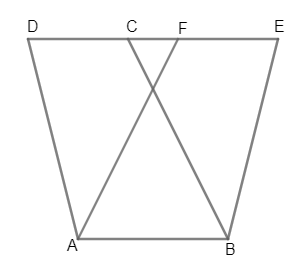
The area of the parallelogram ABCD is 36 $c{{m}^{2}}$. Calculate the height of parallelogram ABEF if AB = 4.2 cm.
Answer
 Verified
650.1k+ views
Hint: Here, we will use the property that two parallelograms between the same parallels and same base have equal area. Also, the area of the parallelogram is given as the product of base and height of the parallelogram. The height of the parallelogram must be perpendicular to its base. We will assume the height of the parallelogram ABEF to be x and then equate its area to the area of ABCD to find x.
Complete step-by-step answer:
There is a property that parallelograms on the same base and between the same parallels have equal area.
Here, the parallelograms ABCD and ABEF are on the same base AB and both are between the same parallels, that is, between AB and DE.
Let us assume that the height of the parallelogram ABEF to be equal to x.
Since, its base is AB, so its area is = $AB\times x$.
Also, the area of the parallelogram ABCD is equal to 36 $c{{m}^{2}}$.
As, area of parallelogram ABEF = area of parallelogram ABCD
So, $AB\times x=36$.
Since, it is given that AB = 4.2 cm. Therefore, we have:
$\begin{align}
& 4.2\times x=36 \\
& \Rightarrow x=\dfrac{36}{4.2} \\
& \Rightarrow x=8.57\text{ cm} \\
\end{align}$
Hence, the height of the parallelogram ABEF is 8.57 cm.
Note: Students should note here that when we are talking about common parallel, we will consider the line DE. Students may face problems at this point because DC and EF both lie on the same line, that is, o DE. Students should also keep in mind that the height of a parallelogram is always perpendicular to its base. So, AG must be perpendicular to AB otherwise the formula that $area=base\times height$ can not be applied.
Complete step-by-step answer:
There is a property that parallelograms on the same base and between the same parallels have equal area.
Here, the parallelograms ABCD and ABEF are on the same base AB and both are between the same parallels, that is, between AB and DE.
Let us assume that the height of the parallelogram ABEF to be equal to x.
Since, its base is AB, so its area is = $AB\times x$.
Also, the area of the parallelogram ABCD is equal to 36 $c{{m}^{2}}$.
As, area of parallelogram ABEF = area of parallelogram ABCD
So, $AB\times x=36$.
Since, it is given that AB = 4.2 cm. Therefore, we have:
$\begin{align}
& 4.2\times x=36 \\
& \Rightarrow x=\dfrac{36}{4.2} \\
& \Rightarrow x=8.57\text{ cm} \\
\end{align}$
Hence, the height of the parallelogram ABEF is 8.57 cm.
Note: Students should note here that when we are talking about common parallel, we will consider the line DE. Students may face problems at this point because DC and EF both lie on the same line, that is, o DE. Students should also keep in mind that the height of a parallelogram is always perpendicular to its base. So, AG must be perpendicular to AB otherwise the formula that $area=base\times height$ can not be applied.
Recently Updated Pages
Basicity of sulphurous acid and sulphuric acid are

Master Class 10 Computer Science: Engaging Questions & Answers for Success
Master Class 10 Social Science: Engaging Questions & Answers for Success
Master Class 10 Science: Engaging Questions & Answers for Success
Class 10 Question and Answer - Your Ultimate Solutions Guide
Master Class 10 Maths: Engaging Questions & Answers for Success
Trending doubts
What is the Total Duration of Football Match?
Explain the Treaty of Vienna of 1815 class 10 social science CBSE
In football, which nation is called "La Roja"?
Why is there a time difference of about 5 hours between class 10 social science CBSE
10 examples of evaporation in daily life with explanations
What is the full form of POSCO class 10 social science CBSE