



The area of rhombus is 240 ${cm}^{2}$ and one of the diagonals is 16cm. Find another diagonal.
Answer
 Verified
625.5k+ views
Hint: We will use the direct formula of the area of the rhombus as it involves length of both the diagonals.
Complete step-by-step answer:
First, let us see the figure of the question.
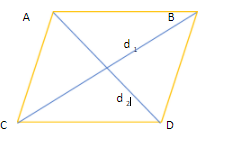
This is the rhombus of area 240 ${cm}^{2}$.
Let its sides be A, B, C and D.
Let us denote one of its diagonals as $d_1$ and the other as $d_2$.
It is given that one of its diagonals $d_1$ is 16cm.
Let the other diagonal $d_2$ be x cm.
We know that the formula of area of the rhombus is: $area = \dfrac{1}{2} \times {d_1} \times {d_2}$
Therefore, the area of the rhombus ABCD = $\dfrac{1}{2} \times 16 \times x$
$
\Rightarrow 240 = \dfrac{1}{2} \times 16 \times x \\
\Rightarrow x = 240 \times 2 \times \dfrac{1}{{16}} \\
\Rightarrow x = \dfrac{{240}}{8} \\
\Rightarrow x = 30cm \\
$
Hence, the other diagonal of the given rhombus is found to be 30 cm.
Note: : The diagonals of the rhombus intersect each other and cut each other in equal parts. So, if any side of the rhombus has been given, then we can also find the area of the rhombus without applying the formula of area of the rhombus.
Complete step-by-step answer:
First, let us see the figure of the question.
This is the rhombus of area 240 ${cm}^{2}$.
Let its sides be A, B, C and D.
Let us denote one of its diagonals as $d_1$ and the other as $d_2$.
It is given that one of its diagonals $d_1$ is 16cm.
Let the other diagonal $d_2$ be x cm.
We know that the formula of area of the rhombus is: $area = \dfrac{1}{2} \times {d_1} \times {d_2}$
Therefore, the area of the rhombus ABCD = $\dfrac{1}{2} \times 16 \times x$
$
\Rightarrow 240 = \dfrac{1}{2} \times 16 \times x \\
\Rightarrow x = 240 \times 2 \times \dfrac{1}{{16}} \\
\Rightarrow x = \dfrac{{240}}{8} \\
\Rightarrow x = 30cm \\
$
Hence, the other diagonal of the given rhombus is found to be 30 cm.
Note: : The diagonals of the rhombus intersect each other and cut each other in equal parts. So, if any side of the rhombus has been given, then we can also find the area of the rhombus without applying the formula of area of the rhombus.
Recently Updated Pages
Master Class 12 Economics: Engaging Questions & Answers for Success

Master Class 12 English: Engaging Questions & Answers for Success
Master Class 12 Social Science: Engaging Questions & Answers for Success
Master Class 12 Maths: Engaging Questions & Answers for Success
Master Class 12 Physics: Engaging Questions & Answers for Success
Master Class 8 English: Engaging Questions & Answers for Success
Trending doubts
What is BLO What is the full form of BLO class 8 social science CBSE
Citizens of India can vote at the age of A 18 years class 8 social science CBSE
Right to vote is a AFundamental Right BFundamental class 8 social science CBSE
Full form of STD, ISD and PCO
What is the area formula of an obtuse triangle class 8 maths CBSE
Give me the opposite gender of Duck class 8 english CBSE