




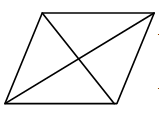
The area of parallelogram whose diagonals represent the vector \[3\mathop i\limits^ \to {\text{ + }}\mathop j\limits^ \to - 2\mathop {k{\text{ }}}\limits^ \to and{\text{ }}\mathop i\limits^ \to {\text{ + }}\mathop j\limits^ \to + 4\mathop {k{\text{ }}}\limits^ \to is\]
(A) $10\sqrt 3 $
(B) $5\sqrt 3 $
(C) $8$
(D) $4$
Answer
 Verified
605.7k+ views
Hint: We have given the position vectors of the diagonals of parallelogram. We have to find the area of parallelogram. Firstly we consider the position vectors of parallelograms as $\mathop a\limits^ \to $ and $\mathop b\limits^ \to $ and we find the cross. Product of these two vectors. The cross product will also be a vector. There we calculate will also be a vector. Then we calculate the magnitude of the resulting vector. Now area a of the parallelogram is given as half the magnitude of cross product of $\mathop a\limits^ \to $ a and $\mathop b\limits^ \to $that is Area of parallelogram \[ = \dfrac{1}{2} \times |\mathop a\limits^ \to \times \mathop b\limits^ \to |\]
Complete step-by-step answer:
The position vectors of diagonal of parallelogram is \[3\mathop i\limits^\Lambda {\text{ + }}\mathop j\limits^\Lambda - 2\mathop {k{\text{ }}}\limits^\Lambda and{\text{ }}\mathop i\limits^\Lambda {\text{ + 3}}\mathop j\limits^\Lambda + 4\mathop {k{\text{ }}}\limits^\Lambda \]
Let us consider that \[\mathop a\limits^ \to = 3\mathop i\limits^\Lambda {\text{ + }}\mathop j\limits^\Lambda - 2\mathop {k{\text{ }}}\limits^\Lambda \]and
\[\mathop b\limits^ \to = \mathop i\limits^\Lambda {\text{ + }}\mathop j\limits^\Lambda + 4\mathop {k{\text{ }}}\limits^\Lambda \]
We have to find the area of parallelogram
\[\begin{gathered}
\to \mathop a\limits^ \to = 3\mathop i\limits^\Lambda {\text{ + }}\mathop j\limits^\Lambda - 2\mathop {k{\text{ }}}\limits^\Lambda \\
\to \mathop b\limits^ \to = \mathop i\limits^\Lambda {\text{ + 3}}\mathop j\limits^\Lambda + 4\mathop {k{\text{ }}}\limits^\Lambda \\
\end{gathered} \]
Area of parallelogram is given as $ = \dfrac{1}{2}|\mathop a\limits^ \to \times \mathop b\limits^ \to |$
So firstly we have to calculate the cross product of $\mathop a\limits^ \to $ and $\mathop b\limits^ \to $ there we calculate its magnitude.
Cross product of $\mathop a\limits^ \to $ a and $\mathop b\limits^ \to $ is given as
$\mathop a\limits^ \to \times \mathop b\limits^ \to = $ \[\left| \begin{gathered}
{\text{ }}\mathop i\limits^\Lambda {\text{ }}\mathop j\limits^\Lambda {\text{ }}\mathop {k{\text{ }}}\limits^\Lambda \\
{\text{ }}3{\text{ }}1{\text{ }} - 2 \\
{\text{ }}1{\text{ }} - 3{\text{ }}4 \\
\end{gathered} \right|\]
Expanding corresponding to first How we get
$\mathop a\limits^ \to \times \mathop b\limits^ \to = $\[\mathop i\limits^\Lambda (4 - 6) - \mathop j\limits^\Lambda (12 + 2) + 2\mathop k\limits^\Lambda ( - 9 - 1)\]
$\Rightarrow \mathop a\limits^ \to \times \mathop b\limits^ \to = $\[ - 2\mathop i\limits^\Lambda - 14\mathop j\limits^\Lambda - 10\mathop k\limits^\Lambda \]
So $\mathop a\limits^ \to \times \mathop b\limits^ \to = $\[ - 2\mathop i\limits^\Lambda - 14\mathop j\limits^\Lambda - 10\mathop k\limits^\Lambda \]
Now we calculate the magnitude of $\mathop a\limits^ \to \times \mathop b\limits^ \to $Magnitude of $\mathop a\limits^ \to \times \mathop b\limits^ \to $ is given as
$\left| {\mathop a\limits^ \to \times \mathop b\limits^ \to } \right|$ \[ = \sqrt {{{\left( { - 2} \right)}^2} + {{(14)}^2} + {{( - 10)}^2}} \]
\[ \Rightarrow \sqrt {4 + 16 + 100} = \sqrt {300} \]
$\Rightarrow \left| {\mathop a\limits^ \to \times \mathop b\limits^ \to } \right|$\[ = \sqrt {300} = 10\sqrt 3 \]
So magnitude of $\mathop a\limits^ \to \times \mathop b\limits^ \to = $$\left| {\mathop a\limits^ \to \times \mathop b\limits^ \to } \right|$\[ = 10\sqrt 3 \] square units
Area of parallelogram $ = \dfrac{1}{2}|\mathop a\limits^ \to \times \mathop b\limits^ \to |$
$ \Rightarrow \dfrac{1}{2}10\sqrt 3 = 5\sqrt 3 $ square units
So option $(B)$ is correct.
Note: Parallelogram is a quadrilateral. whose opposite sides are parallel to each other and opposite angles are equal Diagonal of parallelogram are the line segments whose joins their opposite vertex. The diagonal of parallelograms bisects each other. Cross product is a binary. Operation ovary two vectors in their dimension space. The cross product of two vectors is also a vector whose direction is perpendicular to the plane in which the vector is.
Complete step-by-step answer:
The position vectors of diagonal of parallelogram is \[3\mathop i\limits^\Lambda {\text{ + }}\mathop j\limits^\Lambda - 2\mathop {k{\text{ }}}\limits^\Lambda and{\text{ }}\mathop i\limits^\Lambda {\text{ + 3}}\mathop j\limits^\Lambda + 4\mathop {k{\text{ }}}\limits^\Lambda \]
Let us consider that \[\mathop a\limits^ \to = 3\mathop i\limits^\Lambda {\text{ + }}\mathop j\limits^\Lambda - 2\mathop {k{\text{ }}}\limits^\Lambda \]and
\[\mathop b\limits^ \to = \mathop i\limits^\Lambda {\text{ + }}\mathop j\limits^\Lambda + 4\mathop {k{\text{ }}}\limits^\Lambda \]
We have to find the area of parallelogram
\[\begin{gathered}
\to \mathop a\limits^ \to = 3\mathop i\limits^\Lambda {\text{ + }}\mathop j\limits^\Lambda - 2\mathop {k{\text{ }}}\limits^\Lambda \\
\to \mathop b\limits^ \to = \mathop i\limits^\Lambda {\text{ + 3}}\mathop j\limits^\Lambda + 4\mathop {k{\text{ }}}\limits^\Lambda \\
\end{gathered} \]
Area of parallelogram is given as $ = \dfrac{1}{2}|\mathop a\limits^ \to \times \mathop b\limits^ \to |$
So firstly we have to calculate the cross product of $\mathop a\limits^ \to $ and $\mathop b\limits^ \to $ there we calculate its magnitude.
Cross product of $\mathop a\limits^ \to $ a and $\mathop b\limits^ \to $ is given as
$\mathop a\limits^ \to \times \mathop b\limits^ \to = $ \[\left| \begin{gathered}
{\text{ }}\mathop i\limits^\Lambda {\text{ }}\mathop j\limits^\Lambda {\text{ }}\mathop {k{\text{ }}}\limits^\Lambda \\
{\text{ }}3{\text{ }}1{\text{ }} - 2 \\
{\text{ }}1{\text{ }} - 3{\text{ }}4 \\
\end{gathered} \right|\]
Expanding corresponding to first How we get
$\mathop a\limits^ \to \times \mathop b\limits^ \to = $\[\mathop i\limits^\Lambda (4 - 6) - \mathop j\limits^\Lambda (12 + 2) + 2\mathop k\limits^\Lambda ( - 9 - 1)\]
$\Rightarrow \mathop a\limits^ \to \times \mathop b\limits^ \to = $\[ - 2\mathop i\limits^\Lambda - 14\mathop j\limits^\Lambda - 10\mathop k\limits^\Lambda \]
So $\mathop a\limits^ \to \times \mathop b\limits^ \to = $\[ - 2\mathop i\limits^\Lambda - 14\mathop j\limits^\Lambda - 10\mathop k\limits^\Lambda \]
Now we calculate the magnitude of $\mathop a\limits^ \to \times \mathop b\limits^ \to $Magnitude of $\mathop a\limits^ \to \times \mathop b\limits^ \to $ is given as
$\left| {\mathop a\limits^ \to \times \mathop b\limits^ \to } \right|$ \[ = \sqrt {{{\left( { - 2} \right)}^2} + {{(14)}^2} + {{( - 10)}^2}} \]
\[ \Rightarrow \sqrt {4 + 16 + 100} = \sqrt {300} \]
$\Rightarrow \left| {\mathop a\limits^ \to \times \mathop b\limits^ \to } \right|$\[ = \sqrt {300} = 10\sqrt 3 \]
So magnitude of $\mathop a\limits^ \to \times \mathop b\limits^ \to = $$\left| {\mathop a\limits^ \to \times \mathop b\limits^ \to } \right|$\[ = 10\sqrt 3 \] square units
Area of parallelogram $ = \dfrac{1}{2}|\mathop a\limits^ \to \times \mathop b\limits^ \to |$
$ \Rightarrow \dfrac{1}{2}10\sqrt 3 = 5\sqrt 3 $ square units
So option $(B)$ is correct.
Note: Parallelogram is a quadrilateral. whose opposite sides are parallel to each other and opposite angles are equal Diagonal of parallelogram are the line segments whose joins their opposite vertex. The diagonal of parallelograms bisects each other. Cross product is a binary. Operation ovary two vectors in their dimension space. The cross product of two vectors is also a vector whose direction is perpendicular to the plane in which the vector is.
Recently Updated Pages
Master Class 11 English: Engaging Questions & Answers for Success

Master Class 11 Social Science: Engaging Questions & Answers for Success
Master Class 11 Maths: Engaging Questions & Answers for Success
Master Class 11 Biology: Engaging Questions & Answers for Success
Master Class 11 Physics: Engaging Questions & Answers for Success
Master Class 11 Chemistry: Engaging Questions & Answers for Success
Trending doubts
One Metric ton is equal to kg A 10000 B 1000 C 100 class 11 physics CBSE
Difference Between Prokaryotic Cells and Eukaryotic Cells
Find the value of the expression given below sin 30circ class 11 maths CBSE
Difference between physical and chemical change class 11 chemistry CBSE
Two of the body parts which do not appear in MRI are class 11 biology CBSE
Draw a diagram of a plant cell and label at least eight class 11 biology CBSE