




The area of an isosceles triangle is \[60c{{m}^{2}}\] and the length of each of its equal sides is 13cm. Find its base.
Answer
 Verified
626.7k+ views
Hint: Assume ‘a’ as the length of each of the equal sides of the isosceles triangle and ‘b’ as the length of its base. Draw a rough diagram for the given conditions. Construct a line of length ‘h’ perpendicular to the side with length ‘b’, that is base, from the opposite vertex. Find the length of this perpendicular line using Pythagoras theorem given as: - Hypotenuse\[^{2}\] = base\[^{2}\] + perpendicular\[^{2}\]. Now apply the formula for area given as: - Area = \[\dfrac{1}{2}\times \] base \[\times \] height and substitute it with 60 to form another relation in b and h. Solve for the value of b to get the answer.
Complete step-by-step solution
Here, let us assume the length of the equal sides of the isosceles triangle is ‘a’ and the length of the base is b. So, let us draw a diagram for this situation.
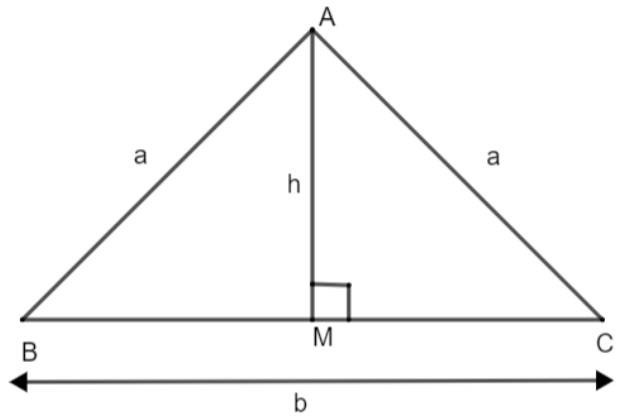
In the above figure, we have constructed AM perpendicular to base BC whose length is h. So, this AM can be considered as the height of the triangle.
Now, we know that in an isosceles triangle the perpendicular line drawn on the base bisects the base. So, we have,
\[\Rightarrow BM=CM=\dfrac{b}{2}\]
Now, in right angle \[\Delta AMC\], we have,
Hypotenuse = a = 13
Base = \[\dfrac{b}{2}\]
Perpendicular = h
Therefore, applying Pythagoras theorem, we get,
\[\Rightarrow \] Hypotenuse\[^{2}\] = base\[^{2}\] + perpendicular\[^{2}\]
\[\begin{align}
& \Rightarrow {{a}^{2}}={{\left( \dfrac{b}{2} \right)}^{2}}+{{h}^{2}} \\
& \Rightarrow {{13}^{2}}=\dfrac{{{b}^{2}}}{4}+{{h}^{2}} \\
\end{align}\]
\[\Rightarrow {{h}^{2}}=169-\dfrac{{{b}^{2}}}{4}\] - (1)
Here, we have been provided that the area of the isosceles triangle is \[60c{{m}^{2}}\]. Therefore, applying the formula for area of triangle given as: - Area = \[\dfrac{1}{2}\times \] base \[\times \] height, we get,
\[\begin{align}
& \Rightarrow 60=\dfrac{1}{2}\times b\times h \\
& \Rightarrow bh=120 \\
\end{align}\]
On squaring both sides, we get,
\[\Rightarrow {{b}^{2}}{{h}^{2}}={{\left( 120 \right)}^{2}}\]
Now, substituting the value of \[{{h}^{2}}\] from equation (1), we get,
\[\begin{align}
& \Rightarrow {{b}^{2}}\times \left( 169-\dfrac{{{b}^{2}}}{4} \right)={{\left( 120 \right)}^{2}} \\
& \Rightarrow {{b}^{2}}\times \left[ \dfrac{\left( 4\times 169 \right)-{{b}^{2}}}{4} \right]={{\left( 120 \right)}^{2}} \\
& \Rightarrow {{b}^{2}}\times \left[ {{\left( 26 \right)}^{2}}-{{b}^{2}} \right]={{\left( 120\times 2 \right)}^{2}} \\
& \Rightarrow {{\left( 26 \right)}^{2}}{{b}^{2}}-{{b}^{4}}={{\left( 240 \right)}^{2}} \\
& \Rightarrow {{b}^{4}}-{{\left( 26 \right)}^{2}}{{b}^{2}}+{{\left( 240 \right)}^{2}}=0 \\
\end{align}\]
Now, solving this bi – quadratic equation using discriminant method, we get,
\[\begin{align}
& \Rightarrow {{b}^{2}}=\dfrac{-\left( -{{\left( 26 \right)}^{2}} \right)\pm \sqrt{{{\left( {{\left( 26 \right)}^{2}} \right)}^{2}}-\left( 4 \right)\times {{\left( 240 \right)}^{2}}}}{2} \\
& \Rightarrow {{b}^{2}}=\dfrac{{{\left( 26 \right)}^{2}}\pm \sqrt{{{\left( 26 \right)}^{4}}-{{\left( 480 \right)}^{2}}}}{2} \\
\end{align}\]
Applying the identity, \[{{a}^{2}}-{{b}^{2}}=\left( a+b \right)\left( a-b \right)\], we get,
\[\Rightarrow {{b}^{2}}=\dfrac{{{\left( 26 \right)}^{2}}\pm \sqrt{\left( {{26}^{2}}+480 \right)\left( {{26}^{2}}-480 \right)}}{2}\]
\[\begin{align}
& \Rightarrow {{b}^{2}}=\dfrac{{{\left( 26 \right)}^{2}}\pm \sqrt{1156\times 196}}{2} \\
& \Rightarrow {{b}^{2}}=\dfrac{676\pm 34\times 14}{2} \\
& \Rightarrow {{b}^{2}}=\dfrac{676\pm 476}{2} \\
\end{align}\]
\[\Rightarrow {{b}^{2}}=100\] or 576
Taking square both sides, we get,
\[\Rightarrow \sqrt{{{b}^{2}}}=\sqrt{100}\] or \[\sqrt{576}\]
So, there can be two values of b, that is 10cm or 24cm.
Note: One may note that here we have obtained two values of b and we have to consider both the values because there is not any reason to reject any values. Note that if b = 10cm then corresponding h = 24cm and if b = 24cm then corresponding h = 10cm. You must check how we have reduced the calculation while solving the biquadratic equation. The terms are very large. so, if we will calculate them by squaring or multiplying then it will take a very long time.
Complete step-by-step solution
Here, let us assume the length of the equal sides of the isosceles triangle is ‘a’ and the length of the base is b. So, let us draw a diagram for this situation.
In the above figure, we have constructed AM perpendicular to base BC whose length is h. So, this AM can be considered as the height of the triangle.
Now, we know that in an isosceles triangle the perpendicular line drawn on the base bisects the base. So, we have,
\[\Rightarrow BM=CM=\dfrac{b}{2}\]
Now, in right angle \[\Delta AMC\], we have,
Hypotenuse = a = 13
Base = \[\dfrac{b}{2}\]
Perpendicular = h
Therefore, applying Pythagoras theorem, we get,
\[\Rightarrow \] Hypotenuse\[^{2}\] = base\[^{2}\] + perpendicular\[^{2}\]
\[\begin{align}
& \Rightarrow {{a}^{2}}={{\left( \dfrac{b}{2} \right)}^{2}}+{{h}^{2}} \\
& \Rightarrow {{13}^{2}}=\dfrac{{{b}^{2}}}{4}+{{h}^{2}} \\
\end{align}\]
\[\Rightarrow {{h}^{2}}=169-\dfrac{{{b}^{2}}}{4}\] - (1)
Here, we have been provided that the area of the isosceles triangle is \[60c{{m}^{2}}\]. Therefore, applying the formula for area of triangle given as: - Area = \[\dfrac{1}{2}\times \] base \[\times \] height, we get,
\[\begin{align}
& \Rightarrow 60=\dfrac{1}{2}\times b\times h \\
& \Rightarrow bh=120 \\
\end{align}\]
On squaring both sides, we get,
\[\Rightarrow {{b}^{2}}{{h}^{2}}={{\left( 120 \right)}^{2}}\]
Now, substituting the value of \[{{h}^{2}}\] from equation (1), we get,
\[\begin{align}
& \Rightarrow {{b}^{2}}\times \left( 169-\dfrac{{{b}^{2}}}{4} \right)={{\left( 120 \right)}^{2}} \\
& \Rightarrow {{b}^{2}}\times \left[ \dfrac{\left( 4\times 169 \right)-{{b}^{2}}}{4} \right]={{\left( 120 \right)}^{2}} \\
& \Rightarrow {{b}^{2}}\times \left[ {{\left( 26 \right)}^{2}}-{{b}^{2}} \right]={{\left( 120\times 2 \right)}^{2}} \\
& \Rightarrow {{\left( 26 \right)}^{2}}{{b}^{2}}-{{b}^{4}}={{\left( 240 \right)}^{2}} \\
& \Rightarrow {{b}^{4}}-{{\left( 26 \right)}^{2}}{{b}^{2}}+{{\left( 240 \right)}^{2}}=0 \\
\end{align}\]
Now, solving this bi – quadratic equation using discriminant method, we get,
\[\begin{align}
& \Rightarrow {{b}^{2}}=\dfrac{-\left( -{{\left( 26 \right)}^{2}} \right)\pm \sqrt{{{\left( {{\left( 26 \right)}^{2}} \right)}^{2}}-\left( 4 \right)\times {{\left( 240 \right)}^{2}}}}{2} \\
& \Rightarrow {{b}^{2}}=\dfrac{{{\left( 26 \right)}^{2}}\pm \sqrt{{{\left( 26 \right)}^{4}}-{{\left( 480 \right)}^{2}}}}{2} \\
\end{align}\]
Applying the identity, \[{{a}^{2}}-{{b}^{2}}=\left( a+b \right)\left( a-b \right)\], we get,
\[\Rightarrow {{b}^{2}}=\dfrac{{{\left( 26 \right)}^{2}}\pm \sqrt{\left( {{26}^{2}}+480 \right)\left( {{26}^{2}}-480 \right)}}{2}\]
\[\begin{align}
& \Rightarrow {{b}^{2}}=\dfrac{{{\left( 26 \right)}^{2}}\pm \sqrt{1156\times 196}}{2} \\
& \Rightarrow {{b}^{2}}=\dfrac{676\pm 34\times 14}{2} \\
& \Rightarrow {{b}^{2}}=\dfrac{676\pm 476}{2} \\
\end{align}\]
\[\Rightarrow {{b}^{2}}=100\] or 576
Taking square both sides, we get,
\[\Rightarrow \sqrt{{{b}^{2}}}=\sqrt{100}\] or \[\sqrt{576}\]
So, there can be two values of b, that is 10cm or 24cm.
Note: One may note that here we have obtained two values of b and we have to consider both the values because there is not any reason to reject any values. Note that if b = 10cm then corresponding h = 24cm and if b = 24cm then corresponding h = 10cm. You must check how we have reduced the calculation while solving the biquadratic equation. The terms are very large. so, if we will calculate them by squaring or multiplying then it will take a very long time.
Recently Updated Pages
Basicity of sulphurous acid and sulphuric acid are

Master Class 10 Computer Science: Engaging Questions & Answers for Success
Master Class 10 Social Science: Engaging Questions & Answers for Success
Master Class 10 Science: Engaging Questions & Answers for Success
Class 10 Question and Answer - Your Ultimate Solutions Guide
Master Class 10 Maths: Engaging Questions & Answers for Success
Trending doubts
What is the Total Duration of Football Match?
Explain the Treaty of Vienna of 1815 class 10 social science CBSE
In football, which nation is called "La Roja"?
Why is there a time difference of about 5 hours between class 10 social science CBSE
10 examples of evaporation in daily life with explanations
What is the full form of POSCO class 10 social science CBSE