




The area of a trapezium with equal non-parallel sides is 168 ${m^2}$. If the lengths of the parallel sides are 36 m and 20 m, find the length of each non-parallel side.
Answer
 Verified
654.9k+ views
Hint: Start solving the question by constructing perpendiculars from vertices $A$ and $B$. Find the length of perpendiculars using the formula of area of a trapezium, $A = \dfrac{{{\text{sum of parallel sides}}}}{2} \times h$, where $h$ is the length of perpendiculars. After that, use Pythagoras theorem in any of the triangles formed by the perpendicular to find the length of non-parallel sides.
Complete step by step answer:
We will first construct perpendiculars $AE$ on $FC$ and $BD$ as shown in the figure,
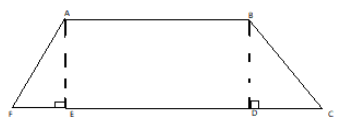
Since, $AB\parallel FC$, the height of perpendiculars is same, that is, $AE = BD$
We are given that the area of trapezium is 168 ${m^2}$.
The area of trapezium is, $A = \dfrac{{{\text{sum of parallel sides}}}}{2} \times h$, where $h$is the length of perpendiculars.
Substitute the given values in the formula to find the value of $h$.
$
168 = \dfrac{{36 + 20}}{2} \times h \\
168 = \dfrac{{56}}{2} \times h \\
168 = 28h \\
h = \dfrac{{168}}{{28}} \\
h = 6{\text{m}} \\
$
Thus, it implies that the length of the perpendiculars is 6m , $AE = BD = 6{\text{ m}}$
Now, we have to find the length of sides $AF$ and $BC$. It is given that the length of the non-parallel sides is equal. Hence, $AF = BC$.
Apply Pythagoras theorem in $\Delta AEF$.
Pythagoras theorem states that, ${\left( {{\text{Hypotenuse}}} \right)^2} = {\left( {{\text{Perpendicular}}} \right)^2}{\text{ + }}{\left( {{\text{Base}}} \right)^2}$
In $\Delta AEF$, $A{F^2} = A{E^2} + F{E^2}$
We will find the value of $FE$ because we have to substitute it in the above equation.
Since, $AB\parallel FC$ , $AE \bot FC$ and $AB \bot FC$, the length of $AB$ and $ED$ are equal.
Thus, $FE + ED + DC = 36$,
Consider $\Delta AEF$ and $\Delta BDC$
From both the triangles, we observed that,
$AF = BC\left( {{\text{Hypotenuse}}} \right)$
$AE = BD\left( {{\text{Perpendicular}}} \right)$
$\angle E = \angle D = {90^ \circ }\left( {{\text{Right angle}}} \right)$
Hence, $\Delta AEF \cong \Delta BDC$ by the RHS property of congruence.
Also, $FE$ and $DC$ will be equal as triangles $\Delta AEF$ and $\Delta BDC$ are congruent by RHS property.
$
2FE + 20 = 36 \\
2FE = 16 \\
FE = 8{\text{m}} \\
$
Now, substituting the values in Pythagoras theorem, we get,
$
A{F^2} = {6^2} + {8^2} \\
A{F^2} = 36 + 64 \\
A{F^2} = 100 \\
AF = 10{\text{m}} \\
$
Thus, the length of the non-parallel sides is 10 m
Note: The length of perpendiculars drawn between parallel lines is the same. Also, triangles, $\Delta AEF$ and $\Delta BDC$ are congruent by RHS property as $\angle E$ and $\angle D$ are right angles, $AE = BD = 6{\text{ m}}$ and hypotenuse $AF = BC$ (given in the question). The congruence of these triangles makes the length $FE$ and $DC$ are equal.
Complete step by step answer:
We will first construct perpendiculars $AE$ on $FC$ and $BD$ as shown in the figure,
Since, $AB\parallel FC$, the height of perpendiculars is same, that is, $AE = BD$
We are given that the area of trapezium is 168 ${m^2}$.
The area of trapezium is, $A = \dfrac{{{\text{sum of parallel sides}}}}{2} \times h$, where $h$is the length of perpendiculars.
Substitute the given values in the formula to find the value of $h$.
$
168 = \dfrac{{36 + 20}}{2} \times h \\
168 = \dfrac{{56}}{2} \times h \\
168 = 28h \\
h = \dfrac{{168}}{{28}} \\
h = 6{\text{m}} \\
$
Thus, it implies that the length of the perpendiculars is 6m , $AE = BD = 6{\text{ m}}$
Now, we have to find the length of sides $AF$ and $BC$. It is given that the length of the non-parallel sides is equal. Hence, $AF = BC$.
Apply Pythagoras theorem in $\Delta AEF$.
Pythagoras theorem states that, ${\left( {{\text{Hypotenuse}}} \right)^2} = {\left( {{\text{Perpendicular}}} \right)^2}{\text{ + }}{\left( {{\text{Base}}} \right)^2}$
In $\Delta AEF$, $A{F^2} = A{E^2} + F{E^2}$
We will find the value of $FE$ because we have to substitute it in the above equation.
Since, $AB\parallel FC$ , $AE \bot FC$ and $AB \bot FC$, the length of $AB$ and $ED$ are equal.
Thus, $FE + ED + DC = 36$,
Consider $\Delta AEF$ and $\Delta BDC$
From both the triangles, we observed that,
$AF = BC\left( {{\text{Hypotenuse}}} \right)$
$AE = BD\left( {{\text{Perpendicular}}} \right)$
$\angle E = \angle D = {90^ \circ }\left( {{\text{Right angle}}} \right)$
Hence, $\Delta AEF \cong \Delta BDC$ by the RHS property of congruence.
Also, $FE$ and $DC$ will be equal as triangles $\Delta AEF$ and $\Delta BDC$ are congruent by RHS property.
$
2FE + 20 = 36 \\
2FE = 16 \\
FE = 8{\text{m}} \\
$
Now, substituting the values in Pythagoras theorem, we get,
$
A{F^2} = {6^2} + {8^2} \\
A{F^2} = 36 + 64 \\
A{F^2} = 100 \\
AF = 10{\text{m}} \\
$
Thus, the length of the non-parallel sides is 10 m
Note: The length of perpendiculars drawn between parallel lines is the same. Also, triangles, $\Delta AEF$ and $\Delta BDC$ are congruent by RHS property as $\angle E$ and $\angle D$ are right angles, $AE = BD = 6{\text{ m}}$ and hypotenuse $AF = BC$ (given in the question). The congruence of these triangles makes the length $FE$ and $DC$ are equal.
Recently Updated Pages
Differentiate between voluntary action and reflex class 10 biology CBSE

The uses of bleaching powder are A It is used bleaching class 10 chemistry CBSE
Fill in the blanks with abstract nouns of the words class 10 english CBSE
How many threedigit numbers are there class 10 maths CBSE
What is a reflex arc class 10 biology CBSE
Construct a square whose diagonal is 6cm Measure the class 10 maths CBSE
Trending doubts
Explain the Treaty of Vienna of 1815 class 10 social science CBSE
The slogan Jai Hind was given by A Lal Bahadur Shastri class 10 social science CBSE
10 examples of evaporation in daily life with explanations
What is the full form of POSCO class 10 social science CBSE
Identify the feminine form of noun nephew a shenephew class 10 english CBSE
CSIR full form?