




The area of a rhombus whose diagonals lengths are 16cm and 24cm is?
Answer
 Verified
622.8k+ views
Hint: We start solving the problem by assigning variables to the length of the diagonals of the given rhombus. We then use the fact that the area of the rhombus is equal to half of the product of the lengths of the diagonals i.e., $\dfrac{{{d}_{1}}\times {{d}_{2}}}{2}$. We then substitute the given values of the lengths of the diagonals and make necessary calculations to get the required area.
Complete step by step answer:
We know that the area of a rhombus can be defined as the amount of space enclosed by a rhombus in a two – dimensional space.
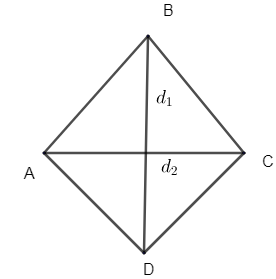
Let us consider a rhombus as shown in the figure. Let ${{d}_{1}}$ be the length of the first diagonal and ${{d}_{2}}$ be the length of the second diagonal of the rhombus.
We have been given the diagonals of the rhombus as 16cm and 24cm. Let us consider ${{d}_{1}}=16cm$and ${{d}_{2}}=24cm$.
We know that if two diagonals of a rhombus are given, then the area can be found using the formula,
Area of rhombus = $\dfrac{1}{2}\times \text{product of lengths of two diagonals}$.
Area of rhombus = $\dfrac{1}{2}\times {{d}_{1}}\times {{d}_{2}}$.
Area of rhombus = $\dfrac{{{d}_{1}}\times {{d}_{2}}}{2}$.
Now, we substitute the lengths of diagonals to find the area of the given rhombus.
Area of rhombus = $\dfrac{16\times 24}{2}$.
Area of rhombus = $16\times 12$.
Area of rhombus = $192c{{m}^{2}}$.
So, we got the area of a rhombus as $192c{{m}^{2}}$.
∴ The area of the rhombus with diagonals lengths 16cm and 24cm is $192c{{m}^{2}}$.
Note:
We can alternatively solve the problem as follows:
We know that the diagonals bisect each other at an angle of ${{90}^{\circ }}$. From the figure we can see that the rhombus is divided into 4 equal right-angled triangles with length of height $\dfrac{{{d}_{1}}}{2}$ and base $\dfrac{{{d}_{2}}}{2}$.
We know that the area of the triangle is $A=\dfrac{1}{2}\times \text{base}\times \text{height}$.
Now, $A=\dfrac{1}{2}\times \dfrac{16}{2}\times \dfrac{24}{2}$.
$A=48c{{m}^{2}}$.
So, we have the area of the rhombus as 4 times the area A.
So, the area of the rhombus is $4A=4\times 48=192c{{m}^{2}}$.
We can also find the length of the sides of the rhombus using the lengths of diagonals.
Complete step by step answer:
We know that the area of a rhombus can be defined as the amount of space enclosed by a rhombus in a two – dimensional space.
Let us consider a rhombus as shown in the figure. Let ${{d}_{1}}$ be the length of the first diagonal and ${{d}_{2}}$ be the length of the second diagonal of the rhombus.
We have been given the diagonals of the rhombus as 16cm and 24cm. Let us consider ${{d}_{1}}=16cm$and ${{d}_{2}}=24cm$.
We know that if two diagonals of a rhombus are given, then the area can be found using the formula,
Area of rhombus = $\dfrac{1}{2}\times \text{product of lengths of two diagonals}$.
Area of rhombus = $\dfrac{1}{2}\times {{d}_{1}}\times {{d}_{2}}$.
Area of rhombus = $\dfrac{{{d}_{1}}\times {{d}_{2}}}{2}$.
Now, we substitute the lengths of diagonals to find the area of the given rhombus.
Area of rhombus = $\dfrac{16\times 24}{2}$.
Area of rhombus = $16\times 12$.
Area of rhombus = $192c{{m}^{2}}$.
So, we got the area of a rhombus as $192c{{m}^{2}}$.
∴ The area of the rhombus with diagonals lengths 16cm and 24cm is $192c{{m}^{2}}$.
Note:
We can alternatively solve the problem as follows:
We know that the diagonals bisect each other at an angle of ${{90}^{\circ }}$. From the figure we can see that the rhombus is divided into 4 equal right-angled triangles with length of height $\dfrac{{{d}_{1}}}{2}$ and base $\dfrac{{{d}_{2}}}{2}$.
We know that the area of the triangle is $A=\dfrac{1}{2}\times \text{base}\times \text{height}$.
Now, $A=\dfrac{1}{2}\times \dfrac{16}{2}\times \dfrac{24}{2}$.
$A=48c{{m}^{2}}$.
So, we have the area of the rhombus as 4 times the area A.
So, the area of the rhombus is $4A=4\times 48=192c{{m}^{2}}$.
We can also find the length of the sides of the rhombus using the lengths of diagonals.
Recently Updated Pages
Master Class 11 English: Engaging Questions & Answers for Success

Master Class 11 Social Science: Engaging Questions & Answers for Success
Master Class 11 Maths: Engaging Questions & Answers for Success
Master Class 11 Biology: Engaging Questions & Answers for Success
Master Class 11 Physics: Engaging Questions & Answers for Success
Master Class 11 Chemistry: Engaging Questions & Answers for Success
Trending doubts
Explain the Treaty of Vienna of 1815 class 10 social science CBSE
What is the full form of POSCO class 10 social science CBSE
Define Potential, Developed, Stock and Reserved resources
The diagonals of a rhombus are 10cm and 24cm Find the class 10 maths CBSE
Fill the blanks with proper collective nouns 1 A of class 10 english CBSE
One number is chosen from numbers 1 to 200 Find the class 10 maths CBSE