




The area of a parallelogram whose diagonal is 6.8cm and the perpendicular to this diagonal from an opposite vertex is 7.5cm is
A. $25.5c{m^2}$
B. $11.9c{m^2}$
C. $12.5c{m^2}$
D. $51c{m^2}$
Answer
 Verified
610.8k+ views
Hint: We draw a parallelogram and its diagonal. The diagonal divides the parallelogram into two triangles. Then we can find the area of the triangles by taking the diagonal as the base and perpendicular distance as the altitude. We can obtain the total area of the parallelogram by taking twice the area of the triangle.
Complete step-by-step answer:
We can draw a parallelogram ABCD with its diagonal AC and the perpendicular distance from B to the diagonal.
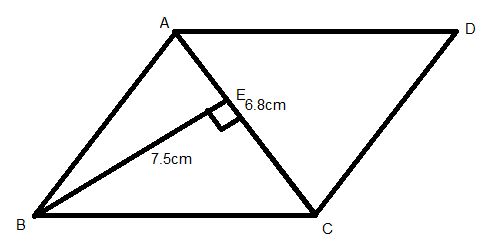
It is given that diagonal is 6.8cm. From the figure, we can write,
$AC = 6.8cm$
It is given that the perpendicular distance from the diagonal is 7.5cm. so we can write,
$BE = 7.5cm$
Now we can consider the triangle ABC. From the figure, AC is base and BE is the altitude. Then the area of the triangle is given by, $a = \dfrac{1}{2} \times AC \times BE$
On substituting the values, we get,
$ \Rightarrow a = \dfrac{1}{2} \times 6.8 \times 7.5$
On simplification we get,
$ \Rightarrow a = 25.5{m^2}$
We know that the diagonal of a parallelogram divides it into 2 triangles of equal area.
So, the total area of the parallelogram ABCD is twice the area of the triangle ABC.
$ \Rightarrow A = 2 \times a$
On substituting the area of the rectangle, we get,
$ \Rightarrow A = 2 \times 25.5$
On simplification we get,
$ \Rightarrow A = 51c{m^2}$
Therefore, the area of the parallelogram is $51c{m^2}$
So, the correct answer is option D.
Note: We know that parallelograms are quadrilaterals that have opposite sides equal and parallel. The diagonals of a parallelogram are equal, so we can take the given length of the diagonal as any of the 2 diagonals. The diagonals of a parallelogram bisect each other. The diagonal also divides the parallelogram into two congruent triangles. As the triangles are congruent, the triangles will have equal area with each having half of the area of the parallelogram.
Complete step-by-step answer:
We can draw a parallelogram ABCD with its diagonal AC and the perpendicular distance from B to the diagonal.
It is given that diagonal is 6.8cm. From the figure, we can write,
$AC = 6.8cm$
It is given that the perpendicular distance from the diagonal is 7.5cm. so we can write,
$BE = 7.5cm$
Now we can consider the triangle ABC. From the figure, AC is base and BE is the altitude. Then the area of the triangle is given by, $a = \dfrac{1}{2} \times AC \times BE$
On substituting the values, we get,
$ \Rightarrow a = \dfrac{1}{2} \times 6.8 \times 7.5$
On simplification we get,
$ \Rightarrow a = 25.5{m^2}$
We know that the diagonal of a parallelogram divides it into 2 triangles of equal area.
So, the total area of the parallelogram ABCD is twice the area of the triangle ABC.
$ \Rightarrow A = 2 \times a$
On substituting the area of the rectangle, we get,
$ \Rightarrow A = 2 \times 25.5$
On simplification we get,
$ \Rightarrow A = 51c{m^2}$
Therefore, the area of the parallelogram is $51c{m^2}$
So, the correct answer is option D.
Note: We know that parallelograms are quadrilaterals that have opposite sides equal and parallel. The diagonals of a parallelogram are equal, so we can take the given length of the diagonal as any of the 2 diagonals. The diagonals of a parallelogram bisect each other. The diagonal also divides the parallelogram into two congruent triangles. As the triangles are congruent, the triangles will have equal area with each having half of the area of the parallelogram.
Recently Updated Pages
Master Class 12 Business Studies: Engaging Questions & Answers for Success

Master Class 12 Biology: Engaging Questions & Answers for Success
Master Class 12 Chemistry: Engaging Questions & Answers for Success
Class 12 Question and Answer - Your Ultimate Solutions Guide
Master Class 11 Social Science: Engaging Questions & Answers for Success
Master Class 11 English: Engaging Questions & Answers for Success
Trending doubts
What is BLO What is the full form of BLO class 8 social science CBSE
What are the 12 elements of nature class 8 chemistry CBSE
Citizens of India can vote at the age of A 18 years class 8 social science CBSE
Right to vote is a AFundamental Right BFundamental class 8 social science CBSE
Advantages and disadvantages of science
Full form of STD, ISD and PCO