




The area of a circle inscribed in an equilateral triangle is 154sq.cm. Find the perimeter of the triangle.
Answer
 Verified
579.3k+ views
Hint: One should be aware of perimeter and area of circle and triangle. It involves some basic formulae for perimeter and area. And basically for triangles, Pythagora's theorem is also used.
Area of circle =$\text{ }\pi {{\text{r}}^{2}}$, Where r is the radius of circle and value of $\pi $ is $\dfrac{22}{7}$.
Equilateral triangle is the triangle which has all sides equal and each angle is of ${{60}^{\circ }}$ .
Pythagoras theorem is used in right-angled triangles.

According to this theorem,
${{\left( hypotenuse \right)}^{2}}={{\left( perpendicular \right)}^{2}}+{{\left( base \right)}^{2}}$
${{\left( AC \right)}^{2}}={{\left( AB \right)}^{2}}+{{\left( BC \right)}^{2}}$
Complete step-by-step answer:
Now, let’s solve the question.
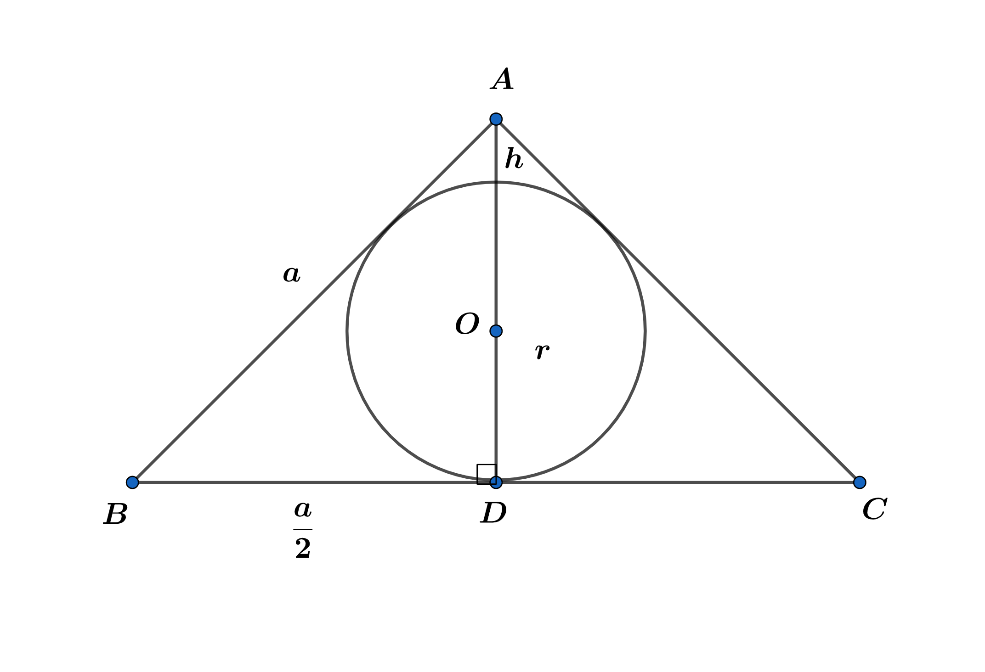
Let the radius of the circle be ‘r’ cm.
Then, area of circle =$\pi {{r}^{2}}$
$\Rightarrow 154=\dfrac{22}{7}\times {{r}^{2}}$
Now, we need to find r.
$\Rightarrow {{r}^{2}}=154\times \dfrac{7}{22}$
After reducing,
$\begin{align}
& \Rightarrow {{r}^{2}}=49 \\
& \Rightarrow r=7cm \\
\end{align}$
As we know that ABC is an equilateral triangle, h is the altitude of $\Delta ABC$ and O is the centre of $\Delta ABC$, is the point of intersection of the angular bisectors. So we can say that these bisectors are also the altitude and medians whose point of intersection divides the medians in the ratio 2:1, hence:
$\therefore \angle $ADB = ${{90}^{\circ }}$ and OD = $\dfrac{1}{3}$ AD and OD is radius of circle.
Now, let each side of the triangle be ‘a’ cm and its height be ‘h’ cm.
Then, \[r=\dfrac{h}{3}\Rightarrow h=3r\]
\[\begin{align}
& \Rightarrow h=3\times 7 \\
& \Rightarrow h=21cm \\
\end{align}\]
From figure we can observe that height is the perpendicular, if a is the side then $\dfrac{a}{\begin{align}
& 2 \\
& \\
\end{align}}$ is the base of the right angled triangle and ‘a’ i.e. side of the triangle will be considered as the hypotenuse of the triangle.
$\Rightarrow {{a}^{2}}={{h}^{2}}+{{\left( \dfrac{a}{2} \right)}^{2}}$
On further solving,
$\begin{align}
& \Rightarrow {{h}^{2}}={{a}^{2}}-{{\left( \dfrac{a}{2} \right)}^{2}} \\
& \Rightarrow h=\sqrt{{{a}^{2}}-{{\left( \dfrac{a}{2} \right)}^{2}}}=\dfrac{\sqrt{3}a}{2} \\
& \Rightarrow \dfrac{21\times 2}{\sqrt{3}}=a \\
& \Rightarrow a=\dfrac{42}{\sqrt{3}}\times \dfrac{\sqrt{3}}{\sqrt{3}} \\
& \Rightarrow 14\sqrt{3} \\
\end{align}$
Value of $\sqrt{3}$ is 1.73.
Perimeter of the equilateral triangle is $3\times 14\times 1.73$ = 72.66cm.
Note: Remember all the formulae before solving questions related to perimeter and area. At the end, solve the whole answer including root value. Do not leave the answer in under root. And always draw diagrams before solving such questions. The common mistake done by students is that they do not rationalise root value.
Area of circle =$\text{ }\pi {{\text{r}}^{2}}$, Where r is the radius of circle and value of $\pi $ is $\dfrac{22}{7}$.
Equilateral triangle is the triangle which has all sides equal and each angle is of ${{60}^{\circ }}$ .
Pythagoras theorem is used in right-angled triangles.
According to this theorem,
${{\left( hypotenuse \right)}^{2}}={{\left( perpendicular \right)}^{2}}+{{\left( base \right)}^{2}}$
${{\left( AC \right)}^{2}}={{\left( AB \right)}^{2}}+{{\left( BC \right)}^{2}}$
Complete step-by-step answer:
Now, let’s solve the question.
Let the radius of the circle be ‘r’ cm.
Then, area of circle =$\pi {{r}^{2}}$
$\Rightarrow 154=\dfrac{22}{7}\times {{r}^{2}}$
Now, we need to find r.
$\Rightarrow {{r}^{2}}=154\times \dfrac{7}{22}$
After reducing,
$\begin{align}
& \Rightarrow {{r}^{2}}=49 \\
& \Rightarrow r=7cm \\
\end{align}$
As we know that ABC is an equilateral triangle, h is the altitude of $\Delta ABC$ and O is the centre of $\Delta ABC$, is the point of intersection of the angular bisectors. So we can say that these bisectors are also the altitude and medians whose point of intersection divides the medians in the ratio 2:1, hence:
$\therefore \angle $ADB = ${{90}^{\circ }}$ and OD = $\dfrac{1}{3}$ AD and OD is radius of circle.
Now, let each side of the triangle be ‘a’ cm and its height be ‘h’ cm.
Then, \[r=\dfrac{h}{3}\Rightarrow h=3r\]
\[\begin{align}
& \Rightarrow h=3\times 7 \\
& \Rightarrow h=21cm \\
\end{align}\]
From figure we can observe that height is the perpendicular, if a is the side then $\dfrac{a}{\begin{align}
& 2 \\
& \\
\end{align}}$ is the base of the right angled triangle and ‘a’ i.e. side of the triangle will be considered as the hypotenuse of the triangle.
$\Rightarrow {{a}^{2}}={{h}^{2}}+{{\left( \dfrac{a}{2} \right)}^{2}}$
On further solving,
$\begin{align}
& \Rightarrow {{h}^{2}}={{a}^{2}}-{{\left( \dfrac{a}{2} \right)}^{2}} \\
& \Rightarrow h=\sqrt{{{a}^{2}}-{{\left( \dfrac{a}{2} \right)}^{2}}}=\dfrac{\sqrt{3}a}{2} \\
& \Rightarrow \dfrac{21\times 2}{\sqrt{3}}=a \\
& \Rightarrow a=\dfrac{42}{\sqrt{3}}\times \dfrac{\sqrt{3}}{\sqrt{3}} \\
& \Rightarrow 14\sqrt{3} \\
\end{align}$
Value of $\sqrt{3}$ is 1.73.
Perimeter of the equilateral triangle is $3\times 14\times 1.73$ = 72.66cm.
Note: Remember all the formulae before solving questions related to perimeter and area. At the end, solve the whole answer including root value. Do not leave the answer in under root. And always draw diagrams before solving such questions. The common mistake done by students is that they do not rationalise root value.
Recently Updated Pages
Master Class 10 Social Science: Engaging Questions & Answers for Success

Master Class 10 Science: Engaging Questions & Answers for Success
Master Class 10 Maths: Engaging Questions & Answers for Success
Master Class 10 General Knowledge: Engaging Questions & Answers for Success
Master Class 10 Computer Science: Engaging Questions & Answers for Success
Class 10 Question and Answer - Your Ultimate Solutions Guide
Trending doubts
What is the full form of PNG A Petrol Natural Gas B class 10 chemistry CBSE
Explain the Treaty of Vienna of 1815 class 10 social science CBSE
In cricket, how many legal balls are there in a standard over?
Why is there a time difference of about 5 hours between class 10 social science CBSE
Who Won 36 Oscar Awards? Record Holder Revealed
What is the median of the first 10 natural numbers class 10 maths CBSE