




The area bounded by $y=\cos x$ , $y=x+1$ , $y=0$ is.
A.$\dfrac{3}{2}$
B.$\dfrac{2}{3}$
C.$\dfrac{1}{2}$
D.$\dfrac{5}{2}$
Answer
 Verified
615.9k+ views
Hint: Start by drawing the diagram of the situation given in the figure. Find the area of the required regions by using the formula of area of triangle and area using definite integration. If needed find the intersection points of the curves given in the question as well.
Complete step-by-step answer:
Let us start the solution to the above question by drawing the representative figure of the situation given the question.
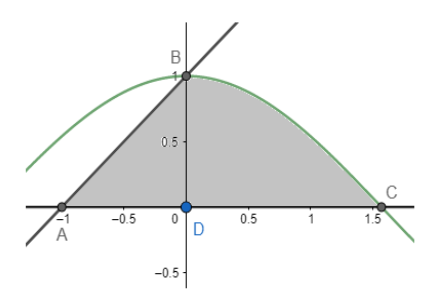
In the figure, the green curve passing through the points B and C is the graph of cosx. Point B is (0,1), as cosx and y=x+1 both pass through the point (0,1). Also, we know that cosx intersects the x-axis at point $C\left( \dfrac{\pi }{2},0 \right)$ . Point A is the intersection of y=x+1 and y=0 and its coordinates are (-1,0).
Now, we need to find the area of the shaded region. ABD is a triangle with height BD=1unit and base AD=1 unit.
$ar\left( \Delta ABD \right)=\dfrac{1}{2}\times AD\times BD=\dfrac{1}{2}\times 1\times 1=\dfrac{1}{2}\text{ uni}{{\text{t}}^{2}}$ .
Now, to find the area of the region BDC, we need to use the method of definite integration. The region is the area bounded by the function y=cosx with the positive x-axis. We know that the area bounded by any general curve y=f(x), in region x=a to x=b is given by $\int\limits_{a}^{b}{f(x)dx}$ .
$ar\left( BCD \right)=\int\limits_{0}^{\dfrac{\pi }{2}}{\cos xdx}$
Now, we know that the integral of cosx is equal to sinx.
$ar\left( BCD \right)=\int\limits_{0}^{\dfrac{\pi }{2}}{\cos xdx}=\sin x|_{0}^{\dfrac{\pi }{2}}=\sin \dfrac{\pi }{2}-\sin 0=1\text{ uni}{{\text{t}}^{2}}$
Now, we know that the area of the total region ABC is the sum of the area of BCD and ABD.
$\therefore ar\left( ABC \right)=ar\left( BCD \right)+ar\left( ABD \right)=1+\dfrac{1}{2}=\dfrac{3}{2}\text{ uni}{{\text{t}}^{2}}$
Therefore, the answer to the above question is option (a).
Note: You need to learn all the integrals of the standard functions along with the values of different trigonometric ratios for different standard angles, as they are used very often. Also, learn the graphs of different standard functions, as in such questions, the most important part is the diagram and for drawing the diagram you need to know the curves.
Complete step-by-step answer:
Let us start the solution to the above question by drawing the representative figure of the situation given the question.
In the figure, the green curve passing through the points B and C is the graph of cosx. Point B is (0,1), as cosx and y=x+1 both pass through the point (0,1). Also, we know that cosx intersects the x-axis at point $C\left( \dfrac{\pi }{2},0 \right)$ . Point A is the intersection of y=x+1 and y=0 and its coordinates are (-1,0).
Now, we need to find the area of the shaded region. ABD is a triangle with height BD=1unit and base AD=1 unit.
$ar\left( \Delta ABD \right)=\dfrac{1}{2}\times AD\times BD=\dfrac{1}{2}\times 1\times 1=\dfrac{1}{2}\text{ uni}{{\text{t}}^{2}}$ .
Now, to find the area of the region BDC, we need to use the method of definite integration. The region is the area bounded by the function y=cosx with the positive x-axis. We know that the area bounded by any general curve y=f(x), in region x=a to x=b is given by $\int\limits_{a}^{b}{f(x)dx}$ .
$ar\left( BCD \right)=\int\limits_{0}^{\dfrac{\pi }{2}}{\cos xdx}$
Now, we know that the integral of cosx is equal to sinx.
$ar\left( BCD \right)=\int\limits_{0}^{\dfrac{\pi }{2}}{\cos xdx}=\sin x|_{0}^{\dfrac{\pi }{2}}=\sin \dfrac{\pi }{2}-\sin 0=1\text{ uni}{{\text{t}}^{2}}$
Now, we know that the area of the total region ABC is the sum of the area of BCD and ABD.
$\therefore ar\left( ABC \right)=ar\left( BCD \right)+ar\left( ABD \right)=1+\dfrac{1}{2}=\dfrac{3}{2}\text{ uni}{{\text{t}}^{2}}$
Therefore, the answer to the above question is option (a).
Note: You need to learn all the integrals of the standard functions along with the values of different trigonometric ratios for different standard angles, as they are used very often. Also, learn the graphs of different standard functions, as in such questions, the most important part is the diagram and for drawing the diagram you need to know the curves.
Recently Updated Pages
Basicity of sulphurous acid and sulphuric acid are

Master Class 11 Business Studies: Engaging Questions & Answers for Success
Master Class 11 Computer Science: Engaging Questions & Answers for Success
Master Class 11 Economics: Engaging Questions & Answers for Success
Master Class 11 Social Science: Engaging Questions & Answers for Success
Master Class 11 English: Engaging Questions & Answers for Success
Trending doubts
One Metric ton is equal to kg A 10000 B 1000 C 100 class 11 physics CBSE
The largest wind power cluster is located in the state class 11 social science CBSE
Explain zero factorial class 11 maths CBSE
State and prove Bernoullis theorem class 11 physics CBSE
Which among the following are examples of coming together class 11 social science CBSE
Can anyone list 10 advantages and disadvantages of friction