




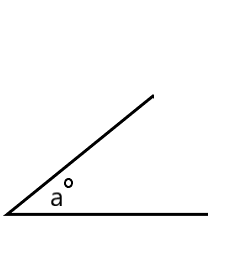
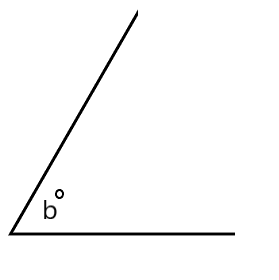
The angles shown below are acute and \[\sin ({a^ \circ }) = \cos {b^ \circ }\]. If a=4k-22 and b=6k-13, what is the value of k? Note that the figures are not drawn to scale.
Answer
 Verified
556.2k+ views
Hint: According to the question, we will first find out ‘b’. Then, we will solve the two equations given in the question in terms of ‘a’ and ‘b’ only, and try to cancel out ‘k’. Then, we will find out the value of ‘a’ and then together put the value of ‘a’ and ‘b’ to find ‘k’.
Formula used: \[\sin a = \cos (90 - a)\]
Complete step by step answer:
Given is \[\sin ({a^ \circ }) = \cos {b^ \circ }\]. Now, we will consider this as equation (1).
We know that \[\sin a = \cos (90 - a)\]. Here, we will consider this equation as equation (2).
After comparing both the equations (1) and (2), we get that:
\[b = (90 - a)\]
We will consider this as equation (3). This equation is important and will be used further.
From the question, we were given two equations:
\[a = 4k - 22{\text{ and }}b = 6k - 13\]
We will solve these two equations, so that the variable ‘k’ gets cancelled out from both the equations, and we get the equation in terms of ‘a’ and ‘b’. So, we will consider the first equation that is \[a = 4k - 22\] as equation (i) and the second one as equation (ii). Now we will multiply equation (i) with 3 and equation (ii) with $2$, so that we cancel out the common terms:
$
\;\;\;3a = 12k - 66 \\
\;\underline
\;\;2b = 12k - 26 \\
- \;\;\;\;\; - \;\;\;\;\;\; + \\
\\
\;\;\;3a - 2b = - 40 \\
$
We can also write it as:
\[2b - 3a = 40\]
Now, we will put the value of ‘b’ from equation (1), and we get:
\[ \Rightarrow 2(90 - a) - 3a = 40\]
We will further solve this to get the value of ‘a’, and we get:
\[ \Rightarrow 180 - 2a - 3a = 40\]
\[ \Rightarrow 180 - 5a = 40\]
\[ \Rightarrow 5a = 140\]
\[ \Rightarrow a = 28\]
Now, we will put the value of ‘a’ in equation (i) and we will get the value of ‘k’:
\[a = 4k - 22\]
\[ \Rightarrow 28 = 4k - 22\]
\[ \Rightarrow 28 + 22 = 4k\]
\[ \Rightarrow 4k = 50\]
\[ \Rightarrow k = \dfrac{{50}}{4}\]
\[ \Rightarrow k = 12.5\]
Therefore, the value of ‘k’ is \[12.5\].
Note: The above method was very easy, but there is another method. If both the angles are given acutely and both the equations are given, then we can add both the equations directly and equate it to 90, because the angles are acute and so equation (1) + equation (2) = 90. Solving this equation, we will get the value of ‘k’.
Formula used: \[\sin a = \cos (90 - a)\]
Complete step by step answer:
Given is \[\sin ({a^ \circ }) = \cos {b^ \circ }\]. Now, we will consider this as equation (1).
We know that \[\sin a = \cos (90 - a)\]. Here, we will consider this equation as equation (2).
After comparing both the equations (1) and (2), we get that:
\[b = (90 - a)\]
We will consider this as equation (3). This equation is important and will be used further.
From the question, we were given two equations:
\[a = 4k - 22{\text{ and }}b = 6k - 13\]
We will solve these two equations, so that the variable ‘k’ gets cancelled out from both the equations, and we get the equation in terms of ‘a’ and ‘b’. So, we will consider the first equation that is \[a = 4k - 22\] as equation (i) and the second one as equation (ii). Now we will multiply equation (i) with 3 and equation (ii) with $2$, so that we cancel out the common terms:
$
\;\;\;3a = 12k - 66 \\
\;\underline
\;\;2b = 12k - 26 \\
- \;\;\;\;\; - \;\;\;\;\;\; + \\
\\
\;\;\;3a - 2b = - 40 \\
$
We can also write it as:
\[2b - 3a = 40\]
Now, we will put the value of ‘b’ from equation (1), and we get:
\[ \Rightarrow 2(90 - a) - 3a = 40\]
We will further solve this to get the value of ‘a’, and we get:
\[ \Rightarrow 180 - 2a - 3a = 40\]
\[ \Rightarrow 180 - 5a = 40\]
\[ \Rightarrow 5a = 140\]
\[ \Rightarrow a = 28\]
Now, we will put the value of ‘a’ in equation (i) and we will get the value of ‘k’:
\[a = 4k - 22\]
\[ \Rightarrow 28 = 4k - 22\]
\[ \Rightarrow 28 + 22 = 4k\]
\[ \Rightarrow 4k = 50\]
\[ \Rightarrow k = \dfrac{{50}}{4}\]
\[ \Rightarrow k = 12.5\]
Therefore, the value of ‘k’ is \[12.5\].
Note: The above method was very easy, but there is another method. If both the angles are given acutely and both the equations are given, then we can add both the equations directly and equate it to 90, because the angles are acute and so equation (1) + equation (2) = 90. Solving this equation, we will get the value of ‘k’.
Recently Updated Pages
Master Class 12 Social Science: Engaging Questions & Answers for Success

Master Class 12 Physics: Engaging Questions & Answers for Success
Master Class 12 Maths: Engaging Questions & Answers for Success
Master Class 12 Economics: Engaging Questions & Answers for Success
Master Class 12 Chemistry: Engaging Questions & Answers for Success
Master Class 12 Business Studies: Engaging Questions & Answers for Success
Trending doubts
Which are the Top 10 Largest Countries of the World?
Draw a labelled sketch of the human eye class 12 physics CBSE
Explain the structure of megasporangium class 12 biology CBSE
What are the major means of transport Explain each class 12 social science CBSE
How many chromosomes are found in human ovum a 46 b class 12 biology CBSE
The diagram of the section of a maize grain is given class 12 biology CBSE