




The angles of elevation of the top of a building and the top of the chimney on the roof of the building from a point on the ground are x and \[{{45}^{o}}\] respectively. The height of the building is h meter. Then the height of the chimney, in meter is:
(a) h cot x + h
(b) h cot x – h
(c) h tan x – h
(d) h tan x + h
Answer
 Verified
653.4k+ views
Hint: To solve this question, we will assume that the height of the chimney be ‘y m’. Also, we will assume that the distance of the point from where things are being observed from the building is ‘p m’. Now, according to the data given in the question, we will form two equations with the two unknown variables (x and p) and then we will solve it by substitution method.
Complete step-by-step answer:
The rough sketch of all the things as mentioned in the question is given below.
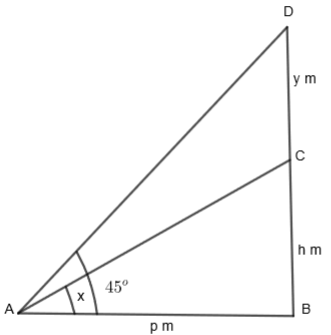
So, we can see from the figure that the point from which all the things have been observed is A. The height of the building is BC = h m. The height of the chimney is y m. And the horizontal distance of both the chimney and the building from point A is p m. The angle of elevation of the top of the building = \[\angle CAB\] and the angle of elevation of the top of the chimney is \[\angle DAB.\]
Now, we will consider the triangle ABC. Triangle ABC is a right-angled triangle. In the right-angled triangle XYZ, we can say that,
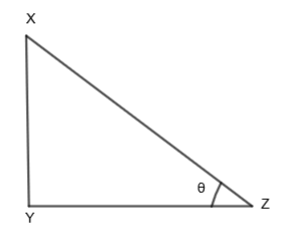
\[\tan \theta =\dfrac{XY}{YZ}\]
Thus, in triangle ABC, we can say that,
\[\tan \left( \angle CAB \right)=\dfrac{BC}{AB}\]
Here, we know that, \[\angle CAB=x,\] BC = h m and AB = p m. So, we will get the following equation.
\[\Rightarrow \tan x=\dfrac{h}{p}....\left( i \right)\]
Now, we will consider the triangle ABD. Similarly, from the above, we can say that,
\[\tan \left( \angle DAB \right)=\dfrac{DB}{AB}\]
\[\Rightarrow \tan {{45}^{o}}=\dfrac{DB}{AB}\]
We know that \[\tan {{45}^{o}}=1.\] So, we get,
\[\Rightarrow 1=\dfrac{DB}{AB}\]
\[\Rightarrow AB=DB\]
\[\Rightarrow DB=p\text{ }m\]
Now, DB = DC + BC. So, we will get,
\[\Rightarrow DC+CB=p\]
\[\Rightarrow y+h=p...\left( ii \right)\]
From equation (i), we have,
\[\tan x=\dfrac{h}{p}\]
\[\Rightarrow p=\dfrac{h}{\tan x}\]
\[\Rightarrow p=h\cot x....\left( iii \right)\]
Substituting the value of p from (iii) to (ii), we will get,
\[\Rightarrow y+h=h\cot x\]
\[\Rightarrow y=h\cot x-h\]
Thus the height of the chimney = h cot x – h
Hence, option (b) is the right answer.
Note: In this question, we are not given whether the horizontal distance from A to the building and chimney are the same or not. Here, we have assumed that the distance of A to the building and distance of A to the chimney are the same horizontally. If we don’t assume this, then we will get an extra variable in the final answer which we do not desire.
Complete step-by-step answer:
The rough sketch of all the things as mentioned in the question is given below.
So, we can see from the figure that the point from which all the things have been observed is A. The height of the building is BC = h m. The height of the chimney is y m. And the horizontal distance of both the chimney and the building from point A is p m. The angle of elevation of the top of the building = \[\angle CAB\] and the angle of elevation of the top of the chimney is \[\angle DAB.\]
Now, we will consider the triangle ABC. Triangle ABC is a right-angled triangle. In the right-angled triangle XYZ, we can say that,
\[\tan \theta =\dfrac{XY}{YZ}\]
Thus, in triangle ABC, we can say that,
\[\tan \left( \angle CAB \right)=\dfrac{BC}{AB}\]
Here, we know that, \[\angle CAB=x,\] BC = h m and AB = p m. So, we will get the following equation.
\[\Rightarrow \tan x=\dfrac{h}{p}....\left( i \right)\]
Now, we will consider the triangle ABD. Similarly, from the above, we can say that,
\[\tan \left( \angle DAB \right)=\dfrac{DB}{AB}\]
\[\Rightarrow \tan {{45}^{o}}=\dfrac{DB}{AB}\]
We know that \[\tan {{45}^{o}}=1.\] So, we get,
\[\Rightarrow 1=\dfrac{DB}{AB}\]
\[\Rightarrow AB=DB\]
\[\Rightarrow DB=p\text{ }m\]
Now, DB = DC + BC. So, we will get,
\[\Rightarrow DC+CB=p\]
\[\Rightarrow y+h=p...\left( ii \right)\]
From equation (i), we have,
\[\tan x=\dfrac{h}{p}\]
\[\Rightarrow p=\dfrac{h}{\tan x}\]
\[\Rightarrow p=h\cot x....\left( iii \right)\]
Substituting the value of p from (iii) to (ii), we will get,
\[\Rightarrow y+h=h\cot x\]
\[\Rightarrow y=h\cot x-h\]
Thus the height of the chimney = h cot x – h
Hence, option (b) is the right answer.
Note: In this question, we are not given whether the horizontal distance from A to the building and chimney are the same or not. Here, we have assumed that the distance of A to the building and distance of A to the chimney are the same horizontally. If we don’t assume this, then we will get an extra variable in the final answer which we do not desire.
Recently Updated Pages
Master Class 11 English: Engaging Questions & Answers for Success

Master Class 11 Physics: Engaging Questions & Answers for Success
Master Class 11 Computer Science: Engaging Questions & Answers for Success
Master Class 11 Chemistry: Engaging Questions & Answers for Success
Master Class 11 Social Science: Engaging Questions & Answers for Success
Master Class 11 Accountancy: Engaging Questions & Answers for Success
Trending doubts
Difference Between Prokaryotic Cells and Eukaryotic Cells
Two of the body parts which do not appear in MRI are class 11 biology CBSE
One Metric ton is equal to kg A 10000 B 1000 C 100 class 11 physics CBSE
10 examples of friction in our daily life
Draw a diagram of nephron and explain its structur class 11 biology CBSE
Draw a diagram of a plant cell and label at least eight class 11 biology CBSE