



The angles of a quadrilateral are in AP and the greatest angle is the double of the least angle. Then find the least angle in radian.
\[
A.{\text{ }}\dfrac{\pi }{6} \\
B.{\text{ }}\dfrac{\pi }{4} \\
C.{\text{ }}\dfrac{\pi }{3} \\
D.{\text{ }}\dfrac{\pi }{5} \\
\]
Answer
 Verified
650.1k+ views
Hint: Sum of all the angles of a quadrilateral is equal to \[2\pi \]. So, we have to form two equations, one with the given condition between greatest and the least angle and another with the condition that the sum of all the angles is equal to \[2\pi \]. On solving these equations, we will get the least angle.
Complete Step-by-step answer:
As we know that the sum of all the angles of a quadrilateral is equal to \[2\pi \].
And we are given that all the angles of the quadrilateral are in AP.
As we know that AP is the sequence in which the difference of each consecutive term is the same.
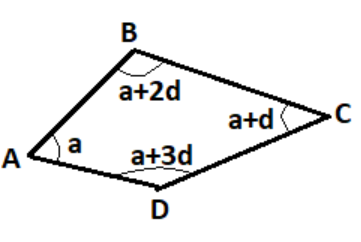
So, if the least angle of the quadrilateral ABCD is a.
Then according to the condition of AP, it's all other angles must be a + d, a + 2d, a + 3d. Where a and d are in radians.
So, a will be the least angle of the quadrilateral ABCD and a + 3d will be the greatest angle of the quadrilateral ABCD.
Now the sum of all the angles should be equal to \[2\pi \].
So, (a) + (a + d) + (a + 2d) + (a + 3d) = \[2\pi \]
4a + 6d = \[2\pi \]
Dividing both sides of the above equation by 2. We get,
2a + 3d = \[\pi \] (1)
Now as given in the question that the greatest angle is the double of the least angle.
So, a + 3d = 2a
Now subtracting both sides of the above equation by a. We get,
3d = a
Now putting the value of 3d in equation 1. We get,
2a + a = \[\pi \]
So, 3a = \[\pi \]
\[a = \dfrac{\pi }{3}\]
So, the least angle of the quadrilateral in radian will be \[\dfrac{\pi }{3}\].
Hence, the correct option will be C.
Note:- Whenever we come up with this type of problem, we assume the least angle as a and the other angles as (a + d), (a + 2d) and (a + 3d). Because all the angles of the quadrilateral are in AP and the difference of two consecutive terms (here angles) is equal. And then equate the sum of all angles of the quadrilateral with \[2\pi \] because the sum of all the angles of the quadrilateral is equal to \[2\pi \] . And then we equate twice of a with a + 3d because it is given in the question. Now after solving these two equations we will get the value of a which is the required least angle of the quadrilateral. This will be the easiest and efficient way to find the solution of the problem.
Complete Step-by-step answer:
As we know that the sum of all the angles of a quadrilateral is equal to \[2\pi \].
And we are given that all the angles of the quadrilateral are in AP.
As we know that AP is the sequence in which the difference of each consecutive term is the same.
So, if the least angle of the quadrilateral ABCD is a.
Then according to the condition of AP, it's all other angles must be a + d, a + 2d, a + 3d. Where a and d are in radians.
So, a will be the least angle of the quadrilateral ABCD and a + 3d will be the greatest angle of the quadrilateral ABCD.
Now the sum of all the angles should be equal to \[2\pi \].
So, (a) + (a + d) + (a + 2d) + (a + 3d) = \[2\pi \]
4a + 6d = \[2\pi \]
Dividing both sides of the above equation by 2. We get,
2a + 3d = \[\pi \] (1)
Now as given in the question that the greatest angle is the double of the least angle.
So, a + 3d = 2a
Now subtracting both sides of the above equation by a. We get,
3d = a
Now putting the value of 3d in equation 1. We get,
2a + a = \[\pi \]
So, 3a = \[\pi \]
\[a = \dfrac{\pi }{3}\]
So, the least angle of the quadrilateral in radian will be \[\dfrac{\pi }{3}\].
Hence, the correct option will be C.
Note:- Whenever we come up with this type of problem, we assume the least angle as a and the other angles as (a + d), (a + 2d) and (a + 3d). Because all the angles of the quadrilateral are in AP and the difference of two consecutive terms (here angles) is equal. And then equate the sum of all angles of the quadrilateral with \[2\pi \] because the sum of all the angles of the quadrilateral is equal to \[2\pi \] . And then we equate twice of a with a + 3d because it is given in the question. Now after solving these two equations we will get the value of a which is the required least angle of the quadrilateral. This will be the easiest and efficient way to find the solution of the problem.
Recently Updated Pages
Master Class 11 English: Engaging Questions & Answers for Success

Master Class 11 Social Science: Engaging Questions & Answers for Success
Master Class 11 Maths: Engaging Questions & Answers for Success
Master Class 11 Biology: Engaging Questions & Answers for Success
Master Class 11 Physics: Engaging Questions & Answers for Success
Master Class 11 Chemistry: Engaging Questions & Answers for Success
Trending doubts