




The angle of intersection of the parabolas \[{y^2} = 4ax\] and \[{x^2} = 4ay\] at the origin is
A \[\dfrac{\pi }{6}\]
B \[\dfrac{\pi }{3}\]
C \[\dfrac{\pi }{2}\]
D \[\dfrac{\pi }{4}\]
Answer
 Verified
640.8k+ views
Hint: In this problem, first we need to draw the curve of two parabolas. Now, find the first derivative of the given parabolas. Next, find the angle between the two parabolas at the origin.
Complete step-by-step answer:
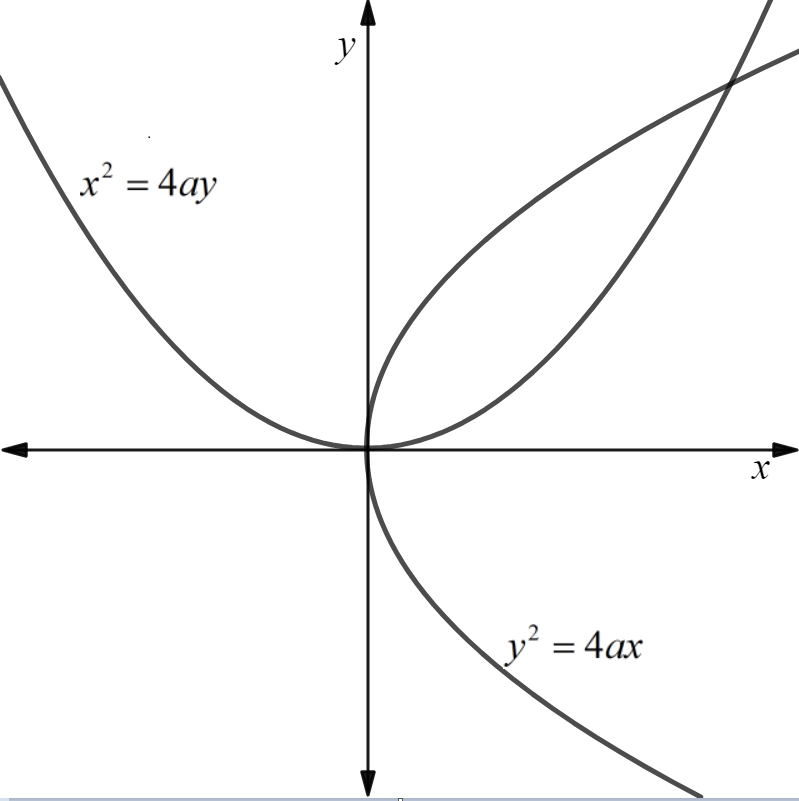
The graph of the parabolas \[{y^2} = 4ax\] and \[{x^2} = 4ay\] is shown below.
Now, find the first derivative of the parabola \[{y^2} = 4ax\] with respect to \[x\] as shown below.
\[\begin{gathered}
\,\,\,\,\,\,\,\dfrac{d}{{dx}}\left( {{y^2}} \right) = \dfrac{d}{{dx}}\left( {4ax} \right) \\
\Rightarrow 2y\dfrac{{dy}}{{dx}} = 4a\dfrac{d}{{dx}}\left( x \right) \\
\Rightarrow 2y\dfrac{{dy}}{{dx}} = 4a \\
\Rightarrow \dfrac{{dy}}{{dx}} = \dfrac{{4a}}{{2y}} \\
\Rightarrow \dfrac{{dy}}{{dx}} = \dfrac{{2a}}{y} \\
\end{gathered}\]
From the above figure, it can be observed that, \[\dfrac{{dy}}{{dx}} \to \infty\], therefore,
\[\begin{gathered}
\,\,\,\,\,\tan {\theta _1} = \tan \dfrac{\pi }{2} \\
\Rightarrow {\theta _1} = \dfrac{\pi }{2} \\
\end{gathered}\]
Now, find the first derivative of the parabola \[{x^2} = 4ay\] with respect to \[x\] as shown below.
\[\begin{gathered}
\,\,\,\,\,\,\,\dfrac{d}{{dx}}\left( {{x^2}} \right) = \dfrac{d}{{dx}}\left( {4ay} \right) \\
\Rightarrow 2x = 4a\dfrac{{dy}}{{dx}} \\
\Rightarrow \dfrac{{dy}}{{dx}} = \dfrac{{2x}}{{4a}} \\
\Rightarrow \dfrac{{dy}}{{dx}} = \dfrac{x}{{2a}} \\
\end{gathered}\]
From the above figure, it can be observed that, \[\dfrac{{dy}}{{dx}} \to 0\], therefore,
\[\begin{gathered}
\,\,\,\,\,\tan {\theta _2} = \tan 0 \\
\Rightarrow {\theta _2} = 0 \\
\end{gathered}\]
Now, the angle between the two curves is calculated as follows:
\[\begin{gathered}
\,\,\,\,\,\,\,{\theta _1} - {\theta _2} \\
\Rightarrow \dfrac{\pi }{2} - 0 \\
\Rightarrow \dfrac{\pi }{2} \\
\end{gathered}\]
Thus, option (C) is the correct answer.
Note: The parabola, \[{y^2} = 4ax\] makes an angle of 90 degree at the origin, whereas, the parabola \[{x^2} = 4ay\] makes an angle of 0 degree at origin.
Complete step-by-step answer:
The graph of the parabolas \[{y^2} = 4ax\] and \[{x^2} = 4ay\] is shown below.
Now, find the first derivative of the parabola \[{y^2} = 4ax\] with respect to \[x\] as shown below.
\[\begin{gathered}
\,\,\,\,\,\,\,\dfrac{d}{{dx}}\left( {{y^2}} \right) = \dfrac{d}{{dx}}\left( {4ax} \right) \\
\Rightarrow 2y\dfrac{{dy}}{{dx}} = 4a\dfrac{d}{{dx}}\left( x \right) \\
\Rightarrow 2y\dfrac{{dy}}{{dx}} = 4a \\
\Rightarrow \dfrac{{dy}}{{dx}} = \dfrac{{4a}}{{2y}} \\
\Rightarrow \dfrac{{dy}}{{dx}} = \dfrac{{2a}}{y} \\
\end{gathered}\]
From the above figure, it can be observed that, \[\dfrac{{dy}}{{dx}} \to \infty\], therefore,
\[\begin{gathered}
\,\,\,\,\,\tan {\theta _1} = \tan \dfrac{\pi }{2} \\
\Rightarrow {\theta _1} = \dfrac{\pi }{2} \\
\end{gathered}\]
Now, find the first derivative of the parabola \[{x^2} = 4ay\] with respect to \[x\] as shown below.
\[\begin{gathered}
\,\,\,\,\,\,\,\dfrac{d}{{dx}}\left( {{x^2}} \right) = \dfrac{d}{{dx}}\left( {4ay} \right) \\
\Rightarrow 2x = 4a\dfrac{{dy}}{{dx}} \\
\Rightarrow \dfrac{{dy}}{{dx}} = \dfrac{{2x}}{{4a}} \\
\Rightarrow \dfrac{{dy}}{{dx}} = \dfrac{x}{{2a}} \\
\end{gathered}\]
From the above figure, it can be observed that, \[\dfrac{{dy}}{{dx}} \to 0\], therefore,
\[\begin{gathered}
\,\,\,\,\,\tan {\theta _2} = \tan 0 \\
\Rightarrow {\theta _2} = 0 \\
\end{gathered}\]
Now, the angle between the two curves is calculated as follows:
\[\begin{gathered}
\,\,\,\,\,\,\,{\theta _1} - {\theta _2} \\
\Rightarrow \dfrac{\pi }{2} - 0 \\
\Rightarrow \dfrac{\pi }{2} \\
\end{gathered}\]
Thus, option (C) is the correct answer.
Note: The parabola, \[{y^2} = 4ax\] makes an angle of 90 degree at the origin, whereas, the parabola \[{x^2} = 4ay\] makes an angle of 0 degree at origin.
Recently Updated Pages
Master Class 11 English: Engaging Questions & Answers for Success

Master Class 11 Social Science: Engaging Questions & Answers for Success
Master Class 11 Maths: Engaging Questions & Answers for Success
Master Class 11 Biology: Engaging Questions & Answers for Success
Master Class 11 Physics: Engaging Questions & Answers for Success
Master Class 11 Chemistry: Engaging Questions & Answers for Success
Trending doubts
One Metric ton is equal to kg A 10000 B 1000 C 100 class 11 physics CBSE
Difference Between Prokaryotic Cells and Eukaryotic Cells
Find the value of the expression given below sin 30circ class 11 maths CBSE
Difference between physical and chemical change class 11 chemistry CBSE
Two of the body parts which do not appear in MRI are class 11 biology CBSE
Draw a diagram of a plant cell and label at least eight class 11 biology CBSE