




The angle of incidence of a light ray incident on a polished silvered mirror is given to ${25^0}$. What can you say about the angle of reflection?
Answer
 Verified
531.6k+ views
Hint: Reflection is the bouncing back of a light ray when it is incident on a polished silvery surface. Any reflecting light would follow the laws of reflection since they are universal in nature. In this question we shall use the fundamental laws of reflection. We know the angle of incidence and from that we will be able to calculate the angle of reflection.
Complete step by step answer:
Whenever a light ray strikes a fully polished or silvered surface, it bounces back into the same medium. This phenomenon is called reflection.Depending upon the kind of surface the light ray is incident on, there are two types of reflection:
Regular reflection: When the surface on which the light ray falls is smooth and even, the light ray gets reflected as a beam. The image produced is clearly visible.
Irregular reflection: When the surface on which the light ray falls is uneven, the light ray gets reflected but in different directions. The image produced is not clearly visible.
In this question, nothing has been mentioned about the surface and so by convention we will assume the surface to be even and smooth.The laws of reflection can be given as:
-When a light ray strikes a surface, the angle of incidence is always equal to the angle of reflection.
-The incident ray, the normal ray and the reflected ray lie in the same plane.The situation can be visualised as
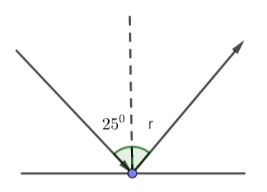
In accordance with the first law, the angle of reflection in the given situation would be equal to ${25^0}$ .
Hence, the angle of reflection is ${25^0}$.
Note: We take the reference baseline to measure the angles of incidence and reflection to be the normal. Since in this question, nothing was mentioned about the angle of incidence in terms of where it has been measured from so we assumed it by convention to be measured from the normal itself. The normal is a line passing through the point of incidence and perpendicular to the surface.
Complete step by step answer:
Whenever a light ray strikes a fully polished or silvered surface, it bounces back into the same medium. This phenomenon is called reflection.Depending upon the kind of surface the light ray is incident on, there are two types of reflection:
Regular reflection: When the surface on which the light ray falls is smooth and even, the light ray gets reflected as a beam. The image produced is clearly visible.
Irregular reflection: When the surface on which the light ray falls is uneven, the light ray gets reflected but in different directions. The image produced is not clearly visible.
In this question, nothing has been mentioned about the surface and so by convention we will assume the surface to be even and smooth.The laws of reflection can be given as:
-When a light ray strikes a surface, the angle of incidence is always equal to the angle of reflection.
-The incident ray, the normal ray and the reflected ray lie in the same plane.The situation can be visualised as
In accordance with the first law, the angle of reflection in the given situation would be equal to ${25^0}$ .
Hence, the angle of reflection is ${25^0}$.
Note: We take the reference baseline to measure the angles of incidence and reflection to be the normal. Since in this question, nothing was mentioned about the angle of incidence in terms of where it has been measured from so we assumed it by convention to be measured from the normal itself. The normal is a line passing through the point of incidence and perpendicular to the surface.
Recently Updated Pages
Master Class 11 English: Engaging Questions & Answers for Success

Master Class 11 Social Science: Engaging Questions & Answers for Success
Master Class 11 Maths: Engaging Questions & Answers for Success
Master Class 11 Biology: Engaging Questions & Answers for Success
Master Class 11 Physics: Engaging Questions & Answers for Success
Master Class 11 Chemistry: Engaging Questions & Answers for Success
Trending doubts
Explain the Treaty of Vienna of 1815 class 10 social science CBSE
What is the Total Duration of Football Match?
First Cotton Mill of India
In which year voting age was reduced from 21 to 18?
10 examples of evaporation in daily life with explanations
What planets have no moons Which one has only one moon class 10 physics CBSE