




The angle of incidence in air for a light ray is 40 degrees. If the ray travels through water of refractive index 4/3. Find the angle of refraction.
($\sin {{40}^{{}^\circ }}=0.643$)
Answer
 Verified
633.6k+ views
Hint: The relationship of angle of incidence and angle of refraction at interface of two media is given by Snell’s law. Snell’s law states that the ratio of the sines of the angles of incidence and refraction is equal to the reciprocal of the ratio of the indices of refraction.
Use Snell’s law to find the angle of refraction.
Formula used:
Law of refraction or Snell’s law, $\dfrac{\sin {{\theta }_{1}}}{\sin {{\theta }_{2}}}=\left( \dfrac{{{\mu }_{2}}}{{{\mu }_{1}}} \right)$
Complete step-by-step answer:
When a light wave passes at some angle from one medium to another medium, its direction changes. This phenomenon is referred to as refraction.
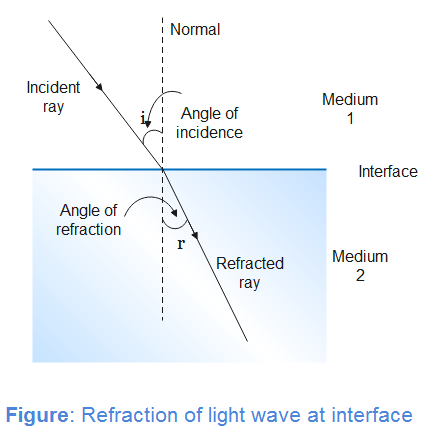
Angle of incidence is defined as the angle between incident ray and normal to the interface of the media and angle of refraction is the angle between refracted ray and normal as shown in figure.
Angle of incidence and angle of refraction are related by Snell’s law. Snell’s law states that the ratio of the sines of the angles of incidence and refraction is equal to the reciprocal of the ratio of the indices of refraction.
$\dfrac{\sin i}{\sin r}=\left( \dfrac{{{\mu }_{2}}}{{{\mu }_{1}}} \right)$
We are given that angle of incidence $i={{40}^{{}^\circ }}$ refractive index of medium 2 which is water is ${{\mu }_{2}}=\dfrac{4}{3}$. We know that the refractive index of air is ${{\mu }_{1}}=1$. Substituting these values in Snell’s law, we have
$\dfrac{\sin {{40}^{{}^\circ }}}{\sin r}=\dfrac{4/3}{1}$
On rearranging and solving the above equation, we get
$\sin r=\dfrac{3}{4}\sin {{40}^{{}^\circ }}=\dfrac{3}{4}\times 0.643\approx 0.48$
Therefore, angle of refraction is $r={{\sin }^{-1}}\left( 0.48 \right)$
Note: The law of refraction or Snell’s law is valid for all pairs of media at the point of incidence. Incident ray, normal and refracted ray lie in the same plane.
Refractive index of a medium is a unitless quantity. It is also defined as the ratio of velocity of wave in the medium to velocity of wave in vacuum. Refractive index of air or free space is unity.
Use Snell’s law to find the angle of refraction.
Formula used:
Law of refraction or Snell’s law, $\dfrac{\sin {{\theta }_{1}}}{\sin {{\theta }_{2}}}=\left( \dfrac{{{\mu }_{2}}}{{{\mu }_{1}}} \right)$
Complete step-by-step answer:
When a light wave passes at some angle from one medium to another medium, its direction changes. This phenomenon is referred to as refraction.
Angle of incidence is defined as the angle between incident ray and normal to the interface of the media and angle of refraction is the angle between refracted ray and normal as shown in figure.
Angle of incidence and angle of refraction are related by Snell’s law. Snell’s law states that the ratio of the sines of the angles of incidence and refraction is equal to the reciprocal of the ratio of the indices of refraction.
$\dfrac{\sin i}{\sin r}=\left( \dfrac{{{\mu }_{2}}}{{{\mu }_{1}}} \right)$
We are given that angle of incidence $i={{40}^{{}^\circ }}$ refractive index of medium 2 which is water is ${{\mu }_{2}}=\dfrac{4}{3}$. We know that the refractive index of air is ${{\mu }_{1}}=1$. Substituting these values in Snell’s law, we have
$\dfrac{\sin {{40}^{{}^\circ }}}{\sin r}=\dfrac{4/3}{1}$
On rearranging and solving the above equation, we get
$\sin r=\dfrac{3}{4}\sin {{40}^{{}^\circ }}=\dfrac{3}{4}\times 0.643\approx 0.48$
Therefore, angle of refraction is $r={{\sin }^{-1}}\left( 0.48 \right)$
Note: The law of refraction or Snell’s law is valid for all pairs of media at the point of incidence. Incident ray, normal and refracted ray lie in the same plane.
Refractive index of a medium is a unitless quantity. It is also defined as the ratio of velocity of wave in the medium to velocity of wave in vacuum. Refractive index of air or free space is unity.
Recently Updated Pages
Which will be the least stable resonating structure class 11 chemistry CBSE

How many 5 digit telephone numbers can be construc-class-11-maths-CBSE
How do you find the angle of the resultant vector class 11 physics CBSE
Draw labelled diagram of the following i Gram seed class 11 biology CBSE
1 Quintal is equal to a 110 kg b 10 kg c 100kg d 1000 class 11 physics CBSE
What is the need and importance of classification class 11 biology CBSE
Trending doubts
One Metric ton is equal to kg A 10000 B 1000 C 100 class 11 physics CBSE
Find the value of the expression given below sin 30circ class 11 maths CBSE
Draw a diagram of nephron and explain its structur class 11 biology CBSE
10 examples of friction in our daily life
Proton was discovered by A Thomson B Rutherford C Chadwick class 11 chemistry CBSE
The teeth used for biting and cutting food are called class 11 biology CBSE