




The angle of elevation of the top of the TV tower from the three points A, B, and C in a straight line (in the horizontal plane) through the foot of the tower are $\alpha ,2\alpha ,3\alpha $ respectively. If \[AB = a\]the height of the tower is
A) $a\tan \alpha $
B) $a\sin \alpha $
C) $a\sin 2\alpha $
D) $a\sin 3\alpha $
Answer
 Verified
581.1k+ views
Hint:
In this question, we need to determine the height of the tower such that the angle of elevation from three different collinear ground points has been given. For this, we will use the tangent of the trigonometric functions to establish a relation between the height of the tower and the length of the point from the foot of the tower.
Complete step by step solution:
Let us consider a tower of the top point at ‘T’.
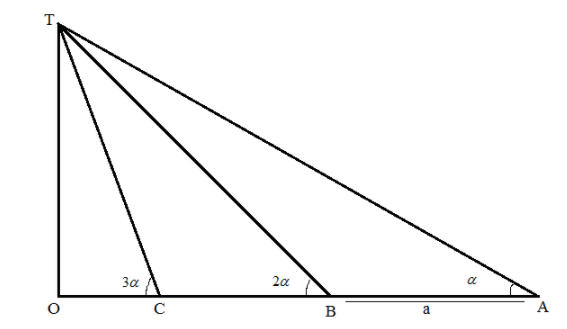
The ratio of the perpendicular and the base of the right-angled triangle is the trigonometric tangent of the triangle. Mathematically, $\tan \theta = \dfrac{{perpendicular}}{{base}}$.
In the triangle TOA, angle TOA is at right-angle, and so, AT acts as the hypotenuse of the triangle, TO as the perpendicular, and OA as the base for the angle TAO.
According to the question, $\angle TAO = \alpha $. So, substituting the same in the formula, $\tan \theta = \dfrac{{perpendicular}}{{base}}$ we get
$
\tan \theta = \dfrac{{perpendicular}}{{base}} \\
\Rightarrow \tan \left( {\angle TAO} \right) = \dfrac{{OT}}{{OA}} \\
\Rightarrow \tan \alpha = \dfrac{{OT}}{{OB + BA}} \\
\Rightarrow \tan \alpha = \dfrac{{OT}}{{OB + a}} - - - - (i) \\
$
Again, In the triangle TOB, angle TOB is at right-angle, and so, TB acts as the hypotenuse of the triangle, TO as the perpendicular, and OB as the base for the angle TBO.
According to the question, $\angle TBO = 2\alpha $. So, substituting the same in the formula, $\tan \theta = \dfrac{{perpendicular}}{{base}}$ we get
$
\tan \theta = \dfrac{{perpendicular}}{{base}} \\ \Rightarrow
\tan \left( {\angle TBO} \right) = \dfrac{{OT}}{{OB}} \\ \Rightarrow
\tan 2\alpha = \dfrac{{OT}}{{OB}} \\ \Rightarrow
OB = \dfrac{{OT}}{{\tan 2\alpha }} - - - - (ii) \\
$
From equation (i) and (ii), we get
$OT = (OB + a)\tan \alpha {\text{ and }}OT = OB\tan 2\alpha $.
Equating these two equations, we get
\[
(OB + a)\tan \alpha = OB\tan 2\alpha \\ \Rightarrow
(OB + a)\tan \alpha = OB\left( {\tan \left( {\alpha + \alpha } \right)} \right) \\ \Rightarrow
(OB + a)\tan \alpha = OB\left( {\dfrac{{\tan \alpha + \tan \alpha }}{{1 - \tan \alpha \cdot \tan \alpha }}} \right) \\ \Rightarrow
(OB + a) = OB\left( {\dfrac{2}{{1 - {{\tan }^2}\alpha }}} \right) \\ \Rightarrow
OB\left( {\dfrac{2}{{1 - {{\tan }^2}\alpha }} - 1} \right) = a \\ \Rightarrow
OB\left( {\dfrac{{2 - 1 + {{\tan }^2}\alpha }}{{1 - {{\tan }^2}\alpha }}} \right) = a \\ \Rightarrow
OB = a\left( {\dfrac{{1 - {{\tan }^2}\alpha }}{{1 + {{\tan }^2}\alpha }}} \right) - - - - (iii) \\
\]
From equation (i), $OT = (OB + a)\tan \alpha $.
Substituting the values obtained in the equation (iii) in the equation $OT = (OB + a)\tan \alpha $, we get
$
OT = (OB + a)\tan \alpha \\
= \left[ {a\left( {\dfrac{{1 - {{\tan }^2}\alpha }}{{1 + {{\tan }^2}\alpha }}} \right) + a} \right]\tan \alpha \\
= a\left[ {\dfrac{{1 - {{\tan }^2}\alpha + 1 + {{\tan }^2}\alpha }}{{1 + {{\tan }^2}\alpha }}} \right]\tan \alpha \\
= a\left[ {\dfrac{{2\tan \alpha }}{{1 + {{\tan }^2}\alpha }}} \right] \\
= a\left[ {\dfrac{{2\tan \alpha }}{{{{\sec }^2}\alpha }}} \right]{\text{ }}\left[ {\because 1 + {{\tan }^2}\alpha = {{\sec }^2}\alpha } \right] \\
= 2a\left[ {\dfrac{{\sin \alpha }}{{\cos \alpha }} \times {{\cos }^2}\alpha } \right]{\text{ }}\left[ {\because \tan \alpha = \dfrac{{\sin \alpha }}{{\cos \alpha }}} \right] \\
= 2a\sin \alpha \cos \alpha \\
= a\sin 2\alpha {\text{ }}\left[ {\because 2\sin \alpha \cos \alpha = \sin 2\alpha } \right] \\
$
Hence, the height of the tower is $a\sin 2\alpha $.
Option C is correct.
Note:
Students must be careful while selecting the perpendicular and the base of the right-angle triangle. The side opposite to the angle under consideration is the perpendicular while the side other than the hypotenuse (longest side of the triangle) and the perpendicular will act as the base.
In this question, we need to determine the height of the tower such that the angle of elevation from three different collinear ground points has been given. For this, we will use the tangent of the trigonometric functions to establish a relation between the height of the tower and the length of the point from the foot of the tower.
Complete step by step solution:
Let us consider a tower of the top point at ‘T’.
The ratio of the perpendicular and the base of the right-angled triangle is the trigonometric tangent of the triangle. Mathematically, $\tan \theta = \dfrac{{perpendicular}}{{base}}$.
In the triangle TOA, angle TOA is at right-angle, and so, AT acts as the hypotenuse of the triangle, TO as the perpendicular, and OA as the base for the angle TAO.
According to the question, $\angle TAO = \alpha $. So, substituting the same in the formula, $\tan \theta = \dfrac{{perpendicular}}{{base}}$ we get
$
\tan \theta = \dfrac{{perpendicular}}{{base}} \\
\Rightarrow \tan \left( {\angle TAO} \right) = \dfrac{{OT}}{{OA}} \\
\Rightarrow \tan \alpha = \dfrac{{OT}}{{OB + BA}} \\
\Rightarrow \tan \alpha = \dfrac{{OT}}{{OB + a}} - - - - (i) \\
$
Again, In the triangle TOB, angle TOB is at right-angle, and so, TB acts as the hypotenuse of the triangle, TO as the perpendicular, and OB as the base for the angle TBO.
According to the question, $\angle TBO = 2\alpha $. So, substituting the same in the formula, $\tan \theta = \dfrac{{perpendicular}}{{base}}$ we get
$
\tan \theta = \dfrac{{perpendicular}}{{base}} \\ \Rightarrow
\tan \left( {\angle TBO} \right) = \dfrac{{OT}}{{OB}} \\ \Rightarrow
\tan 2\alpha = \dfrac{{OT}}{{OB}} \\ \Rightarrow
OB = \dfrac{{OT}}{{\tan 2\alpha }} - - - - (ii) \\
$
From equation (i) and (ii), we get
$OT = (OB + a)\tan \alpha {\text{ and }}OT = OB\tan 2\alpha $.
Equating these two equations, we get
\[
(OB + a)\tan \alpha = OB\tan 2\alpha \\ \Rightarrow
(OB + a)\tan \alpha = OB\left( {\tan \left( {\alpha + \alpha } \right)} \right) \\ \Rightarrow
(OB + a)\tan \alpha = OB\left( {\dfrac{{\tan \alpha + \tan \alpha }}{{1 - \tan \alpha \cdot \tan \alpha }}} \right) \\ \Rightarrow
(OB + a) = OB\left( {\dfrac{2}{{1 - {{\tan }^2}\alpha }}} \right) \\ \Rightarrow
OB\left( {\dfrac{2}{{1 - {{\tan }^2}\alpha }} - 1} \right) = a \\ \Rightarrow
OB\left( {\dfrac{{2 - 1 + {{\tan }^2}\alpha }}{{1 - {{\tan }^2}\alpha }}} \right) = a \\ \Rightarrow
OB = a\left( {\dfrac{{1 - {{\tan }^2}\alpha }}{{1 + {{\tan }^2}\alpha }}} \right) - - - - (iii) \\
\]
From equation (i), $OT = (OB + a)\tan \alpha $.
Substituting the values obtained in the equation (iii) in the equation $OT = (OB + a)\tan \alpha $, we get
$
OT = (OB + a)\tan \alpha \\
= \left[ {a\left( {\dfrac{{1 - {{\tan }^2}\alpha }}{{1 + {{\tan }^2}\alpha }}} \right) + a} \right]\tan \alpha \\
= a\left[ {\dfrac{{1 - {{\tan }^2}\alpha + 1 + {{\tan }^2}\alpha }}{{1 + {{\tan }^2}\alpha }}} \right]\tan \alpha \\
= a\left[ {\dfrac{{2\tan \alpha }}{{1 + {{\tan }^2}\alpha }}} \right] \\
= a\left[ {\dfrac{{2\tan \alpha }}{{{{\sec }^2}\alpha }}} \right]{\text{ }}\left[ {\because 1 + {{\tan }^2}\alpha = {{\sec }^2}\alpha } \right] \\
= 2a\left[ {\dfrac{{\sin \alpha }}{{\cos \alpha }} \times {{\cos }^2}\alpha } \right]{\text{ }}\left[ {\because \tan \alpha = \dfrac{{\sin \alpha }}{{\cos \alpha }}} \right] \\
= 2a\sin \alpha \cos \alpha \\
= a\sin 2\alpha {\text{ }}\left[ {\because 2\sin \alpha \cos \alpha = \sin 2\alpha } \right] \\
$
Hence, the height of the tower is $a\sin 2\alpha $.
Option C is correct.
Note:
Students must be careful while selecting the perpendicular and the base of the right-angle triangle. The side opposite to the angle under consideration is the perpendicular while the side other than the hypotenuse (longest side of the triangle) and the perpendicular will act as the base.
Recently Updated Pages
Master Class 10 Computer Science: Engaging Questions & Answers for Success

Master Class 10 General Knowledge: Engaging Questions & Answers for Success
Master Class 10 English: Engaging Questions & Answers for Success
Master Class 10 Social Science: Engaging Questions & Answers for Success
Master Class 10 Maths: Engaging Questions & Answers for Success
Master Class 10 Science: Engaging Questions & Answers for Success
Trending doubts
What is the median of the first 10 natural numbers class 10 maths CBSE
Which women's tennis player has 24 Grand Slam singles titles?
Who is the Brand Ambassador of Incredible India?
Why is there a time difference of about 5 hours between class 10 social science CBSE
Write a letter to the principal requesting him to grant class 10 english CBSE
A moving boat is observed from the top of a 150 m high class 10 maths CBSE