




The angle of elevation of the top of the pillar at any point A on the ground is $ 15{}^\circ $ . On walking 100 ft towards the pillar the angle becomes $ 30{}^\circ $ . Then height of pillar is
(a) $ 50\left( 2+\sqrt{3} \right) $
(b) 50
(c) $ 100\left( 2+\sqrt{3} \right) $
(d) $ 100\left( 2-\sqrt{3} \right) $
Answer
 Verified
666k+ views
Hint: First, we will assume the height of the pillar to be h. Then we will draw figures to get a better understanding.
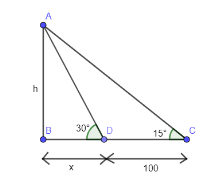
We will first find the value of x by using the trigonometric rule $ \tan \theta =\dfrac{opposite}{adjacent} $ in $ \Delta ADB $ . Then, we will use this in $ \Delta ACB $ . On solving this equation, we will get the equation in root form. So, to remove that we will use conjugate of the number which will be easy to solve. Also, we will use $ \tan 15{}^\circ =\tan \left( 45{}^\circ -30{}^\circ \right) $ and will apply the formula $ \tan \left( a-b \right)=\dfrac{\tan a-\tan b}{1+\tan a\tan b} $ . Thus, on solving we will get the value of h.
Complete step-by-step answer:
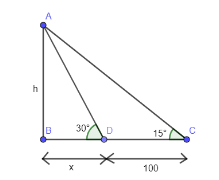
Here, AB is a pillar considered as h. CD is 100 ft as mentioned in question. We have assumed the remaining distance BD as x. So, total length BC is equal to
$ BC=BD+DC=x+100 $ ………………………………(1)
Now, taking $ \Delta ADB $ and using trigonometric rule i.e. $ \tan \theta =\dfrac{opposite}{adjacent} $ we get
$ \tan \theta =\dfrac{opposite}{adjacent} $
$ \tan 30{}^\circ =\dfrac{AB}{BD}=\dfrac{h}{x} $
We know the value of $ \tan 30{}^\circ $ is $ \dfrac{1}{\sqrt{3}} $ so, on substituting this values, we get
$ \dfrac{1}{\sqrt{3}}=\dfrac{h}{x} $
Now, making x as subject, we will get equation as
$ x=h\sqrt{3} $ …………………………..(2)
Similarly, we will take $ \Delta ACB $ and applying the rule $ \tan \theta =\dfrac{opposite}{adjacent} $ , we get
$ \tan 15{}^\circ =\dfrac{AB}{BC} $
We can write $ \tan 15{}^\circ =\tan \left( 45{}^\circ -30{}^\circ \right) $ and substituting values of AB and BC, we get
$ \tan \left( 45{}^\circ -30{}^\circ \right)=\dfrac{h}{x+100} $
Here, we will the formula of $ \tan \left( a-b \right)=\dfrac{\tan a-\tan b}{1+\tan a\tan b} $ where a is $ 45{}^\circ $ and b is $ 30{}^\circ $ . On substituting this formula, we get equation as
$ \dfrac{\tan 45{}^\circ -\tan 30{}^\circ }{1+\tan 45{}^\circ \tan 30{}^\circ }=\dfrac{h}{x+100} $
Now, we know that value of $ \tan 45{}^\circ =1 $ and $ \tan 30{}^\circ $ is $ \dfrac{1}{\sqrt{3}} $ so, on putting this we will get
$ \dfrac{1-\dfrac{1}{\sqrt{3}}}{1+1\left( \dfrac{1}{\sqrt{3}} \right)}=\dfrac{h}{x+100} $
On further solving, we get
$ \dfrac{\dfrac{\sqrt{3-}1}{\sqrt{3}}}{\dfrac{\sqrt{3}+1}{\sqrt{3}}}=\dfrac{h}{x+100} $
Now, we cancel the denominator term as it is common. So, we will get
$ \dfrac{\sqrt{3}-1}{\sqrt{3}+1}=\dfrac{h}{x+100} $
Now, we will multiply LHS side with the numerator term i.e. $ \sqrt{3}-1 $ to remove the root sign. So, we can write
$ \dfrac{\sqrt{3}-1}{\sqrt{3}+1}\times \dfrac{\sqrt{3}-1}{\sqrt{3}-1}=\dfrac{h}{x+100} $
On solving, we get
$ \dfrac{{{\left( \sqrt{3}-1 \right)}^{2}}}{\left( \sqrt{3}+1 \right)\left( \sqrt{3}-1 \right)}=\dfrac{h}{x+100} $
Using the formula $ \left( a+b \right)\left( a-b \right)={{a}^{2}}-{{b}^{2}} $ So, we will get
$ \dfrac{{{\left( \sqrt{3}-1 \right)}^{2}}}{{{\left( \sqrt{3} \right)}^{2}}-{{\left( 1 \right)}^{2}}}=\dfrac{h}{x+100} $
On simplifying, we get
$ \dfrac{{{\sqrt{3}}^{2}}-2\sqrt{3}+1}{3-1}=\dfrac{h}{x+100} $ using the formula $ {{\left( a-b \right)}^{2}}={{a}^{2}}-2ab+{{b}^{2}} $
Further we get equation as
$ \dfrac{4-2\sqrt{3}}{2}=\dfrac{h}{x+100} $
Taking 2 common from LHS side and putting value of x in RHS from equation (2), we get
$ 2-\sqrt{3}=\dfrac{h}{h\sqrt{3}+100} $
On cross multiplying, we get equation as
$ \left( 2-\sqrt{3} \right)\left( h\sqrt{3}+100 \right)=h $
On solving we get
$ 2\sqrt{3}h+200=h+3h+100\sqrt{3} $
$ 2\sqrt{3}h+200=4h+100\sqrt{3} $
Now, taking h terms on one side and constant term on other side, so we get
$ 200-100\sqrt{3}=4h-2\sqrt{3}h $
$ 100\left( 2-\sqrt{3} \right)=2h\left( 2-\sqrt{3} \right) $
On cancelling the terms, we get
$ 100=2h $
Dividing the equation by 2, we get
$ h=\dfrac{100}{2}=50 $
Thus, the height of pillar AB is 50 ft.
Option (b) is the correct answer.
Note: Remember, in this type of problem figure is must. Otherwise this problem cannot be solved. Students sometimes makes mistake in understanding this line i.e. The angle of elevation of the top of the pillar at any point A on the ground is $ 15{}^\circ $ . On walking 100 ft towards the pillar the angle becomes $ 30{}^\circ $ . By this they consider base value as 100 ft. And then applying $ \tan \theta =\dfrac{opposite}{adjacent} $ answer will be obtained which will be wrong. So, do understand the line and draw the figure accordingly.
We will first find the value of x by using the trigonometric rule $ \tan \theta =\dfrac{opposite}{adjacent} $ in $ \Delta ADB $ . Then, we will use this in $ \Delta ACB $ . On solving this equation, we will get the equation in root form. So, to remove that we will use conjugate of the number which will be easy to solve. Also, we will use $ \tan 15{}^\circ =\tan \left( 45{}^\circ -30{}^\circ \right) $ and will apply the formula $ \tan \left( a-b \right)=\dfrac{\tan a-\tan b}{1+\tan a\tan b} $ . Thus, on solving we will get the value of h.
Complete step-by-step answer:
Here, AB is a pillar considered as h. CD is 100 ft as mentioned in question. We have assumed the remaining distance BD as x. So, total length BC is equal to
$ BC=BD+DC=x+100 $ ………………………………(1)
Now, taking $ \Delta ADB $ and using trigonometric rule i.e. $ \tan \theta =\dfrac{opposite}{adjacent} $ we get
$ \tan \theta =\dfrac{opposite}{adjacent} $
$ \tan 30{}^\circ =\dfrac{AB}{BD}=\dfrac{h}{x} $
We know the value of $ \tan 30{}^\circ $ is $ \dfrac{1}{\sqrt{3}} $ so, on substituting this values, we get
$ \dfrac{1}{\sqrt{3}}=\dfrac{h}{x} $
Now, making x as subject, we will get equation as
$ x=h\sqrt{3} $ …………………………..(2)
Similarly, we will take $ \Delta ACB $ and applying the rule $ \tan \theta =\dfrac{opposite}{adjacent} $ , we get
$ \tan 15{}^\circ =\dfrac{AB}{BC} $
We can write $ \tan 15{}^\circ =\tan \left( 45{}^\circ -30{}^\circ \right) $ and substituting values of AB and BC, we get
$ \tan \left( 45{}^\circ -30{}^\circ \right)=\dfrac{h}{x+100} $
Here, we will the formula of $ \tan \left( a-b \right)=\dfrac{\tan a-\tan b}{1+\tan a\tan b} $ where a is $ 45{}^\circ $ and b is $ 30{}^\circ $ . On substituting this formula, we get equation as
$ \dfrac{\tan 45{}^\circ -\tan 30{}^\circ }{1+\tan 45{}^\circ \tan 30{}^\circ }=\dfrac{h}{x+100} $
Now, we know that value of $ \tan 45{}^\circ =1 $ and $ \tan 30{}^\circ $ is $ \dfrac{1}{\sqrt{3}} $ so, on putting this we will get
$ \dfrac{1-\dfrac{1}{\sqrt{3}}}{1+1\left( \dfrac{1}{\sqrt{3}} \right)}=\dfrac{h}{x+100} $
On further solving, we get
$ \dfrac{\dfrac{\sqrt{3-}1}{\sqrt{3}}}{\dfrac{\sqrt{3}+1}{\sqrt{3}}}=\dfrac{h}{x+100} $
Now, we cancel the denominator term as it is common. So, we will get
$ \dfrac{\sqrt{3}-1}{\sqrt{3}+1}=\dfrac{h}{x+100} $
Now, we will multiply LHS side with the numerator term i.e. $ \sqrt{3}-1 $ to remove the root sign. So, we can write
$ \dfrac{\sqrt{3}-1}{\sqrt{3}+1}\times \dfrac{\sqrt{3}-1}{\sqrt{3}-1}=\dfrac{h}{x+100} $
On solving, we get
$ \dfrac{{{\left( \sqrt{3}-1 \right)}^{2}}}{\left( \sqrt{3}+1 \right)\left( \sqrt{3}-1 \right)}=\dfrac{h}{x+100} $
Using the formula $ \left( a+b \right)\left( a-b \right)={{a}^{2}}-{{b}^{2}} $ So, we will get
$ \dfrac{{{\left( \sqrt{3}-1 \right)}^{2}}}{{{\left( \sqrt{3} \right)}^{2}}-{{\left( 1 \right)}^{2}}}=\dfrac{h}{x+100} $
On simplifying, we get
$ \dfrac{{{\sqrt{3}}^{2}}-2\sqrt{3}+1}{3-1}=\dfrac{h}{x+100} $ using the formula $ {{\left( a-b \right)}^{2}}={{a}^{2}}-2ab+{{b}^{2}} $
Further we get equation as
$ \dfrac{4-2\sqrt{3}}{2}=\dfrac{h}{x+100} $
Taking 2 common from LHS side and putting value of x in RHS from equation (2), we get
$ 2-\sqrt{3}=\dfrac{h}{h\sqrt{3}+100} $
On cross multiplying, we get equation as
$ \left( 2-\sqrt{3} \right)\left( h\sqrt{3}+100 \right)=h $
On solving we get
$ 2\sqrt{3}h+200=h+3h+100\sqrt{3} $
$ 2\sqrt{3}h+200=4h+100\sqrt{3} $
Now, taking h terms on one side and constant term on other side, so we get
$ 200-100\sqrt{3}=4h-2\sqrt{3}h $
$ 100\left( 2-\sqrt{3} \right)=2h\left( 2-\sqrt{3} \right) $
On cancelling the terms, we get
$ 100=2h $
Dividing the equation by 2, we get
$ h=\dfrac{100}{2}=50 $
Thus, the height of pillar AB is 50 ft.
Option (b) is the correct answer.
Note: Remember, in this type of problem figure is must. Otherwise this problem cannot be solved. Students sometimes makes mistake in understanding this line i.e. The angle of elevation of the top of the pillar at any point A on the ground is $ 15{}^\circ $ . On walking 100 ft towards the pillar the angle becomes $ 30{}^\circ $ . By this they consider base value as 100 ft. And then applying $ \tan \theta =\dfrac{opposite}{adjacent} $ answer will be obtained which will be wrong. So, do understand the line and draw the figure accordingly.
Recently Updated Pages
If x a + bt + ct2 where x is in meters and t is in class 11 physics CBSE

A car covers the first half distance between two places class 11 physics CBSE
The resultant of two vectors overrightarrow P and overrightarrow class 11 physics CBSE
Find the value of cos 135 class 11 maths CBSE
A mass M is held in place by an applied force F and class 11 physics CBSE
A solution of glucose in water is labelled as 10 dfracwv class 11 chemistry CBSE
Trending doubts
Find the value of the expression given below sin 30circ class 11 maths CBSE
One Metric ton is equal to kg A 10000 B 1000 C 100 class 11 physics CBSE
Draw a diagram of nephron and explain its structur class 11 biology CBSE
10 examples of friction in our daily life
Proton was discovered by A Thomson B Rutherford C Chadwick class 11 chemistry CBSE
Bond order ofO2 O2+ O2 and O22 is in order A O2 langle class 11 chemistry CBSE