




The angle of elevation of the top of a tower standing on a horizontal plane from point A is \[\alpha \]. After walking a distance d towards the foot of the tower the angle of elevation is found to be \[\beta \]. The height of the tower is:
(a) \[\dfrac{d}{\cot \alpha +\cot \beta }\]
(b) \[\dfrac{d}{\cot \alpha -\cot \beta }\]
(c) \[\dfrac{d}{\tan \beta -\tan \alpha }\]
(d) \[\dfrac{d}{\tan \beta +\tan \alpha }\]
Answer
 Verified
650.1k+ views
Hint: First of all, draw a tower AB of height h and its angle of elevation at point of C on the ground. Now move distance ‘d’ towards the tower and draw an angle of elevation from the top of the tower at this point as \[\beta \]. Now take \[\tan \alpha \] and \[\tan \beta \] and use \[\tan \theta =\dfrac{perpendicular}{base}\] on two triangles to the desired required value.
Complete step-by-step answer:
Here, we are given that the angle of elevation of the top of a tower standing on a horizontal plane from a point A is \[\alpha \]. After walking a distance d towards the foot of the tower the angle of elevation is found to be \[\beta \]. We have to find the value of the height of the tower.
First of all, let us draw a tower AB and angle of its elevation as \[\alpha \].
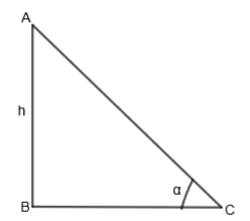
After walking a distance ‘d’ towards the tower, the angle of elevation is \[\beta \].
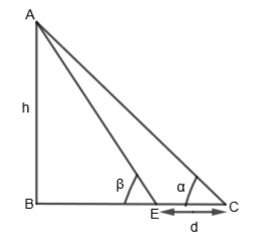
Let us assume that the height of the tower as h. Let us consider \[\Delta ABC\]. We know that,
\[\tan \theta =\dfrac{perpendicular}{base}\]
So, in \[\Delta ABC\], we get,
\[\tan \alpha =\dfrac{AB}{BC}....\left( i \right)\]
From the diagram, we can see that, AB =h, BC = BE + EC = BE + d
By substituting these values in equation (i), we get,
\[\tan \alpha =\dfrac{h}{BE+d}....\left( ii \right)\]
Now, let us consider \[\Delta ABE\], again we know that,
\[\tan \theta =\dfrac{perpendicular}{base}\]
So, in \[\Delta ABE\], we get,
\[\tan \beta =\dfrac{AB}{BE}\]
We know that AB = h, so we get,
\[\tan \beta =\dfrac{h}{BE}\]
By multiplying BE on both sides of the above equation, we get,
\[BE\tan \beta =h\]
\[\Rightarrow BE=\dfrac{h}{\tan \beta }\]
By substituting the value of BE in equation (ii), we get,
\[\tan \alpha =\dfrac{h}{\dfrac{h}{\tan \beta }+d}\]
By cross multiplying the above equation, we get,
\[\tan \alpha \left( \dfrac{h}{\tan \beta }+d \right)=h\]
\[\dfrac{\left( \tan \alpha \right)h}{\left( \tan \beta \right)}+\left( \tan \alpha \right)d=h\]
\[\left( \tan \alpha \right)d=h-h\left( \dfrac{\tan \alpha }{\tan \beta } \right)\]
By taking out h common, we get,
\[\left( \tan \alpha \right)d=h\left( 1-\dfrac{\tan \alpha }{\tan \beta } \right)\]
\[h=\dfrac{d\left( \tan \alpha \right)}{1-\dfrac{\tan \alpha }{\tan \beta }}\]
\[h=\dfrac{d\tan \alpha \tan \beta }{\left( \tan \beta -\tan \alpha \right)}\]
By dividing the numerator and denominator by \[\tan \alpha \tan \beta \], we get,
\[h=\dfrac{d}{\dfrac{\tan \beta -\tan \alpha }{\tan \alpha \tan \beta }}\]
\[h=\dfrac{d}{\dfrac{1}{\tan \alpha }-\dfrac{1}{\tan \beta }}\]
We know that \[\dfrac{1}{\tan \theta }=\cot \theta \]. By using this, we get,
\[h=\dfrac{d}{\cot \alpha -\cot \beta }\]
So, we get the height of the tower as \[\dfrac{d}{\cot \alpha -\cot \beta }\]
Hence, option (b) is the right answer.
Note: In this question, some students make this mistake of interchanging the position of \[\alpha \text{ and }\beta \]. So, this must be taken care of because a person is walking towards the tower and not away from it. Also, students must be careful while substituting \[\dfrac{h}{\tan \beta }\] in the expression of \[\tan \alpha \] because sometimes calculation mistakes arise.
Complete step-by-step answer:
Here, we are given that the angle of elevation of the top of a tower standing on a horizontal plane from a point A is \[\alpha \]. After walking a distance d towards the foot of the tower the angle of elevation is found to be \[\beta \]. We have to find the value of the height of the tower.
First of all, let us draw a tower AB and angle of its elevation as \[\alpha \].
After walking a distance ‘d’ towards the tower, the angle of elevation is \[\beta \].
Let us assume that the height of the tower as h. Let us consider \[\Delta ABC\]. We know that,
\[\tan \theta =\dfrac{perpendicular}{base}\]
So, in \[\Delta ABC\], we get,
\[\tan \alpha =\dfrac{AB}{BC}....\left( i \right)\]
From the diagram, we can see that, AB =h, BC = BE + EC = BE + d
By substituting these values in equation (i), we get,
\[\tan \alpha =\dfrac{h}{BE+d}....\left( ii \right)\]
Now, let us consider \[\Delta ABE\], again we know that,
\[\tan \theta =\dfrac{perpendicular}{base}\]
So, in \[\Delta ABE\], we get,
\[\tan \beta =\dfrac{AB}{BE}\]
We know that AB = h, so we get,
\[\tan \beta =\dfrac{h}{BE}\]
By multiplying BE on both sides of the above equation, we get,
\[BE\tan \beta =h\]
\[\Rightarrow BE=\dfrac{h}{\tan \beta }\]
By substituting the value of BE in equation (ii), we get,
\[\tan \alpha =\dfrac{h}{\dfrac{h}{\tan \beta }+d}\]
By cross multiplying the above equation, we get,
\[\tan \alpha \left( \dfrac{h}{\tan \beta }+d \right)=h\]
\[\dfrac{\left( \tan \alpha \right)h}{\left( \tan \beta \right)}+\left( \tan \alpha \right)d=h\]
\[\left( \tan \alpha \right)d=h-h\left( \dfrac{\tan \alpha }{\tan \beta } \right)\]
By taking out h common, we get,
\[\left( \tan \alpha \right)d=h\left( 1-\dfrac{\tan \alpha }{\tan \beta } \right)\]
\[h=\dfrac{d\left( \tan \alpha \right)}{1-\dfrac{\tan \alpha }{\tan \beta }}\]
\[h=\dfrac{d\tan \alpha \tan \beta }{\left( \tan \beta -\tan \alpha \right)}\]
By dividing the numerator and denominator by \[\tan \alpha \tan \beta \], we get,
\[h=\dfrac{d}{\dfrac{\tan \beta -\tan \alpha }{\tan \alpha \tan \beta }}\]
\[h=\dfrac{d}{\dfrac{1}{\tan \alpha }-\dfrac{1}{\tan \beta }}\]
We know that \[\dfrac{1}{\tan \theta }=\cot \theta \]. By using this, we get,
\[h=\dfrac{d}{\cot \alpha -\cot \beta }\]
So, we get the height of the tower as \[\dfrac{d}{\cot \alpha -\cot \beta }\]
Hence, option (b) is the right answer.
Note: In this question, some students make this mistake of interchanging the position of \[\alpha \text{ and }\beta \]. So, this must be taken care of because a person is walking towards the tower and not away from it. Also, students must be careful while substituting \[\dfrac{h}{\tan \beta }\] in the expression of \[\tan \alpha \] because sometimes calculation mistakes arise.
Recently Updated Pages
Master Class 11 English: Engaging Questions & Answers for Success

Master Class 11 Social Science: Engaging Questions & Answers for Success
Master Class 11 Maths: Engaging Questions & Answers for Success
Master Class 11 Biology: Engaging Questions & Answers for Success
Master Class 11 Physics: Engaging Questions & Answers for Success
Master Class 11 Chemistry: Engaging Questions & Answers for Success
Trending doubts
One Metric ton is equal to kg A 10000 B 1000 C 100 class 11 physics CBSE
Difference Between Prokaryotic Cells and Eukaryotic Cells
Find the value of the expression given below sin 30circ class 11 maths CBSE
Difference between physical and chemical change class 11 chemistry CBSE
Two of the body parts which do not appear in MRI are class 11 biology CBSE
Draw a diagram of a plant cell and label at least eight class 11 biology CBSE