




The angle of elevation of the top of a tower 30m high from the foot of another tower in the same plane is ${60^ \circ }$ and the angle of elevation of the top of the second tower from the foot of the first tower is ${30^ \circ }$. Find the height of the other tower.
Answer
 Verified
609k+ views
Hint:
We will solve this question by using the trigonometric function $\tan \theta = \dfrac{{{\text{perpendicular}}}}{{{\text{base}}}}$ in the right triangles, one by one, obtained by sketching the given conditions. We will calculate the value of the base common to both the triangles and then we will put the value of base to calculate the value of the height of the second tower.
Complete step by step solution:
We are given that the angle of elevation of the top of a tower whose height is 30m from the foot of the other tower is ${60^ \circ }$.
The angle of elevation of the top of the second tower from the foot of the other tower is ${30^ \circ }$.
We need to find the height of the second tower.
The figure of this given question will be:
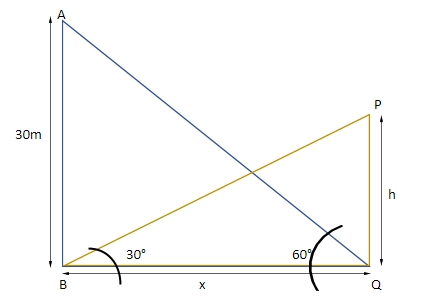
Let AB be the first tower and PQ be the second tower with height h. The angle of elevation of the first tower AB from the foot of the second tower PQ is $\angle AQB = {60^ \circ }$. The angle of elevation of the second tower PQ from the foot of the first tower AB is$\angle PBQ = {30^ \circ }$ .
Applying the trigonometric identity $\tan \theta = \dfrac{{{\text{perpendicular}}}}{{{\text{base}}}}$ in $\vartriangle ABQ$ ,
$
\Rightarrow \tan {60^ \circ } = \dfrac{{30}}{x} \\
\Rightarrow \sqrt 3 = \dfrac{{30}}{x} \\
\Rightarrow x = \dfrac{{30}}{{\sqrt 3 }} \\
$
Applying $\tan \theta = \dfrac{{{\text{perpendicular}}}}{{{\text{base}}}}$ in the $\vartriangle PBQ$ ,
$ \Rightarrow \tan {30^ \circ } = \dfrac{h}{x}$
Substituting the value of x in the above equation, we get
$
\Rightarrow \tan {30^ \circ } = \dfrac{h}{{\left( {\dfrac{{30}}{{\sqrt 3 }}} \right)}} \\
\Rightarrow \dfrac{1}{{\sqrt 3 }} = \dfrac{{h\sqrt 3 }}{{30}} \\
\Rightarrow h = \dfrac{{30}}{3} = 10m \\
$
Therefore, the height of the second tower is 10m.
Note:
In this question, you may go wrong in understanding the setup and hence constructing the diagram to get a clear view and also in the use of the calculation of the x to calculate the value of the height of the tower. This question is a part of a major concept, Trigonometry, of mathematics which is widely used in real – life. We measure heights of big monuments and buildings, depth of the sea and many more other spaces of life where heights and distances are involved.
We will solve this question by using the trigonometric function $\tan \theta = \dfrac{{{\text{perpendicular}}}}{{{\text{base}}}}$ in the right triangles, one by one, obtained by sketching the given conditions. We will calculate the value of the base common to both the triangles and then we will put the value of base to calculate the value of the height of the second tower.
Complete step by step solution:
We are given that the angle of elevation of the top of a tower whose height is 30m from the foot of the other tower is ${60^ \circ }$.
The angle of elevation of the top of the second tower from the foot of the other tower is ${30^ \circ }$.
We need to find the height of the second tower.
The figure of this given question will be:
Let AB be the first tower and PQ be the second tower with height h. The angle of elevation of the first tower AB from the foot of the second tower PQ is $\angle AQB = {60^ \circ }$. The angle of elevation of the second tower PQ from the foot of the first tower AB is$\angle PBQ = {30^ \circ }$ .
Applying the trigonometric identity $\tan \theta = \dfrac{{{\text{perpendicular}}}}{{{\text{base}}}}$ in $\vartriangle ABQ$ ,
$
\Rightarrow \tan {60^ \circ } = \dfrac{{30}}{x} \\
\Rightarrow \sqrt 3 = \dfrac{{30}}{x} \\
\Rightarrow x = \dfrac{{30}}{{\sqrt 3 }} \\
$
Applying $\tan \theta = \dfrac{{{\text{perpendicular}}}}{{{\text{base}}}}$ in the $\vartriangle PBQ$ ,
$ \Rightarrow \tan {30^ \circ } = \dfrac{h}{x}$
Substituting the value of x in the above equation, we get
$
\Rightarrow \tan {30^ \circ } = \dfrac{h}{{\left( {\dfrac{{30}}{{\sqrt 3 }}} \right)}} \\
\Rightarrow \dfrac{1}{{\sqrt 3 }} = \dfrac{{h\sqrt 3 }}{{30}} \\
\Rightarrow h = \dfrac{{30}}{3} = 10m \\
$
Therefore, the height of the second tower is 10m.
Note:
In this question, you may go wrong in understanding the setup and hence constructing the diagram to get a clear view and also in the use of the calculation of the x to calculate the value of the height of the tower. This question is a part of a major concept, Trigonometry, of mathematics which is widely used in real – life. We measure heights of big monuments and buildings, depth of the sea and many more other spaces of life where heights and distances are involved.
Recently Updated Pages
Master Class 12 Business Studies: Engaging Questions & Answers for Success

Master Class 12 Biology: Engaging Questions & Answers for Success
Master Class 12 Chemistry: Engaging Questions & Answers for Success
Class 12 Question and Answer - Your Ultimate Solutions Guide
Master Class 11 Social Science: Engaging Questions & Answers for Success
Master Class 11 English: Engaging Questions & Answers for Success
Trending doubts
Explain the Treaty of Vienna of 1815 class 10 social science CBSE
Who Won 36 Oscar Awards? Record Holder Revealed
What is the median of the first 10 natural numbers class 10 maths CBSE
Why is it 530 pm in india when it is 1200 afternoon class 10 social science CBSE
What is the full form of POSCO class 10 social science CBSE
The highest temperature in Karnataka is recorded in class 10 social science CBSE