




The angle of elevation of the top of a hill from the foot of a tower is \[{{60}^{\circ }}\] and the angle of depression from the top of the tower to the foot of the hill is \[{{30}^{\circ }}\]. If the tower is 50m high, find the height of the hill.
Answer
 Verified
615.6k+ views
- Hint: In this question, we first need to draw the diagram with the given conditions which gives us a clear picture of what we have to find. Then assume the height of the hill as some variable and then using the tangent formula we can get the result.
\[\tan \theta =\dfrac{\text{opposite}}{\text{adjacent}}\]
Complete step-by-step solution -
Let us first draw the diagram with the given conditions in the question
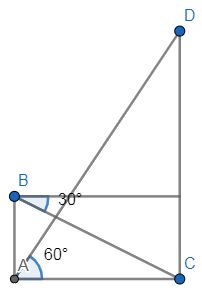
Now, given in the question that
\[\begin{align}
& AB=50 \\
& \angle DAC={{60}^{\circ }} \\
\end{align}\]
Now, from the given angle of depression we can also write that
\[\angle BCA={{30}^{\circ }}\]
Let us assume that the height of the hill as x
\[CD=x\]
Let us also assume the distance between the bottom points of the hill and tower as y.
\[AC=y\]
As we already know the tangent values for some of the standard angles we get,
\[\begin{align}
& \tan {{30}^{\circ }}=\dfrac{1}{\sqrt{3}} \\
& \tan {{60}^{\circ }}=\sqrt{3} \\
\end{align}\]
Now, by applying the tangent formula to the triangle ACD we get,
\[\Rightarrow \tan {{60}^{\circ }}=\dfrac{CD}{AC}\]
Now, on substituting the respective values in the above equation we get,
\[\Rightarrow \sqrt{3}=\dfrac{x}{y}.......\left( 1 \right)\]
Now, by applying the tangent formula to the triangle ABC we get,
\[\Rightarrow \tan {{30}^{\circ }}=\dfrac{AB}{AC}\]
Now, on substituting the respective values in the above equation we get,
\[\Rightarrow \dfrac{1}{\sqrt{3}}=\dfrac{50}{y}\]
Now, by doing cross multiplication in the above equation we get,
\[\therefore y=50\times \sqrt{3}\]
Now, by substituting this value of y in the above equation (1) we get,
\[\begin{align}
& \Rightarrow \sqrt{3}=\dfrac{x}{y} \\
& \Rightarrow \sqrt{3}=\dfrac{x}{50\times \sqrt{3}} \\
\end{align}\]
Now, on further cross multiplication of the terms in the above equation we get,
\[\begin{align}
& \Rightarrow x=\sqrt{3}\times 50\times \sqrt{3} \\
& \Rightarrow x=50\times 3 \\
& \therefore x=150m \\
\end{align}\]
Hence, the height of the hill is 150m.
Note: Instead of assuming some variable y to the base distance AC we can directly calculate it. It is also important to note that instead of finding the value of y and then again substituting back in the equation to get the value of x we can directly get x by dividing both the equations obtained by the tangent formula.
On dividing both the equations obtained by the tangent formula the common term base distance which is AC gets cancelled directly and then by further simplification we can directly get the value of x.
While cross multiplying and rearranging the terms we should not neglect any of the terms because it changes the corresponding equation and so the final result.
\[\tan \theta =\dfrac{\text{opposite}}{\text{adjacent}}\]
Complete step-by-step solution -
Let us first draw the diagram with the given conditions in the question
Now, given in the question that
\[\begin{align}
& AB=50 \\
& \angle DAC={{60}^{\circ }} \\
\end{align}\]
Now, from the given angle of depression we can also write that
\[\angle BCA={{30}^{\circ }}\]
Let us assume that the height of the hill as x
\[CD=x\]
Let us also assume the distance between the bottom points of the hill and tower as y.
\[AC=y\]
As we already know the tangent values for some of the standard angles we get,
\[\begin{align}
& \tan {{30}^{\circ }}=\dfrac{1}{\sqrt{3}} \\
& \tan {{60}^{\circ }}=\sqrt{3} \\
\end{align}\]
Now, by applying the tangent formula to the triangle ACD we get,
\[\Rightarrow \tan {{60}^{\circ }}=\dfrac{CD}{AC}\]
Now, on substituting the respective values in the above equation we get,
\[\Rightarrow \sqrt{3}=\dfrac{x}{y}.......\left( 1 \right)\]
Now, by applying the tangent formula to the triangle ABC we get,
\[\Rightarrow \tan {{30}^{\circ }}=\dfrac{AB}{AC}\]
Now, on substituting the respective values in the above equation we get,
\[\Rightarrow \dfrac{1}{\sqrt{3}}=\dfrac{50}{y}\]
Now, by doing cross multiplication in the above equation we get,
\[\therefore y=50\times \sqrt{3}\]
Now, by substituting this value of y in the above equation (1) we get,
\[\begin{align}
& \Rightarrow \sqrt{3}=\dfrac{x}{y} \\
& \Rightarrow \sqrt{3}=\dfrac{x}{50\times \sqrt{3}} \\
\end{align}\]
Now, on further cross multiplication of the terms in the above equation we get,
\[\begin{align}
& \Rightarrow x=\sqrt{3}\times 50\times \sqrt{3} \\
& \Rightarrow x=50\times 3 \\
& \therefore x=150m \\
\end{align}\]
Hence, the height of the hill is 150m.
Note: Instead of assuming some variable y to the base distance AC we can directly calculate it. It is also important to note that instead of finding the value of y and then again substituting back in the equation to get the value of x we can directly get x by dividing both the equations obtained by the tangent formula.
On dividing both the equations obtained by the tangent formula the common term base distance which is AC gets cancelled directly and then by further simplification we can directly get the value of x.
While cross multiplying and rearranging the terms we should not neglect any of the terms because it changes the corresponding equation and so the final result.
Recently Updated Pages
Master Class 11 Computer Science: Engaging Questions & Answers for Success

Master Class 11 Business Studies: Engaging Questions & Answers for Success
Master Class 11 Economics: Engaging Questions & Answers for Success
Master Class 11 English: Engaging Questions & Answers for Success
Master Class 11 Maths: Engaging Questions & Answers for Success
Master Class 11 Biology: Engaging Questions & Answers for Success
Trending doubts
One Metric ton is equal to kg A 10000 B 1000 C 100 class 11 physics CBSE
There are 720 permutations of the digits 1 2 3 4 5 class 11 maths CBSE
Discuss the various forms of bacteria class 11 biology CBSE
Draw a diagram of a plant cell and label at least eight class 11 biology CBSE
State the laws of reflection of light
Explain zero factorial class 11 maths CBSE