




The angle bisectors BD and CE of a triangle ABC are divided by the incentre $I$ in the ratios 3:2 and 2:1 respectively. Then what is the ratio in which $I$ divides the angle bisector through A?
A. 3:1
B. 11:4
C. 6:5
D. 7:4
Answer
 Verified
642.9k+ views
Hint- First, we will make the figure of a triangle and fill in the details given to us by the question. We will then find out the ratio of each side of the triangle and then solve further to find out the different values and the ratio of $I$.
Complete step-by-step answer:
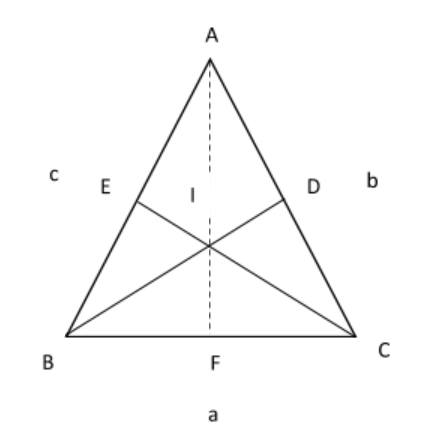
Let the ratio in which dividing AF be $\dfrac{{b + c}}{a}$ (we have to find out)
Let the ratio in which diving BD be $\dfrac{{a + c}}{b}$
Let the ratio in which diving CE be $\dfrac{{a + b}}{c}$
It is given to us in the question that-
$ \to \dfrac{{a + c}}{b} = \dfrac{3}{2}$
$ \to \dfrac{{a + b}}{c} = \dfrac{2}{1}$
Naming the above equations 1 and 2 respectively-
$ \to \dfrac{{a + c}}{b} = \dfrac{3}{2}$ (equation 1)
$ \to \dfrac{{a + b}}{c} = \dfrac{2}{1}$ (equation 2)
Solving equation 1 first by cross multiplication-
$ \to \dfrac{{a + c}}{b} = \dfrac{3}{2}$
$
\to 2a + 2c = 3b \\
\\
\to 2a = 3b - 2c \\
\\
\to 2c = 3b - 2a \\
$
Let this be equation 3-
$ \to 2c = 3b - 2a$ (equation 3)
Now, solving equation 2 by cross multiplication-
$
\to \dfrac{{a + b}}{c} = \dfrac{2}{1} \\
\\
\to a + b = 2c \\
$
Putting the value of 2c from equation 3 into the above equation-
$
\to a + b = 3b - 2a \\
\\
\to 3a = 2b \\
\\
\Rightarrow b = \dfrac{3}{2}a \\
$
Putting the value of b into equation 3, we get-
$
\to 2c = \dfrac{3}{2}a \times 3 - 2a \\
\\
\to 2c = \dfrac{{9a}}{2} - 2a \\
\\
\to 2c = \dfrac{{5a}}{2} \\
\\
\Rightarrow c = \dfrac{{5a}}{4} \\
$
Now, finding out the ratio in which $I$ divides the angle bisector through A-
$ \to \dfrac{{b + c}}{a}$ (as said earlier)
Putting the values of b and c into the above equation-
$
\to \dfrac{{\dfrac{3}{2}a + \dfrac{5}{4}a}}{a} \\
\\
\to \dfrac{3}{2} + \dfrac{5}{4} \\
\\
\to \dfrac{{6 + 5}}{4} \\
\\
\Rightarrow \dfrac{{11}}{4} \\
$
Thus, the ratio is 11:4.
Note: Making a figure in the equation is necessary for better understanding. Do remember that the ratio can always be found out in the way $\dfrac{{a + b}}{c}$, where the numerator is the sum of the opposite two sides and the denominator is the third side where the perpendicular bisector lies.
Complete step-by-step answer:
Let the ratio in which dividing AF be $\dfrac{{b + c}}{a}$ (we have to find out)
Let the ratio in which diving BD be $\dfrac{{a + c}}{b}$
Let the ratio in which diving CE be $\dfrac{{a + b}}{c}$
It is given to us in the question that-
$ \to \dfrac{{a + c}}{b} = \dfrac{3}{2}$
$ \to \dfrac{{a + b}}{c} = \dfrac{2}{1}$
Naming the above equations 1 and 2 respectively-
$ \to \dfrac{{a + c}}{b} = \dfrac{3}{2}$ (equation 1)
$ \to \dfrac{{a + b}}{c} = \dfrac{2}{1}$ (equation 2)
Solving equation 1 first by cross multiplication-
$ \to \dfrac{{a + c}}{b} = \dfrac{3}{2}$
$
\to 2a + 2c = 3b \\
\\
\to 2a = 3b - 2c \\
\\
\to 2c = 3b - 2a \\
$
Let this be equation 3-
$ \to 2c = 3b - 2a$ (equation 3)
Now, solving equation 2 by cross multiplication-
$
\to \dfrac{{a + b}}{c} = \dfrac{2}{1} \\
\\
\to a + b = 2c \\
$
Putting the value of 2c from equation 3 into the above equation-
$
\to a + b = 3b - 2a \\
\\
\to 3a = 2b \\
\\
\Rightarrow b = \dfrac{3}{2}a \\
$
Putting the value of b into equation 3, we get-
$
\to 2c = \dfrac{3}{2}a \times 3 - 2a \\
\\
\to 2c = \dfrac{{9a}}{2} - 2a \\
\\
\to 2c = \dfrac{{5a}}{2} \\
\\
\Rightarrow c = \dfrac{{5a}}{4} \\
$
Now, finding out the ratio in which $I$ divides the angle bisector through A-
$ \to \dfrac{{b + c}}{a}$ (as said earlier)
Putting the values of b and c into the above equation-
$
\to \dfrac{{\dfrac{3}{2}a + \dfrac{5}{4}a}}{a} \\
\\
\to \dfrac{3}{2} + \dfrac{5}{4} \\
\\
\to \dfrac{{6 + 5}}{4} \\
\\
\Rightarrow \dfrac{{11}}{4} \\
$
Thus, the ratio is 11:4.
Note: Making a figure in the equation is necessary for better understanding. Do remember that the ratio can always be found out in the way $\dfrac{{a + b}}{c}$, where the numerator is the sum of the opposite two sides and the denominator is the third side where the perpendicular bisector lies.
Recently Updated Pages
Master Class 10 English: Engaging Questions & Answers for Success

Master Class 10 Social Science: Engaging Questions & Answers for Success
Master Class 10 Computer Science: Engaging Questions & Answers for Success
Class 10 Question and Answer - Your Ultimate Solutions Guide
Master Class 10 General Knowledge: Engaging Questions & Answers for Success
Master Class 10 Maths: Engaging Questions & Answers for Success
Trending doubts
Explain the Treaty of Vienna of 1815 class 10 social science CBSE
Who Won 36 Oscar Awards? Record Holder Revealed
What is the median of the first 10 natural numbers class 10 maths CBSE
Why is it 530 pm in india when it is 1200 afternoon class 10 social science CBSE
Define Potential, Developed, Stock and Reserved resources
Fill the blanks with proper collective nouns 1 A of class 10 english CBSE