




The angle between two perpendicular lines is:
a) ${{90}^{\circ }}$
b) ${{60}^{\circ }}$
c) ${{45}^{\circ }}$
d) ${{120}^{\circ }}$
Answer
 Verified
626.4k+ views
Hint: In this question, we are given that the lines are perpendicular. Therefore, we can form the two angles made by the two lines at the point of intersection. We can then use the fact the sum of two angles in which two sides are part of a common straight line is equal to${{180}^{\circ }}$ . As the two lines are perpendicular the two formed angles should be equal and their sum should be equal to ${{180}^{\circ }}$ . Therefore, each of these angles should be equal to ${{90}^{\circ }}$ .
Complete step by step solution:
Let the two perpendicular lines intersect at the point O. Let A be a point on the first line and B and C be points on the second line as shown in the figure.
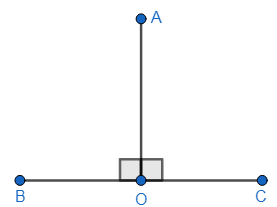
We know that fact the sum of two angles in which two sides are part of a common straight line is equal to${{180}^{\circ }}$. Therefore, we can write
$\angle AOB+\angle AOC={{180}^{\circ }}.......................(1.1)$
Also, as the lines are given to be perpendicular both the formed angles should be equal, therefore, we should have
$\angle AOB=\angle AOC......................(1.2)$
Therefore, using equation (1.2) in (1.1), we obtain
$\begin{align}
& \angle AOB+\angle AOB={{180}^{\circ }} \\
& \Rightarrow 2\angle AOB={{180}^{\circ }} \\
& \Rightarrow \angle AOB=\dfrac{{{180}^{\circ }}}{2}={{90}^{\circ }} \\
\end{align}$
Therefore, using this in equation (1.2), we obtain $\angle AOB=\angle AOC={{90}^{\circ }}$ .
Thus, the angle between two perpendicular lines is ${{90}^{\circ }}$ which matches option (a). Therefore, option (a) is the correct answer to this question.
Note: We should note that as both the formed angles are equal we should not get confused about which of the two formed angles we should consider as both of them have the same angle and thus will give the same answer.
Complete step by step solution:
Let the two perpendicular lines intersect at the point O. Let A be a point on the first line and B and C be points on the second line as shown in the figure.
We know that fact the sum of two angles in which two sides are part of a common straight line is equal to${{180}^{\circ }}$. Therefore, we can write
$\angle AOB+\angle AOC={{180}^{\circ }}.......................(1.1)$
Also, as the lines are given to be perpendicular both the formed angles should be equal, therefore, we should have
$\angle AOB=\angle AOC......................(1.2)$
Therefore, using equation (1.2) in (1.1), we obtain
$\begin{align}
& \angle AOB+\angle AOB={{180}^{\circ }} \\
& \Rightarrow 2\angle AOB={{180}^{\circ }} \\
& \Rightarrow \angle AOB=\dfrac{{{180}^{\circ }}}{2}={{90}^{\circ }} \\
\end{align}$
Therefore, using this in equation (1.2), we obtain $\angle AOB=\angle AOC={{90}^{\circ }}$ .
Thus, the angle between two perpendicular lines is ${{90}^{\circ }}$ which matches option (a). Therefore, option (a) is the correct answer to this question.
Note: We should note that as both the formed angles are equal we should not get confused about which of the two formed angles we should consider as both of them have the same angle and thus will give the same answer.
Recently Updated Pages
Master Class 11 Social Science: Engaging Questions & Answers for Success

Master Class 11 Chemistry: Engaging Questions & Answers for Success
Master Class 9 General Knowledge: Engaging Questions & Answers for Success
Master Class 9 Maths: Engaging Questions & Answers for Success
Master Class 9 Science: Engaging Questions & Answers for Success
Master Class 9 English: Engaging Questions & Answers for Success
Trending doubts
One Metric ton is equal to kg A 10000 B 1000 C 100 class 11 physics CBSE
Difference Between Prokaryotic Cells and Eukaryotic Cells
Two of the body parts which do not appear in MRI are class 11 biology CBSE
1 ton equals to A 100 kg B 1000 kg C 10 kg D 10000 class 11 physics CBSE
Explain zero factorial class 11 maths CBSE
10 examples of friction in our daily life