




The angle between the incident ray and reflected ray is ${60^0}$. What is the angle of incidence?
(A) ${30^0}$
(B) ${60^0}$
(C) ${120^0}$
(D) None of these
Answer
 Verified
495.3k+ views
Hint: This problem can be done with the concept of laws of reflection and by using the general formula of laws of reflection. (i) The angle of incidence is equal to the angle of reflection, and (ii) The incident ray, the normal to the mirror at the point of incidence and the reflected ray, all lie in the same plane.
Complete step by step answer:
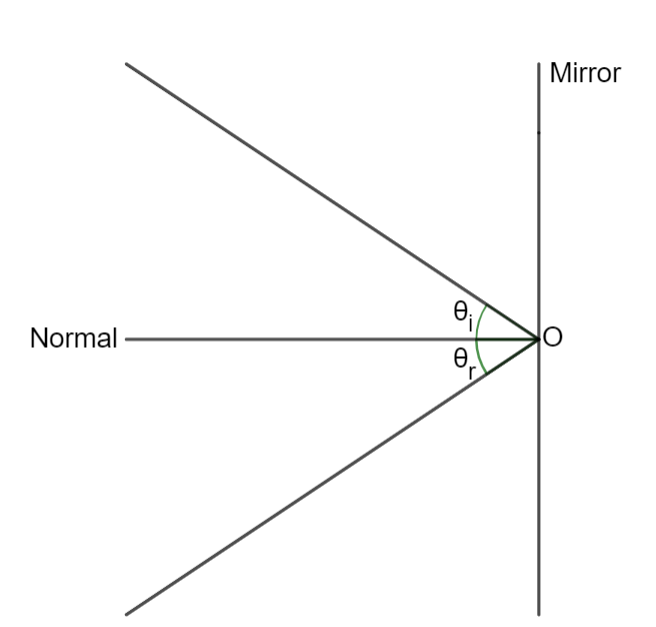
Let's consider angle of incidence= i
Angle of refraction= r
It is given that angle between the incident ray and refracted ray is ${60^0}$
Therefore, from the figure we get
$\angle i{\text{ + }}\angle {\text{r = 6}}{{\text{0}}^0} - - - (1)$
From, the laws of reflection we know that
The angle of incidence is equal to the angle of reflection
Therefore,
$\angle i{\text{ = }}\angle {\text{r}}$
Therefore, the equation (1) can be rewritten as
$\angle i{\text{ + }}\angle {\text{r = 6}}{{\text{0}}^0}$
$2\angle i = {60^0}$
$\therefore \angle i{\text{ = 3}}{{\text{0}}^0}$
Therefore, the angle of incidence is equal to ${30^0}$
Therefore, the correct answer is option (B).
Additional information:
When light falls on an object, it bounces back the light in the same medium from where the light comes. This is called the reflection of light
Mirrors are good reflectors. A mirror can be made by silvering a metal surface with glass in front and paint at its back.
Spherical mirror: Curved shaped mirrors are known as spherical mirrors. Depending upon the type of curve of reflecting surface spherical mirrors are categorized as
Concave Mirror: A spherical mirror, whose reflecting surface is curved inwards is called a concave mirror. It means the reflecting (polished) surface faces the centre of the sphere from which it is made. Convex Mirror: A spherical mirror whose reflecting surface is curved outwards is called a convex mirror
The mid-point or the Centre of the reflecting surface of the mirror is known as the pole of the mirror. It is represented by P. The Centre of the hollow sphere from which the mirror is made is known as Centre of curvature. It is represented by C. Centre of curvature in the concave mirror is in front of the mirror and in the convex mirror, it is behind the mirror. An imaginary straight line which joins the Pole and the Centre of curvature of the mirror is known as the principal axis and the distance between the Centre of curvature and the Pole of the mirror is called the radius of curvature. It is represented by R.
Note:
For mirrors whose radius of curvature is much larger than aperture, there will be a relation between R and f such that $f = \dfrac{{\text{R}}}{2}$ .
Image is the perception of an object. If rays emanating from a point actually meet at another point, then that point is a real image of the point. The image will be virtual if the rays do not actually meet but appear to diverge from the point when produced backward.
Complete step by step answer:
Let's consider angle of incidence= i
Angle of refraction= r
It is given that angle between the incident ray and refracted ray is ${60^0}$
Therefore, from the figure we get
$\angle i{\text{ + }}\angle {\text{r = 6}}{{\text{0}}^0} - - - (1)$
From, the laws of reflection we know that
The angle of incidence is equal to the angle of reflection
Therefore,
$\angle i{\text{ = }}\angle {\text{r}}$
Therefore, the equation (1) can be rewritten as
$\angle i{\text{ + }}\angle {\text{r = 6}}{{\text{0}}^0}$
$2\angle i = {60^0}$
$\therefore \angle i{\text{ = 3}}{{\text{0}}^0}$
Therefore, the angle of incidence is equal to ${30^0}$
Therefore, the correct answer is option (B).
Additional information:
When light falls on an object, it bounces back the light in the same medium from where the light comes. This is called the reflection of light
Mirrors are good reflectors. A mirror can be made by silvering a metal surface with glass in front and paint at its back.
Spherical mirror: Curved shaped mirrors are known as spherical mirrors. Depending upon the type of curve of reflecting surface spherical mirrors are categorized as
Concave Mirror: A spherical mirror, whose reflecting surface is curved inwards is called a concave mirror. It means the reflecting (polished) surface faces the centre of the sphere from which it is made. Convex Mirror: A spherical mirror whose reflecting surface is curved outwards is called a convex mirror
The mid-point or the Centre of the reflecting surface of the mirror is known as the pole of the mirror. It is represented by P. The Centre of the hollow sphere from which the mirror is made is known as Centre of curvature. It is represented by C. Centre of curvature in the concave mirror is in front of the mirror and in the convex mirror, it is behind the mirror. An imaginary straight line which joins the Pole and the Centre of curvature of the mirror is known as the principal axis and the distance between the Centre of curvature and the Pole of the mirror is called the radius of curvature. It is represented by R.
Note:
For mirrors whose radius of curvature is much larger than aperture, there will be a relation between R and f such that $f = \dfrac{{\text{R}}}{2}$ .
Image is the perception of an object. If rays emanating from a point actually meet at another point, then that point is a real image of the point. The image will be virtual if the rays do not actually meet but appear to diverge from the point when produced backward.
Recently Updated Pages
Master Class 12 Social Science: Engaging Questions & Answers for Success

Master Class 12 Physics: Engaging Questions & Answers for Success
Master Class 12 Maths: Engaging Questions & Answers for Success
Master Class 12 Economics: Engaging Questions & Answers for Success
Master Class 12 Chemistry: Engaging Questions & Answers for Success
Master Class 12 Business Studies: Engaging Questions & Answers for Success
Trending doubts
Which are the Top 10 Largest Countries of the World?
Draw a labelled sketch of the human eye class 12 physics CBSE
Explain the structure of megasporangium class 12 biology CBSE
What are the major means of transport Explain each class 12 social science CBSE
How many chromosomes are found in human ovum a 46 b class 12 biology CBSE
The diagram of the section of a maize grain is given class 12 biology CBSE